



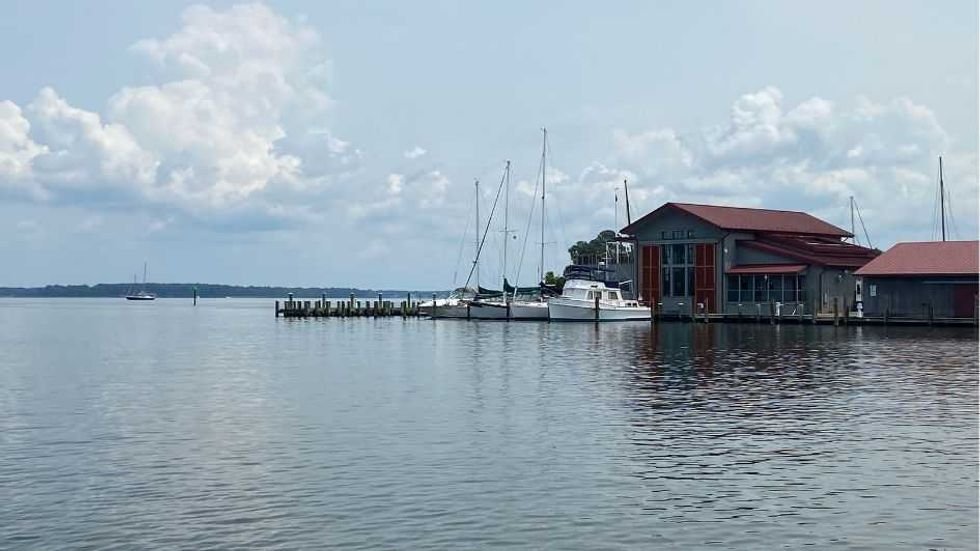
On Aug. 10, 1813, under cover of darkness and fog, 300 British soldiers sailed up the Miles River toward this small Maryland town.They landed on the southern end of St. Michaels, where they quickly overran the local militia. They then returned to their boats and began bombarding the town with their ships’ cannons.One of the museum’s best features is that this isn’t all history preserved behind glass. You can watch shipwrights at work restoring and building wooden boats.That much is history. What supposedly happened next is the stuff of legend.As the story goes, townsfolk hung lanterns high in trees farther inland, creating the illusion that St. Michaels was farther from the shore and sat on higher ground. The British aimed their cannons toward the lights — and overshot the town.The same darkness and fog that allowed the British to approach St. Michaels also helped shield the town from destruction.The British eventually withdrew, while St. Michaels suffered no casualties. One house did take a direct hit from a cannonball, which left a dent in its brickwork. Appropriately enough, it is known today as the Cannonball House.There is just one problem with this terrific story: No one can say for certain that the lantern trick actually happened.But that hasn’t stopped it from becoming part of the town’s identity. St. Michaels proudly calls itself “The Town That Fooled the British,” a claim displayed on the welcome sign as you enter town.And the legend is only one reason this tiny waterfront community makes an unusually good history-filled day trip.A river town’s history and industry Lynn TopelSt. Michaels sits on the banks of the Miles River, a tributary of the Chesapeake Bay. Today, it is a favorite summer destination for vacationers from Washington, Baltimore, Philadelphia, and even New York, as well as a popular draw for boating and sailing enthusiasts.Long before it became a tourist town, however, St. Michaels was established as a trading post in the mid-1600s. Trappers and tobacco farmers made up the early community. An Episcopal parish named after St. Michael the Archangel was built here and eventually gave the town its name.St. Michaels also developed a thriving shipbuilding industry and became particularly known for building Baltimore clippers. These ships were renowned for their speed and maneuverability — qualities that made them valuable for outrunning other vessels and evading blockades.That shipbuilding industry made St. Michaels a British target during the War of 1812. The British attacked the town twice in 1813 as part of their campaign around the Chesapeake Bay. A year later, British forces would move against Baltimore and bombard Fort McHenry, inspiring Francis Scott Key to write the words that became “The Star-Spangled Banner.”As the local economy shifted toward oyster harvesting and crabbing, St. Michaels’ shipyards continued to manufacture workboats suited to the Chesapeake. One example is the bugeye, a type of sailboat watermen used for oyster dredging.You can still see that maritime history up close.An easy day trip Lynn TopelWith a total area of only 1.27 square miles, St. Michaels is easy to navigate if you aren’t planning to spend the night. A day trip from Washington — less than two hours by car — or Baltimore, just over an hour away, is very feasible. Philadelphia is less than two and a half hours away.The first stop for any visitor to the area should be the Chesapeake Bay Maritime Museum, located on 18 acres of waterfront property. With Maryland’s identity so closely intertwined with the Bay, it’s fitting that this is the only museum in the country dedicated to America’s largest estuary.Step into the welcome center, and you’ll find replicas and authentic examples of watercraft used for racing, fishing, oyster harvesting, and leisure.You will also learn how the bay and its boats played a part in American history. One of the most remarkable objects is a 23-foot canoe like the one used by enslaved man Joseph Keene, his pregnant wife, Nellie, and their seven children to escape in 1831. An experienced sailor, Keene navigated his family north up the Chesapeake, likely toward the newly opened Chesapeake & Delaware Canal and Pennsylvania. Against extraordinary odds, the entire family successfully evaded capture and reached freedom. The Bay played an integral role in the maritime routes of the Underground Railroad. Enslaved people used the Chesapeake and its network of rivers and creeks to travel north toward free states, sometimes hiding aboard commercial vessels and sometimes escaping in boats themselves. For experienced sailors like Keene, the same waterways on which they had labored could also provide a path to freedom.Dotting the museum campus are buildings devoted to different aspects of life on the Chesapeake, from sail making and decoy carving to oyster harvesting and crab picking.For younger visitors, don’t miss the water tanks with live blue crabs. Wannabe watermen can explore a life-sized skipjack, a single-mast sailing boat native to the Chesapeake, or climb into the pilot house of the Thor, a 1912 buyboat that purchased catches directly from fishing boats and transported them to market.One of the museum’s best features is that this isn’t all history preserved behind glass. You can watch shipwrights at work restoring and building wooden boats — and don’t hold back if you have questions.There’s also the Hooper Strait Lighthouse, where kids can dress up as lighthouse keepers before climbing to the top for views over the water. Lynn TopelBut perhaps the biggest surprise at the museum has nothing to do with boats.RELATED: The ‘Little House’ books gave me a place to escape. This New York farm took me there for real. Josh SlocumFrederick Douglass lived here, tooThe home of abolitionist Frederick Douglass’ sister Eliza Mitchell now stands on the museum grounds.Eliza married a free man, Peter Mitchell, and lived in St. Michaels for the rest of her life. Their home on Lee Street was slated for demolition until it was saved and moved to the museum in 1981. Restored today, the Mitchell House gives visitors a glimpse of how a family with nine children made do with the space they had.Douglass himself spent part of his youth in and around St. Michaels while enslaved during the 1830s. He worked as a house servant, field laborer, and, later, ship caulker.His time here became an important part of the story he later told about slavery and his escape from it. Visitors can learn more about his life in an exhibit across from the museum’s welcome center. Lynn TopelThe Douglass connection adds another layer to this fascinating town. St. Michaels has its patriotic War of 1812 legend, but it also preserves the much more complicated history of the people who lived along the Chesapeake.Save room for ice creamAfter a few hours at the museum, the best way to finish the day is to find a place to sit, eat, and people-watch on the town’s main street.Talbot Street is the major thoroughfare through the historic district, lined with restored colonial and 19th-century buildings housing restaurants, antique and boutique stores, and art galleries.For the sweetest possible ending, head to Justine’s Ice Cream Parlour, a St. Michaels fixture since 1987. Check out its “Wall of Shakes,” with more than 90 classic and signature flavors.The truly ambitious can attempt the Titanic Sundae Challenge: more than six pounds of ice cream and toppings that must be consumed in under 30 minutes. “Man v. Food” host Casey Webb successfully conquered the challenge in 2019 at Justine’s Ocean City location — and visitors to St. Michaels can attempt the same feat here.By then, you will have covered a remarkable amount of American history for a town barely a square mile in size: Chesapeake shipbuilding, the War of 1812, the Underground Railroad, Frederick Douglass, and generations of watermen who made their living from the Bay.And you may find yourself wondering whether the residents of St. Michaels really did climb into the trees with lanterns one foggy night in 1813 and trick the Royal Navy into firing over their heads.There may never be enough evidence to settle that question, but after more than 200 years, “The Town That Fooled the British” is still telling the story.

FOX NEWS
Melanie Griffith is reflecting on a relaxing weekend away