



Moscow oil refinery attack brings Russia’s war with Ukraine closer to home
 EPA
EPAThere are moments when life in Moscow feels completely normal. Thursday morning wasn’t one of them.
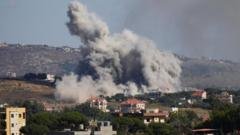
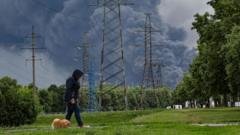
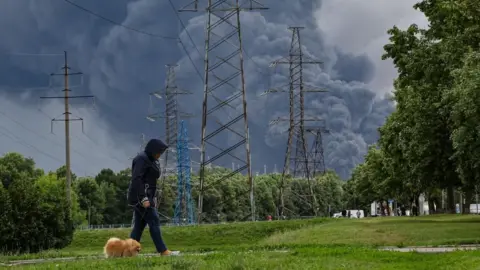
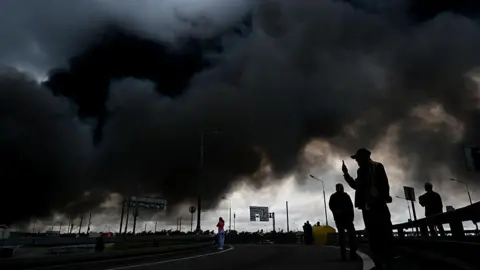
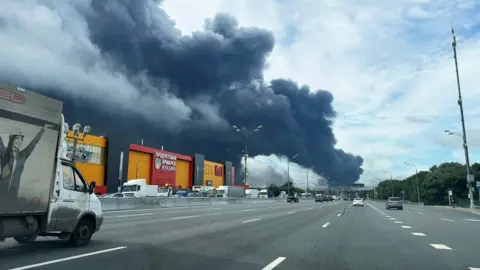
In the south-east of the city an oil refinery had been hit during a Ukrainian drone attack – even from a distance the sight was surreal.
Thick smoke billowing from the direction of the facility had turned the sky dark. Like a giant black shroud, it hung over the Moscow skyline.
As extraordinary and eye-catching this was, so was the reaction of people near the refinery.
Paying minimal attention to the huge clouds of smoke, an angler sat by the side of a pond, staring out across the water as he carried on fishing.
At the playground opposite, children were having fun on the swings.
Shoppers were heading to and from a supermarket, as if this was just another Thursday.
I realised thenthat my sense of what’s normal in Moscow and what’s not, needed updating.
 Anadolu via Getty Images
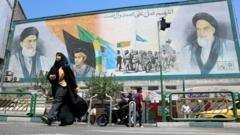
For so long, the war on Ukraine felt very distant to people in the Russian capital. Many pretended it wasn’t happening at all, but that’s harder to do as the front line creeps closer to the city.
Over the past year-and-a-half, Muscovites have woken to news that army generals in Moscow have been assassinated, and drones have been targeting the capital.
In a sense, abnormal is already the new normal.
Thursday’s attack was one of the largest aerial assaults on the Moscow region since Russia’s full-scale invasion of Ukraine.
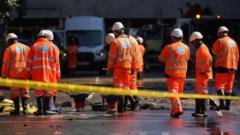
As well as damage to the oil refinery, shopping centres and residential buildings were hit, too. According to the governor of the Moscow region, an eight-year-old girl was killed in a fire caused by one of the drone strikes.
“I’m not totally surprised by what happened,” says Slava, who lives in an apartment block opposite the oil refinery. “But I didn’t expect such a big attack.”
“I heard explosions and saw lots of smoke. It’s the kind of thing you normally see in the movies. I saw it from my apartment window.”
 Reuters
But another local resident, Nadezhda, saw nothing normal in what’s happening.
“It took us four years to win World War Two, even though our soldiers had little food and water,” she told me.
“Today we have all the resources we need. But this war goes on. I’m shocked.”
How do the Russian authorities respond to people like Nadezhda, to Russians struggling to understand why the Kremlin’s so-called “special military operation” is taking so long, and how it can be that the war has come to their city?
Russian officials regularly accuse the West of prolonging the war in Ukraine, blaming European leaders and Nato for supporting Kyiv.
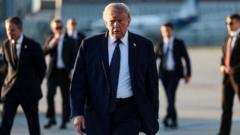
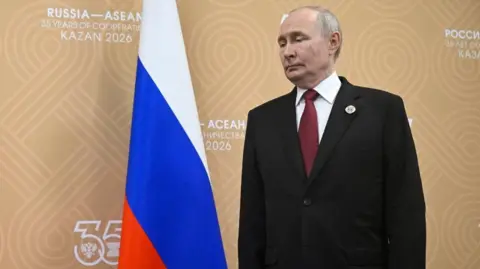
But on Thursday, President Vladimir Putin said nothing about the drone assault. The news bulletins on Russian TV channels barely mentioned it.
When Russian newspapers reported the story the following day, I detected a common thread in their coverage: a coordinated message, perhaps, for the domestic audience.
It can be summed up as this: “However bad it is for us, Ukraine’s suffering more”.
“Our attacks are doing far more damage to Ukraine than Ukraine is doing to us,” declared the ultra-pro-Kremlin Komsomolskaya Pravda.
“Our strikes to demilitarise Ukraine are far more powerful and effective than Ukrainian attacks,” wrote the tabloid Moskovsky Komsomolets.
The narrative was almost identical in the government paper Rossiyskaya Gazeta: “Our attacks on defence enterprises working for the Ukrainian army are much more powerful than those which Russians, unfortunately, are having to deal with.”
“Our strikes on Ukrainian infrastructure linked to the military-industrial complex are far more effective and produce more results,” commented business daily Kommersant.
 Reuters
When the Kremlin finally reacted, it had a similar message.
“You should look for more footage coming out of various cities in Ukraine,” Putin’s spokesman Dmitry Peskov told reporters.
“Footage showing the results of strikes carried out by our armed forces is impressive. These strikes will continue.”
There is no sign that Ukrainian drone attacks on Russian cities have given Putin pause for thought. From his recent speeches and statements, the Kremlin leader seems determined to continue Russia’s assault on Ukraine, confident that in this war of attrition his country will prevail.
But there are signs that long-range Ukrainian strikes – particularly on Russian oil facilities – are increasing the pressure on the Russian economy. Petrol shortages and rationing have been reported in some parts of the country, and prices have been rising at the pumps.
In what has become the new normal, Moscow is expecting more drone strikes.
“The Ukrainian attack on the Moscow region on 18 June won’t be the last attack, or even one of the last,” predicted Moskovsky Komsomolets.
“There’s nothing we can do about this,” one woman told me last Thursday as she looked up at the clouds of smoke.
“It’s our government that must decide what to do. All we can do is watch.”