






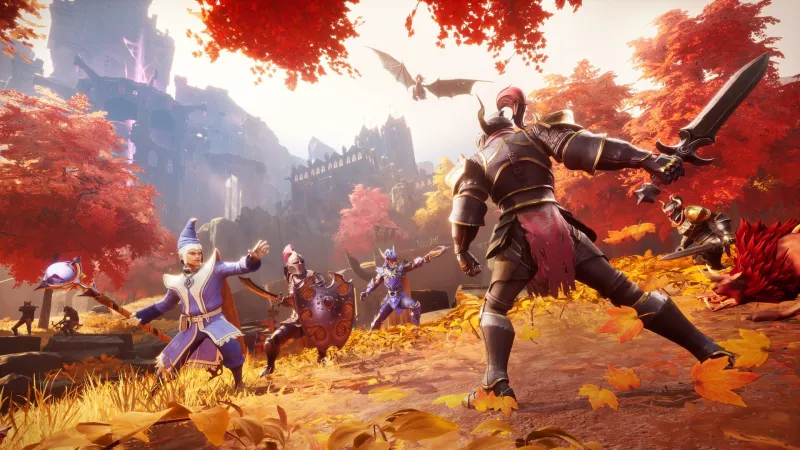
RuneScape: Dragonwilds strikes a respectable balance between a fantasy RPG and survival crafting game. The variety of environments and hidden lore for those who want it give depth to an otherwise nondescript setting and offer many hours of content for those who can tolerate its crafting system. But, without having an attachment to the RuneScape series, or a love for chopping wood or mining ore, it’s difficult to enjoy past the opening chapter. Though there is fun to be had, I wish certain parts of it didn’t feel as tedious or locked behind a grind for materials.
Dragonwilds expands the RuneScape world and brings back familiar faces to ground players in the dragon-infested continent of Ashenfall. It revolves around the history of Ashenfall’s early settlers and the takedown of Dragon Queen Kuldra, told indirectly through glowing blue books and side quests. Those stories of grief and greed are interesting, but mostly a backdrop for common tasks like plundering temples and stabbing rats.
Most activities tie back to the crafting system, whether that’s foraging for food or smithing swords. You can build tools, weapons, armor, jewelry, furniture, structures, and more. Dragonwilds lets you spend as much time as you want farming materials, though some, like ores, are more necessary than others. Magic spells can speed up some of the monotony, but that also requires leveling up your skills enough to learn those spells.
Even with crafting at its core, Dragonwilds is bloated with workstations and items that are more laborious than fun to collect. I blame the increasingly high number of materials needed to craft higher-level weapons and armor, and the multiple station types that could have been combined into one. As you get stronger, the number of materials you need for your gear increases, too. For example, my gear now needs Fine Cloth woven from threads and gold bars. By the time I reached the halfway point of the game, I had separate stations for tools and weapons, armor, jewelry, bows and arrows, and magical weapons like wands.
Classes don’t really exist in Dragonwilds. Instead of explicitly choosing a class like in a traditional RPG, you swap between roles by switching your gear – like swapping from armor to robes to switch from melee to magic. Changing classes felt pointless because I could force my way through most challenges with a sword, and bows and wands are less effective given the circumstances. Many confrontations involve flanking from multiple sides, so long-range combat isn’t ideal. Magic isn’t bad, but not many creatures have magical weaknesses and melee can easily do more damage with attack speed and buffs.
Dragonwilds is massive. Just the first arc took 20 to 30 hours to finish before I slew my first dragon. Fellhollow, the second arc, took about the same time to complete its story quests, and it didn’t make me any more excited to reach Dowdun Reach because I adapted so quickly to expectations. At the start of each region, I expect to grind for materials for three to five hours before I could expect to survive an “expedition” from my base, let alone bungling around uncharted territory to complete a quest with vague instructions. Thankfully, this steep on-ramp can be smoothed over through a setting that eases the experience grind, but the base way to play encourages the tedium to set in. To its credit, Dragonwilds spices up exploration in each region with gimmicks like “soulrifting” in Fellholllow, which unlocks alternate planes and invisible bridges.
Ideally, you avoid dying in any game, but Dragonwilds twists the knife as much as a Soulslike; when your health depletes, you drop your entire inventory and teleport back to the last place you camped. To avoid the inconvenience of refilling your bag, it’s easier to run back to the gravestone to retrieve your inventory. I’m grateful that I don’t just lose all the items, and that Dragonwilds spawns gravestones outside of dungeons instead of making me go back inside to claim them. Still, it’s annoying to be unexpectedly overpowered and then need to dive back into dangerous territory just to avoid another crafting spree. You can turn this annoying convention off in the settings, but playing the game as intended leads to cumbersome situations.
For better or worse, Dragonwilds brings back the “old school” feeling of discovering what to do without overt handholding. An NPC may suggest a general direction, but won’t tell you that you need an Iron Pickaxe to mine a dragon’s teeth to complete your quest. Players who have trouble understanding these hints could spend hours trying to decipher exactly how to find the items they need to progress.
Dragonwilds prioritizes the journey of completing quests over how easy they are to finish. After all, that means more time in the crafting system and discovering more about your environment, like rocks you didn’t know you could mine or hidden lore from a side quest you might have missed. Alternatively, it could lead to hours of repetitive grinding for materials, trying to unlock new clues or power-ups without getting any closer to the next objective.
RuneScape: Dragonwilds freshened my perspective on survival-crafting games with base-building and farming under dragon-dominated skies. I floundered for answers on how to progress to the next story quest without clear direction, and while I could explore in the meantime, other games in similar genres can offer the same thing with more entertainment along the way. In a genre full of compelling modern classics like Valheim, RuneScape: Dragonwilds is a difficult game to recommend.