
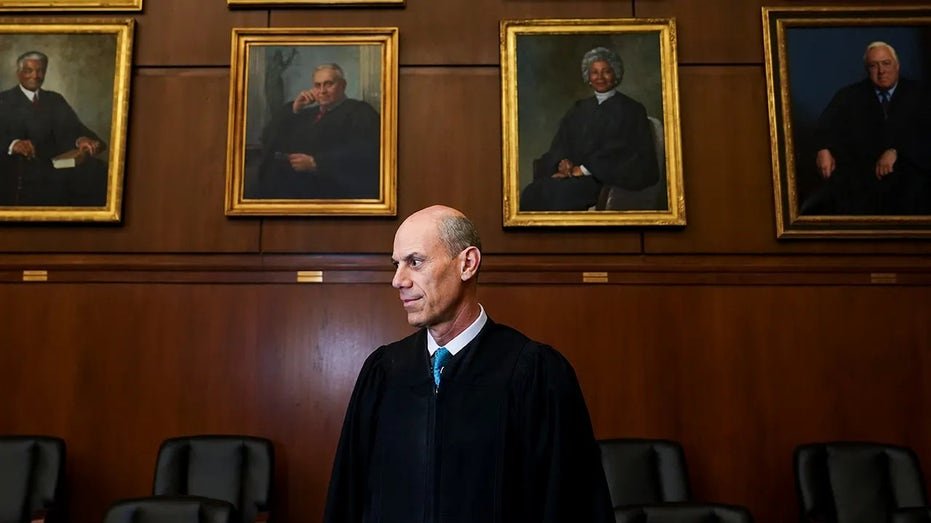
Chief Judge James Boasberg is frustrated … and he is not alone. Recently, the D.C. federal judge reportedly groused that the D.C. appellate court had ordered him to reconsider a case about whether the D.C. government engaged in biased enforcement against political graffiti. Conversely, the litigants are equally irked over what they see as Boasberg’s bias after he responded by, again, dismissing their claims without a trial.
For a second time, Boasberg has barred pro-life groups from access to a jury after members were arrested for writing in chalk, “Black Pre-Born Lives Matter” on a sidewalk while Black Lives Matter writings were left untouched.
I wrote earlier about the emerging body of “Boasberg’s Law,” cases in which the judge has increasingly shown an untethered and expansive view of his own authority. Recently, Boasberg was found to have committed an “abuse of discretion” in twice finding that the Trump administration was in contempt of court for failing to turn around deportation flights.
DC APPEALS COURT ORDERS JUDGE BOASBERG TO HALT TRUMP CONTEMPT PROBE OVER DEPORTATION FLIGHTS
My disagreements with Boasberg are not over the underlying issues, but rather the court’s rejection of basic limits on its own authority. While chastising President Donald Trump for exceeding his authority, Boasberg has been reversed for exceeding his own.
In the earlier case, Boasberg dismissed grand jury subpoenas in the probe of Fed Chair Jerome Powell. I have been critical of that probe, but Boasberg’s refusal to allow the subpoenas to be executed was based on an opinion that was rife with open hostility for Trump, dubious sources and biased observations.
I have similar reservations in this latest case. During the Black Lives Matter protests of 2020, streets in Washington were covered with BLM graffiti and the police watched as protesters wrote slogans and slurs on stores, streets and sidewalks. The government itself even commissioned a massive painting of the message on a street near the White House.
GOP LAWMAKERS URGE SUPREME COURT TO STRENGTHEN FIRST AMENDMENT PROTECTIONS FOR STREET PREACHERS
However, when the Frederick Douglass Foundation and Students for Life of America wrote their pro-life version of the slogan, they were immediately arrested and the chalk protest removed.
The D.C. Circuit’s reversal of Boasberg in the case was a major victory for free speech. Boasberg had applied the wrong standard to kill the case, holding that the group could not challenge the selective enforcement of the laws. In reaching that conclusion, Boasberg applied the wrong standard, imposing the heavy burden of proving that the city was engaged in “invidious enforcement.” While that standard was used correctly to dismiss an equal protection claim, it is not the standard for a free speech challenge.
The court did not hide its dissatisfaction with the thrust of Boasberg’s opinion in dismissing the First Amendment claim:
“The First Amendment prohibits government discrimination on the basis of viewpoint. ‘To permit one side … to have a monopoly in expressing its views … is the antithesis of constitutional guarantees.’ The protection for freedom of speech applies not only to legislation, but also to enforcement of the laws.”
The appellate court sent the case back to Boasberg with the opportunity to apply the correct standard and to create a substantive record before issuing a ruling on the free speech claim.
Boasberg took the case and ruled again that the groups would not be allowed a trial. The new dismissal was issued despite the standard that, in seeking such a dismissal before a trial, the court must accept all material facts in favor of the nonmoving party or, in this case, the pro-life and pro-free-speech litigants.
Boasberg rejected the factual claim that they were “similarly situated” to the BLM protesters. The litigants presented the results of discovery on the point, but Boasberg dismissed the claim on his own subjective view of the evidence.
They have now filed again with the appellate court to appeal his order.
Some of Boasberg’s factual findings are baffling. For example, he maintains that the groups did not show that MPD officers “even witnessed any specific defacement during [Black Lives Matter] protests.” However, the groups presented such evidence as bodycam video of officers watching as a protester spray-painted ‘I can’t breathe’ on the street near the White House two weeks after the arrests of the pro-life protesters. They submitted other video evidence of officers watching protesters spray-paint BLM messages outside of the Department of Justice.
Moreover, they presented what they claimed was guidance from Assistant Chief of Police Jeffery Carroll, in charge of the Metropolitan Police Department’s Special Operations Division, in the application of different treatment for graffiti.
Carroll reportedly admitted to being “present” at BLM protests featuring “defacement” of property, public and private and Lt. Jason Bagshaw admitted that he also saw defacement “related to” BLM protests.
This does not mean that a jury would rule for these litigants but rather that the court cannot substitute its judgment for a jury when a credible and supported claim has been made by litigants.
CLICK HERE FOR MORE FOX NEWS OPINION
Boasberg declares that no such credible evidence was presented. The fact is that a reasonable jury could conclude that there was different treatment shown in the enforcement of these laws based on the content of the speech.
The biased enforcement of laws to crack down on speech is a common reality in other countries where courts enable such selective enforcement. In countries such as Iran and China, no level of evidence is sufficient to overcome the bias of courts in showing a preference for one side.
Judge Boasberg has had a distinguished career that is now being undone by a lack of restraint in these decisions. Again, I believe that the judge has been on solid ground in some of these conflicts, including criticizing the use of “intemperate and disrespectful” language in filings and demanding compliance with his orders. However, while Chief Judge Boasberg has described the president’s claim of expansive powers as “awfully frightening,” the same can be said about a judge who substitutes his own judgment for juries and disregards legal standards for disfavored groups. The Unfinished Story of the American Revolution.”
CLICK HERE TO READ MORE FROM JONATHAN TURLEY