


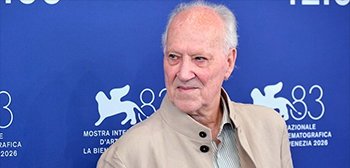

“Every man should pull a boat over a mountain once in his life.” While this year’s Venice Film Festival, an incredible and unexpected opportunity arose to speak with maestro Werner Herzog. Naturally, I couldn’t pass it up. Herzog came to Venice this year (after receiving a Lifetime Achievement Golden Lion in Venice just last year) to present his new film Bucking Fastard, a narrative feature about twin sisters who speak in unison. It’s Herzog’s 21st narrative movie so far, not counting any of his docs, and it’s dedicated to David Lynch. Bucking Fastard stars real life sisters / actors Kate Mara and Rooney Mara as Jean and Joan Holbrooke, inspired by the real life British identical twin sisters Freda and Greta Chaplin. It’s a strange and peculiar story, something only Herzog could dream up and bring to life on screen, and it features a mystical fox that appears in the second half of the film 🦊 (which he briefly talks about in the interview). Aside from asking Herzog about this film, it was the perfect opportunity to spend a few minutes talking with the iconic German director about cinema in general & his thoughts on the world today. A genuine honor to meet him.
Werner Herzog is one of my favorite directors, and one of the things I admire most about him is his unique ability to constantly surprise us. His films explore the most unexpected facets of human nature, whether it’s the man obsessed with befriending ferocious wild animals in Grizzly Man (which is joining the Criterion Collection), the researchers living at the edge of the civilization in Encounters at the End of the World, or the madman attempting to pull a steamship into the Amazon jungle in Fitzcarraldo. When I realized I had ~15 brief but invaluable minutes face-to-face with this living legend, I certainly couldn’t pass up the opportunity to not only discuss his latest film but also to pick his brain on a variety of topics. I asked for his perspective on the current state of movies, which kind of films he finds more challenging, and whether an artist can—and should—try to influence the world around them. And of course, I couldn’t resist asking the 84-year-old director, who seems to have visited every corner of the planet, to share some of his life wisdom.

You have made many films about dreamers driven by passion. In this film Bucking Fastard, two sisters are also pursuing a dream of great love and a better place where everyone is kind. Do you think dreamers still have a place in the harsh reality of this world? Can they survive?
Werner Herzog: Well, sure. Dreams are part of our makeup, of our existence. And, of course, this is even more so about love. But where do you find love? Where do you find that country? Is it an illusion, or is it on a different continent, in Arcadia or Atlantis?
Or in the Orkney Islands?
Herzog: Exactly, I hope the Orkneys will hear me.
Have you ever been?
Herzog: No, but I should go to the Orkneys. I’ve never been there. And, and the shepherd in the film says to them, “The whole world should be like the Orkneys.”
I was in Scotland and saw them from the northernmost point, and I also dream of visiting…
Herzog: Sure. Since I’ve not been there, and you haven’t been there, it’s an inner landscape. It’s a landscape of the soul. And much of the landscape I have done in my movies consists of landscapes of the soul.
Now, regarding the sisters in the film, they pursue a man because they are in love with him, but at the same time, they are pursued by men. In my opinion, it felt like the men in the film mostly represent a menace. Was that intentional, or am I reading too much into it?
Herzog: No, very few… Yes, there is [menace]. There’s a young forklift driver with a very low IQ, and he’s confused. Everything in the world confuses him, and he cannot figure out who is who—who is Jeanie, who is Joanie. He cuts a big strand of hair from one, and now they are different. This is terrible for them. And also, I would remind you of the wedding reception scene.
Two girls sneak in wearing something close to wedding gowns. They pretend to be bridesmaids, wanting to be in the photo to capture that happiness of love. Then, I think the father of the bride discovers them and says, “Are you intoxicated? Are you here for free booze?” All of a sudden, there’s a crisis. But then, a man who had spoken to them before comes up & lies, saying, “No, I brought them here. I’m sorry, I didn’t inform you.” So, there is suddenly a noble gentleman who rescues them. And there are other people who come to their rescue, like Timothy, the man who gives them a free apartment, and an aunt… well, not a man, but—
There’s always a counterweight, as you say. For each villain there’s someone who helps them.
Herzog: Yeah, not villains per se. For example — the man they are in love with is not a villain; he’s just a scoundrel. He’s playing it all. He enjoys having intimate hours in the garden shed.
Yeah, but you could say he exploits them in a way.
Herzog: Yeah, but he’s not just an idiot. He is also tormented when he has to tell them, “Sorry, I’m getting married, and my cousin is not really my cousin—we found each other.” So, it’s… and Orlando Bloom is wonderful in it because it’s a very multifaceted character. He’s not just an exploiter; he has charm.
Of course. He’s very good.
Herzog: He has charm, he’s handsome, and he’s confident.
Yes. I’m very sad that he doesn’t act in more movies because I just want to see him more. He’s so gorgeous.
Herzog: Yeah. But there are many others whom I’d like to see more of in film. Yeah, definitely. They are all very good. But Domhnall Gleeson, for example…
Well, he is popular; he gets lots of roles. I’ve seen his new film, by the way, shot in Scotland.
Herzog: Yes, he is a wonderful, wonderful actor.
About the cave in the third act, which also seems to represent a world of dreams for them, or a passage to the other country they are looking for. How did you come up with this idea when writing the script? Did your work on Cave of Forgotten Dreams influence you?
Herzog: No. The cave in Cave of Forgotten Dreams is significant because it was used by Paleolithic people to make cave paintings. Here, you have a whole landscape that is imaginary. You can see gigantic halls, a ballroom with chandeliers, and even a little train with tourists passing by the underground post office. It’s an imaginary place, and that’s the beauty of it.
Having made films for decades and witnessed the evolution of cinema, how do you view the landscape of filmmaking today? Do you feel it has evolved positively, or do you see a decline?
Herzog: That’s a very general question, so let me narrow it down. I think much of what you see in theaters today—the big event films—have enormous value in the special effects, with dinosaurs or dragons flying and whatever else. They have a lot of star power, but many of them have a deficit in storytelling. Storytelling was much more interesting in the 1950s, for example.
It’s an interesting moment because the industry sometimes looks to me because I am good at storytelling and I do not use any special effects. It’s funny, because people are so invested in digital effects that the big question now—which I think is discussed out there and found on the internet—is whether the fox in my film is a digital artifact. No, it’s a real fox. 🦊
It looks very real.
Herzog: Two farm boys had it, 10 and 12 years old — wonderful boys. It was a friend, their pet, and it lived on the farm. And it was always right next to the camera.
Wow, it’s a beautiful moment. I honestly really love the fox.
Herzog: But my point is, it is a fox and not a digital artifact. I am very confident that storytelling is going to stay because it has been with us for tens of thousands of years. It’s obvious, and it’s going to stay.
Speaking of storytelling: another question concerning documentaries and features. For you, is it harder to invent your truth in fiction or to capture truth of a chaotic life in a doc?
Herzog: You see, that is a very big question… If you had 8 hours [for this interview], I would be more comfortable. For me, movies are movies, whether documentary or otherwise. When you look at mine, they are never “issue films”; they are never journalism. It’s something different… I want to evolve the genre of documentaries in a new way, in a fresher way.
Of course, I try to find “illumination” — something that touches you deeply and gives you deep insight — in both documentaries and feature films. In documentaries, I do things that you normally do in feature films, like casting and scripting. Some of them are scripted or partially scripted. I also use repetition, just as you do in a feature film. But with real people who tell me the story of their lives, I might say, “This was ten times too long; let’s condense it,” and I repeat it 5 times until we are content. You see, this is some methodology from the other side of filmmaking. I use music and I use inventions, all for the sake of giving the audience something that is not just facts, but illumination.
I have another big question for you. Hayao Miyazaki, the Japanese animator, said he gave up the idea of changing people’s minds with his films. Do you agree with him – or do you think cinema still has an impact, or should have an impact?
Herzog: We [filmmakers] are storytellers. So, why should we need to change the world? I give you all the joy of storytelling. I don’t know if Miyazaki was ever really out to change the world, but it is healthy that he moved away from that idea. You see, when somebody says, “I’m here to make the world a better place,” that makes me cringe. There’s something not right about that.
If somebody wants to do that in practical terms, yes – go out to the ghettos in East Los Angeles and bring them music instruments. Some people are good at music, and that is changing the world.
I understand. I read your memoirs, where you described many extreme experiences. Do you believe that wisdom is reserved only for people who “walk the talk”—so to speak, experience life, go out into the world, and do different things—or can it come to people who just stay home and never leave their doorstep?
Herzog: Well, there’s no rule [to wisdom]. If you look into literature, there were people like Hemingway or Joseph Conrad, who were on ships in the Congo and in the Far East, and Hemingway in Africa and God knows where. But then there are people like Proust, who mostly spent 15 years in bed, never left his bed, and dictated his books to his maidservant, to his housekeeper. So, it’s the same in films.
Yes, but for you personally, do you need to experience the world? Do you have the urge?
Herzog: Well, I think to be a director, you have to know the world, and you have to know the heart of men. If you don’t, it will be hard to be a director of actors, to read them right, see the moment, see their qualities, and make the best out of them.
I always try to get the very, very best out of my actors, and all my actors were at their best when they worked with me. Kinski, Nicholas Cage… all of his films—and he says it himself—the film which was by far his best was Bad Lieutenant. Only a long pause, and another pause, and then the film that got him the Academy Award [Leaving Las Vegas in 1995]. So, I get the best out of the actors, and I also try to get the best out of audiences. I work for them, and I want to get the very best out of my audiences.
Thank you to Werner Herzog for his time and to Obscured Pictures for arranging this convo.

Werner Herzog’s Bucking Fastard just premiered at the 2026 Venice Film Festival in the Main Competition, and it also screened at the Telluride, Toronto, Zurich, San Sebastian, and New York Film Festivals this fall. No final release date is set yet – stay tuned for more updates. Herzog’s latest documentary film titled Ghost Elephants released earlier this year (view the trailer). Bucking Fastard is expected to open sometime 2027.
Read more posts in: Feat, Interviews, Venice 26