





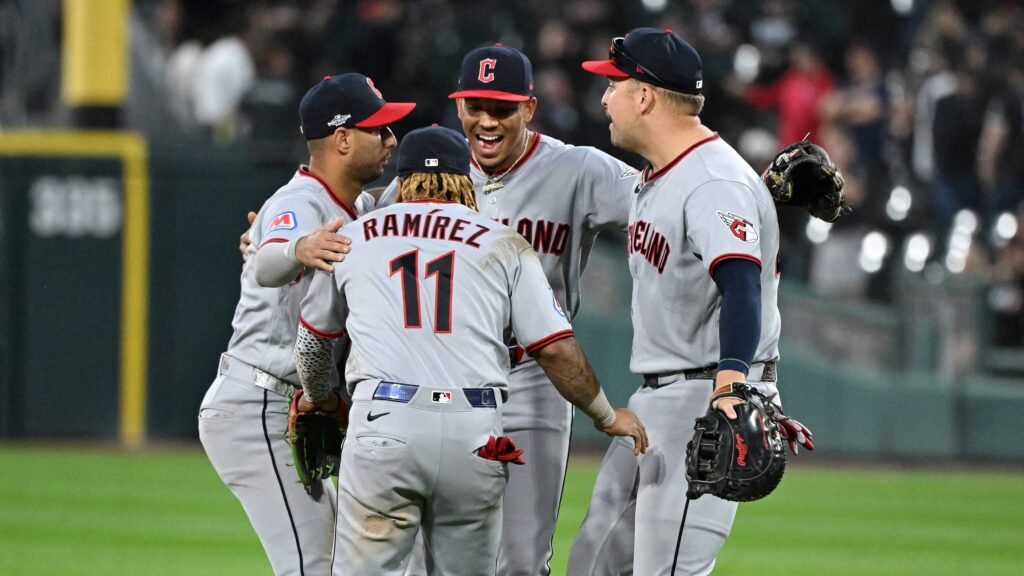
With their backs against the wall, the Cleveland Guardians survived the first of two in Chicago, defeating the White Sox in Game Three of the ALDS. Cleveland scored nine runs on eleven hits on the way to a 9-3 victory in the Windy City.
The first two games of the series were phenomenal for the pitching staff, while the offense struggled; then, in game three, the script flipped as the offense woke up and the bullpen had its blemishes.
It is imperative that the Guardians synchronize their pitching and hitting to force a decisive Game Five.
The first aspect of the equation for victory is that Parker Messick needs to deliver a long start while not giving up a home run. If Messick can keep the Chicago offense at bay, it takes the pressure off the offense and gives the bullpen much-needed rest.
Secondly, the offense needs to keep producing runs. This starts with successful at-bats against White Sox opener Hagen Smith, a pitcher the Guardians haven’t scored an earned run off in this series.
The offense needs to keep pressuring the White Sox pitching staff by getting runners on base before two outs. In Cleveland’s three bases-loaded situations this series, they scored a run only when the bases were loaded before two outs.
Lastly, the bullpen needs to shut down Chicago late in the game. The bullpen has been up and down throughout the series, but now, more than ever, it needs to be perfect. The bullpen has allowed five of the White Sox’s ten runs this series.
On a positive note, the Guardians have several regular-season starters who can pitch in Game 4 if needed. Foster Griffin and Joey Cantillo performed well in their reliever roles last game despite being starters. Tanner Bibee is another asset that Cleveland could utilize, although he has not pitched at all this postseason.
Game Three was a preview of how competitive the Guardians can be when their bats wake up in the postseason, despite the team’s overall flaws in the win.
The offense proved its capabilities after managing only three runs in the first two games of the series. Cleveland not only scored but also produced runs throughout the game: four in the third, one in the fifth, and insurance runs in the eighth and ninth.
For the most part, Cleveland’s pitching was stellar in the victory, striking out 19 White Sox batters, a postseason pitching record for most strikeouts in a 9-inning game.
Cleveland’s offense was shut down 1-2-3 in the offensive half of the first inning, giving the White Sox an early edge in their first home postseason game this year.
Then, in the bottom of the first inning, Guardians’ opener Daniel Espino gave up one run on two hits and walked a batter in his 0.2 innings of work, giving Chicago an early lead and igniting the White Sox faithful at Rate Field.
Another pitching flaw occurred when Hunter Gaddis entered the game in the sixth inning with two outs and runners on first and second. Gaddis gave up a single to Randal Grichuk to load the bases, then a free run when he hit Colson Montgomery, making it 5-2.
Gaddis then hit the very next batter, Sam Antonacci, and walked in another run, keeping the bases loaded. Gaddis was bailed out of what could have been a game-tying single by Miguel Vargas when José Ramírez made an incredible play, knocking the ball out of the air and throwing Vargas out at first to end the inning.
If the Guardians can finally get their hitting and pitching to perform well at the same time, they’ll have a much better chance of winning Game 4 and the series overall. The team needs to play as one unit.
 Add us as a preferred source on Google