




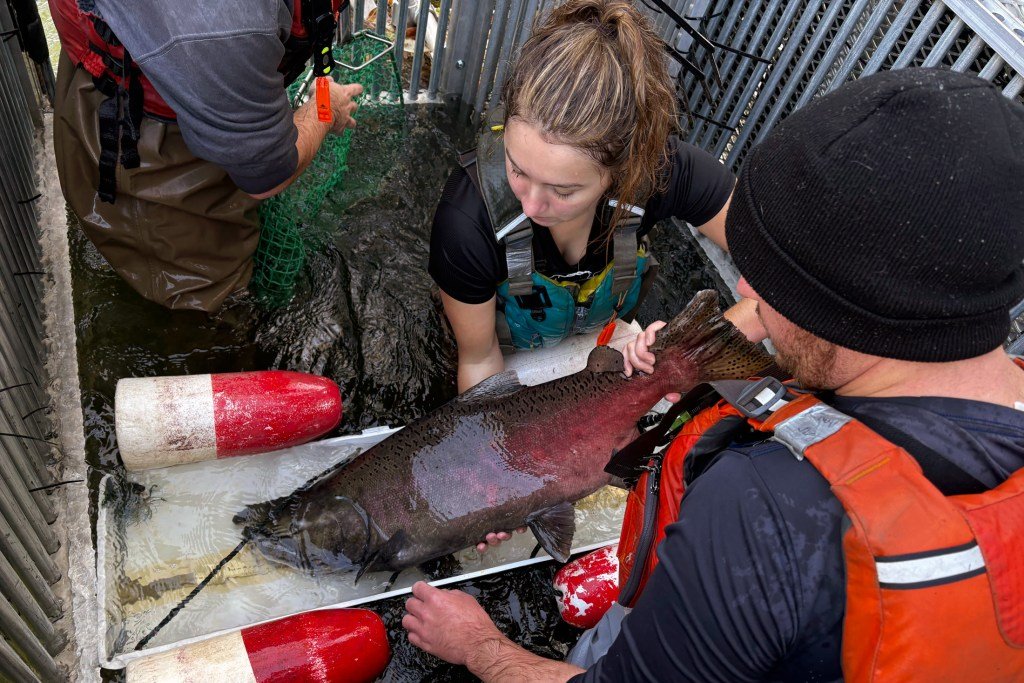
In California, a long-abused river has been reborn. For decades, humans disrupted its course and restricted its flows to the detriment of its ecosystem, only to lately reverse direction and restore it to a facsimile of its natural state. And salmon, the bellwethers of aquatic health, have responded, returning much faster and in greater abundance than anyone anticipated.
This description applies not to the Klamath River — or not only to the Klamath, recently liberated from its four lower dams — but rather to the far less-celebrated Putah Creek. Near its headwaters in the Mayacamas Mountains, the Putah is narrow and boulder-studded; as it nears the Sacramento River’s floodplain, it begins to slow and broaden. Along its 85-mile course, it is imprisoned behind dams, siphoned off by ditches, squeezed between artificially straightened and hardened banks. Although it lacked salmon for decades, in 2025 more than 2,000 chinook returned to spawn — an improbable triumph that reflects both human-led restoration and the resilience of the fish themselves.
“It’s the Field of Dreams thing: ‘If you build it, they will come,’” said Andrew Rypel, a fish ecologist formerly at the University of California, Davis and today at Auburn University. “With science, with community, you can do some really special things.”

Putah Creek’s history epitomizes how humans have mistreated rivers in the Central Valley, the swath of hyper-productive cropland whose hubristic water infrastructure Joan Didion called “plumbing on the grand scale.” In 1957, the Bureau of Reclamation saddled Putah with the Monticello and Putah Diversion dams to impound water for farms and cities. Soon the creek’s feeble flows became too warm to support salmon and most other native fish, which were supplanted by heat-tolerant invasives like bass. In 1989 and 1990, the lower creek dried up altogether, leaving thousands of fish carcasses pocking the mud. “(T)he wildlife’s severely stressed, dying, or dead,” lamented the city manager of Davis, through which Putah trickles.
In this tragedy, however, lay the seeds of Putah’s rejuvenation. In 1990, the Putah Creek Council, an environmental group, whose case would later be joined by the city of Davis and U.C. Davis, sued the Solano County agencies responsible for running the dams, arguing that California law requires dam managers to keep fish in good condition. The parties finally arrived at a 2000 settlement called the Putah Creek Accord, which required water managers to release flows in ways that roughly mimicked nature. No longer would the creek dry up in summer, and extra spring pulses would catalyze fish breeding. The accord also wagered that a fall surge of water, called an “attraction flow,” would encourage salmon to return.
“It was a speculative, ‘Well, maybe this is going to work’ kind of thing,” said Phil Stevens, executive director of the Putah Creek Council. “Nobody knew whether the salmon would come or not.”

The flows the accord provided were fairly meager: Today, 95% of Putah Creek’s water is still diverted for human use. Yet even that small dose of water — augmented by other restoration activities, like riparian plantings and community cleanups — worked wonders. By 2012, scientists declared that native fish like Sacramento suckers and tule perch had already “regained dominance.” A year later, eight chinook salmon, lured by the attraction flows, ventured into Putah Creek — the first to spawn there in decades. The following year, several hundred salmon arrived; in 2016, around 1,500 made it. Conservation groups inaugurated a Salmon Fest in the town of Winters, an event that would once have been unthinkable. The astonishing comeback, said Christine Parisek, a postdoctoral scholar at U.C. Davis’s Center for Watershed Sciences, proves that “it’s possible to recover the ecology of a system” by bringing back its natural flows — even if you have to wait years.
Fish, it turned out, just needed water.
Fish, it turned out, just needed water.
AS PUTAH’S SALMON RETURNED, the question arose: Where were they coming from? Salmon famously head home to their birth streams to spawn, but, since Putah had been devoid of chinook for years, these piscine pioneers were clearly “strays” from elsewhere. The mystery was cracked in 2020, when Rypel and others discovered that the overwhelming majority of Putah’s new salmon were born in Central Valley fish hatcheries and conveyed by truck during dry years to the San Francisco Estuary, an unnatural youth that left them poorly imprinted upon their home waters. Years later, as adults, they’d entered the Sacramento River and blundered up the Toe Drain, a warm channelized ditch that led them to Putah proper. Hatchery salmon’s tendency to deviate from their natal rivers is generally considered undesirable, as it often leads them to breed with wild-born fish and dilute precious gene pools — but in Putah Creek, there were no wild fish to corrupt.
“If you do the hard habitat work, the hatchery fish can help you,” Rypel said. From a few disoriented strays, a sui generis population had arisen.
More discoveries followed. In a 2025 study, Rypel and colleagues analyzed otoliths — the tiny stones that fish form in their inner ears — from Putah chinook. As fish grow, their otoliths acquire the elemental signature of the surrounding waters, enabling researchers to figure out where any particular salmon spent her life. The Putah Creek otoliths revealed that some of the fish hadn’t sprung from hatcheries. Instead, they’d been born in the creek, gone to sea, and returned as adults, fulfilling the romantic salmon life-cycle in its entirety. Putah Creek’s accidental chinook had sloughed off their domestic roots and begun to truly rewild.

The Central Valley’s salmon populations have long been collapsing beneath the weight of dams, diversions, drought and other stressors; if trends hold, they may be “extirpated or minimally abundant” by century’s end. Putah Creek is among the few streams whose runs are growing rather than shrinking. “You can go ahead and pooh-pooh the hatchery fish, but it’s all hands on deck,” said Max Stevenson, Putah’s streamkeeper, a position created by the accord and funded by the Solano County Water Agency.
For all this progress, Putah still faces challenges. Its bed is in many places compacted or smothered by silt, depriving salmon of spawning grounds; although Stevenson has tried to remedy the shortfall by breaking up the existing gravel with heavy machinery and trucking in more, the job’s far from finished. Even more problematic, a 10-foot-high check dam blocks salmon migration until late fall, the end of irrigation season, when water managers pull up wooden boards so chinook can proceed upstream — the most antiquated form of fish passage imaginable. In 2021, torrential rains flushed so much organic matter into Putah Creek that low-oxygen water killed incoming salmon before the check dam was opened, wiping out nearly an entire year of spawners. Stevenson hopes to resolve the issue by building a bypass channel or underwater fish ladder that would allow salmon to negotiate the check dam, or even upgrading irrigation infrastructure so that the dam can be removed altogether.
To restore salmon in such a fundamentally altered environment, Rypel said, qualifies as “reconciliation ecology” — the concept of carving out space for nature in a world irrevocably transformed by humanity. The Central Valley’s chinook are reared on flooded rice farms, migrate along irrigation ditches and spawn in trucked-in gravels. These artificial conditions may represent the future of salmon in Anthropocenic California — a place whose every inch has been reengineered by people, yet still contains room for fish, if we let them in.
“We can build cities, we can make factories, we can go to the moon,” Stevenson said. “We can make a salmon run here if we want one.”