




The Ceuta Affair Tests American ‘Civilizationism’
What really happened in Spanish Africa last week?
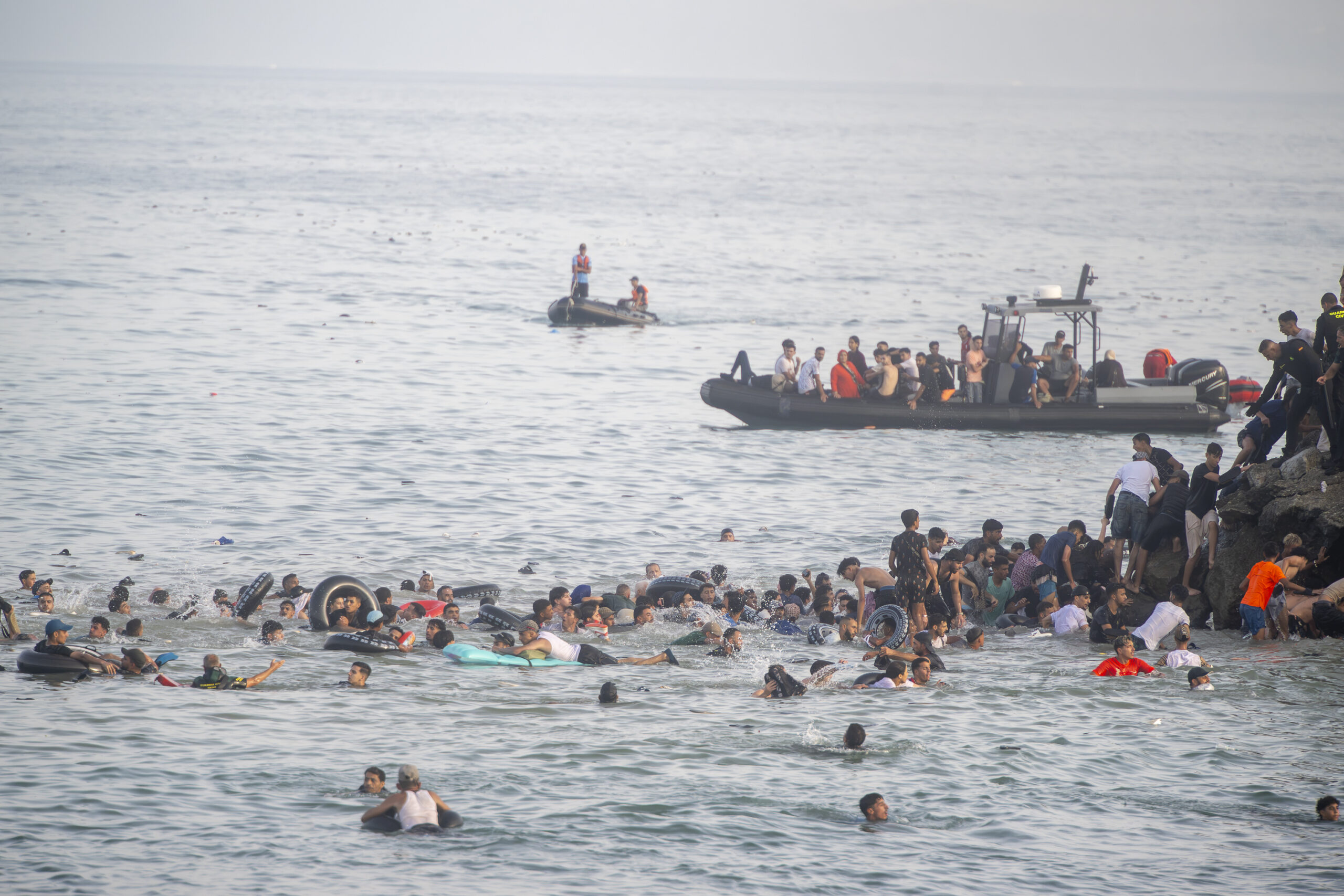
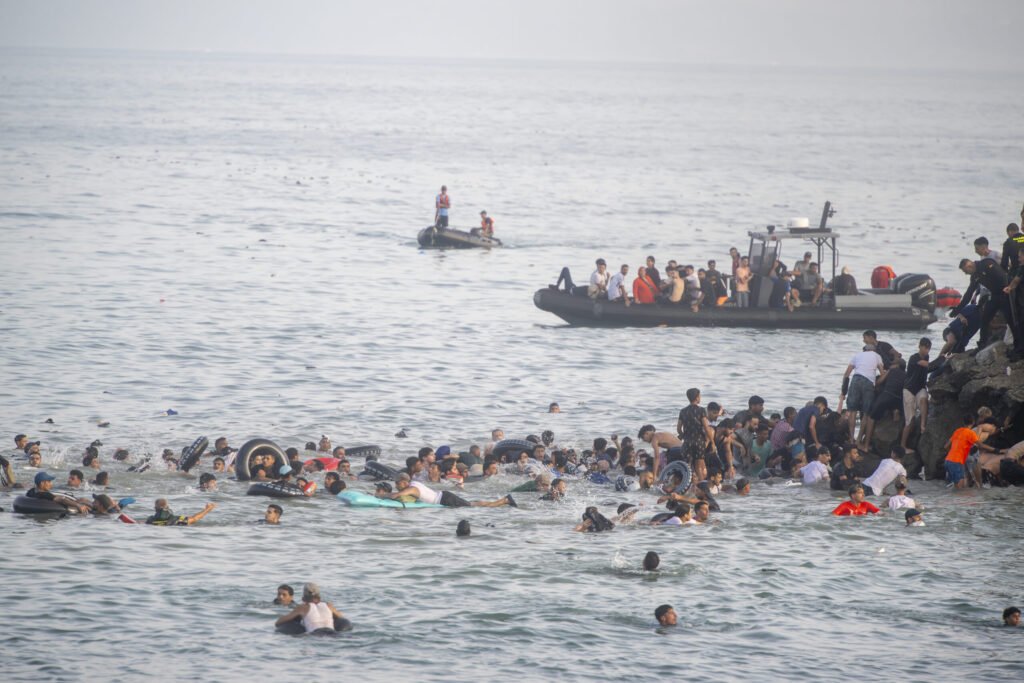
At the end of July, the Spanish exclave of Ceuta found itself on the receiving end of an invasion. Ceuta is, alongside its sister city Melilla and a few barren rocks along the Moroccan coastline, all that remains of a 600-year-old Iberian presence in North Africa. And last Thursday and Friday, more than 70,000 migrants surged into this small Spanish foothold, overwhelming the security forces and making themselves at home.
In some sense, this was predictable. The prime minister of Spain, Pedro Sánchez, is perhaps the most pro-migration leader in Europe. In April of this year, his government enacted an astonishingly liberal—some might say certifiably insane—policy that will grant status and benefits to, conservatively, over half a million heretofore illegal immigrants. And in July, Spain’s highest court issued a ruling that weakened the government’s ability to swiftly deport migrants who cross into Ceuta and Melilla. Add to these “pull” factors a glum economic climate within both Morocco and most of its neighbors to the south and east, and you have the makings of a crisis.
But there were also stranger aspects to the affair. Rather than building up gradually, it burst forth all at once, following a mysterious spate of text and social media messages from accounts which have already disappeared. Although many of the migrants who seek to enter Spanish territories from Morocco have traveled there from sub-Saharan Africa, the overwhelming majority of last week’s crossers into Ceuta looked like North Africans.
Most peculiarly of all, the movements of these migrants, which at the very least could not have failed to attract the attention of Rabat, appear in fact to have been facilitated by Morocco’s government. Per the New York Times:
Others said the Moroccan authorities had encouraged them to cross the border into Ceuta. Youssef Alaoui, 26, said that as he approached the border on Thursday, along with a group of others, the police pointed them in the right direction. “They just kept saying, ‘Go that way, go that way,’” Mr. Alaoui recalled….
Mohammed Ahmidho, 37, said he had heard about Thursday’s influx into Spain on social media. When he neared the border, he said, Moroccan police officers had encouraged him, saying “come to Spain.”
The Times and other media outlets have also noted that Morocco has a history of using migrant flows as a policy tool. “I don’t know why they let us through,” another migrant was quoted as saying. “Maybe they had some political reason. They opened the border and let everyone go by.” There are even allegations that Moroccan intelligence agents were present in the scrum.
What “political reason” could there be? Some have pointed to Spain’s budding relationship with Algeria, Morocco’s perennial rival (Sánchez visited Algiers the week before the invasion). Others have emphasized Rabat’s longstanding desire to embarrass Spain over its last colonial-era holdings, which Morocco naturally claims for itself.
There are additional actors to consider. The desire of the White House to take Sánchez to task for his vociferous opposition to the Iran War (plus his country’s refusal to commit to NATO-wide defense spending targets, plus his intense criticism of Israel) is well-known. Less well known but equally real are the close ties between the Trump administration and the Moroccan government. During his first term, Trump recognized Morocco’s claim over Western Sahara, and last month the Moroccan government thanked our president by naming a highway through the disputed territory in his honor.
The Republican Congress, too, has been a great friend to Rabat: As Kentucky Congressman Thomas Massie noted last week, the House of Representatives recently passed a bill that would provide Morocco with $40 million in aid, with an accompanying committee report suggesting the North African kingdom’s claims to Ceuta and Melilla deserve a hearing.
It also pays to look at who else was cheering for the invasion. With her usual subtlety and politesse, Laura Loomer wrote in a social media post that “the invasion of Spain by Islamic third world parasites is bad for society but good for the acceleration we need to make the general public harbor animosity toward Islam.”
Israeli government officials have also weighed in: “Spain, which never misses an opportunity to lecture Israel, has declared a state of emergency in Ceuta,” Israel’s UN ambassador said on X, adding that “maybe before it continues lecturing us, it’s time it explained to the world why it still maintains colonial enclaves in Africa.” (It is worth noting that Israel has cultivated significant defense and intelligence ties with Morocco, particularly since the latter’s accession to the Abraham Accords.) And analysts from ultra-hawkish DC think tanks like the Hudson Institute, the Foundation for Defense of Democracies, and the American Enterprise Institute have gone out of their way to give Morocco a free pass and heap all of the blame on Madrid.
If cui bono is still a useful guide to geopolitics, it’s enough to make one wonder. Particularly striking has been the response of the Trump White House. After all, this is an administration which came to power largely on the strength of its promises to staunch illegal migration; it would be reasonable to expect criticism of the weaponization of this phenomenon, particularly when directed against Europe. I thought we were against unleashing tens of thousands of Muslim migrants into the Christian West?
But as far as I can tell, there has not been one official U.S. government condemnation of Morocco. Not even a solitary question has been raised. Quite the opposite, in fact: two days after the crisis began, President Donald Trump sent a flattering Throne Day message to the king of Morocco, lauding his “wise leadership,” reiterating U.S. support for his claims to Western Sahara, and hailing the “new era” being built jointly by the American and Moroccan peoples. (He laid it on a little thick, truth be told.)
Whatever role Washington may or may not have played in the events themselves, its interest since the crisis has been purely in wielding it as a cudgel against Spain and Europe. There is little in the way of positive engagement or offers of assistance; it is pure kritik, which is landing in Europe less like the admonition of a friend and more like the gloating of an enemy.
Indeed, if the move was intended to isolate Spain, or even help nudge Europe away from a supranational bureaucracy back to a continent of nation-states, it appears likely to fail. After some initial isolation, during which Sánchez played the role of a “red Orbán” (as one European parliamentarian put it) and 22 countries condemned Spain’s immigration policies in a letter, the EU now looks to be rallying around Madrid. At an emergency EU meeting Tuesday officials praised Spain’s “swift response” to the crisis, with Belgium’s leader drawing the lesson that “anyone wanting to put pressure on us can use migration as a geopolitical weapon.” One legacy of Ceuta may be more, rather than less, EU cohesion.
Look, I’m a confirmed skeptic of Blobby Atlanticism, and confess to doubts about the new “civilizational” project to shore up the West that is all the rage in Foggy Bottom. (Old wine in new bottles, it seems to me; let the Old World attend to its own problems.) So the prospect of a rupture with the Euros isn’t troubling in and of itself.
What is more concerning is the seeming embrace of what our Marxist friends (and Laura Loomer, apparently) call “accelerationism:” in this case, offering tacit support for conduct all civilized nations should condemn just because it “heightens the contradictions”—another bit of Marxist lingo—and punishes a political opponent. That sort of thing is, or should be, beneath us.
The post The Ceuta Affair Tests American ‘Civilizationism’ appeared first on The American Conservative.