






Rubio’s Western Civ Speech Backfires
America’s top diplomat treated Persian civilization as an inherent enemy.

The Trump administration, whatever it may claim, tried to engineer regime change in Iran. When President Donald Trump announced the American–Israeli strikes that launched the current war, he offered immunity to Iran’s soldiers if they laid down their arms, and he called on its people to take over their government.
“To the great proud people of Iran, I say tonight that the hour of your freedom is at hand,” Trump declared. During an interview with the Washington Post the next day, regime change was top of mind for the president.
Nearly eight months later, the Islamic Republic of Iran is still standing. One reason for its resilience under intense military and economic pressure is that the Iranian people—despite claims to the contrary from Iran hawks and some diaspora Iranians—rallied around the regime as their protector against external aggression.
And one reason they rallied is that Trump has given every impression that the U.S. is at war with the Iranian people, not just their oppressive regime. “A whole civilization will die tonight, never to be brought back again,” he threatened in April. Such statements are impossible to square with Trump’s proclaimed empathy for the Iranian people.
Trump is now joined in that ill-advised effort of mixed messaging by America’s top diplomat, Secretary of State Marco Rubio, who recently gave an intellectual twist to Trump’s hostility to Iranian civilization. Predictably, the Islamic Republic pointed to Rubio’s remarks as further evidence that the U.S. is at war with Iran’s people and indeed its entire history and culture, not just its government.
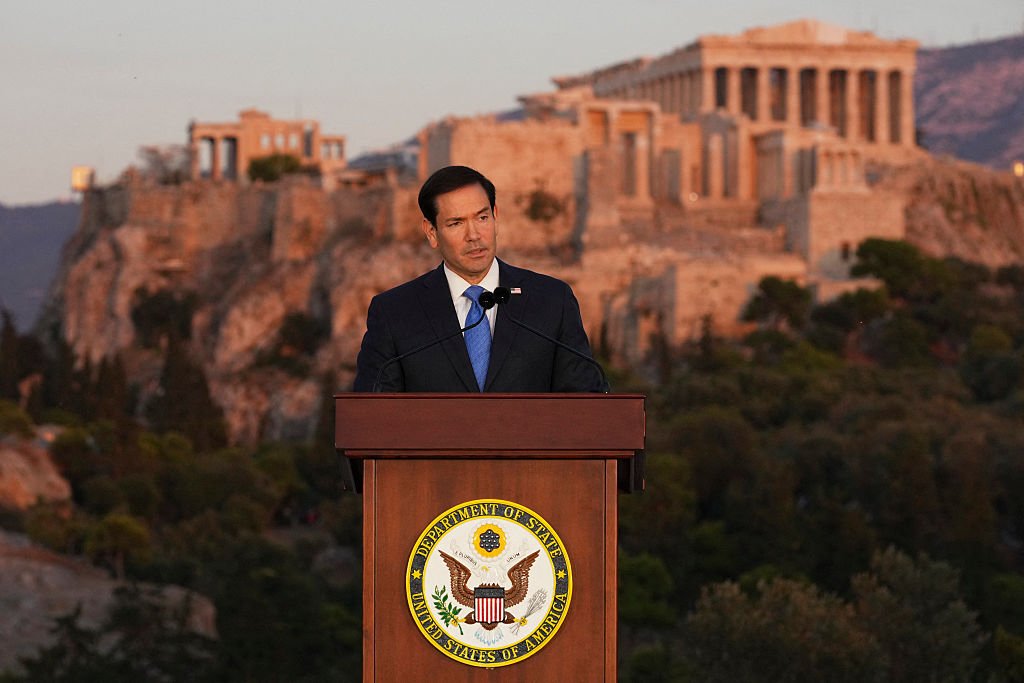
Rubio made his unwise rhetorical intervention during a soaring speech last week on Western civilization, delivered in Athens against the dramatic backdrop of the Acropolis. The aesthetics were kino, as the kids say, but the substance of the speech was confused and counterproductive.
The secretary thematized the profound influence of ancient Greece on America’s Founders, and to be sure, this influence cannot be denied. But Rubio went further, insinuating, with minimal subtlety, that Iran’s own historic civilization is hostile to the West.
Early in the speech, Rubio narrated the second Persian invasion of Greece, when “the armies of Xerxes arrived in this city and they put its sanctuaries to the torch.” Most of the Athenians fled, he explained, but a brave few stayed behind in defense of their city, barricading themselves in the Acropolis and “heaving massive stones down the cliffs onto the Persian invaders.”
Later in the speech, Rubio cited “the legendary stand of 300 Spartans—surrounded and hopelessly outnumbered by the vast armies of Persia—who refused the chance to save themselves, choosing to fight to the last man rather than abandon their post or abandon their duty.”
The rhetorical effect, apparently deliberate, was to figure battles between the Persian empire and ancient Greek city-states as precursors to a civilizational clash between Iran and the West today. And indeed, Rubio contrasted the “heroes of the West” with the “radical mullahs of Iran, whose cult of death hails child suicide bombers as national heroes, and portrays martyrdom as an end to itself.”
You don’t have to love the “mullahs of Iran” to see a problem here. In fact, even a radical Iran hawk who despises Tehran’s clerical leadership should easily see the problem.
Rubio’s villainization of Persia bolstered the impression that 1) the U.S. aims to “annihilate” Iran, as Trump repeatedly says, and 2) that it harbors this eliminationist intent for deep cultural reasons divorced from the foreign and domestic policies of the Islamic Republic. The speech, in other words, was a PR coup for Tehran.
Iranian officials, with justification, pounced. “Praising resistance when it serves ‘one’s own’ and denigrating it when it comes from ‘the other’ is not civilization; it is sophistry in the service of domination,” said Ali Akbar Velayati, a senior advisor to Supreme Leader Mojtaba Khamenei. “Mr. Rubio, your problem is not with the Islamic Revolution; It is with a strong, independent Iranian civilization.”
If Rubio’s speech was an own goal, the ball didn’t exactly bounce off his shinguard as he leapt to block the opponent’s free kick—the secretary turned around at midfield and blasted the leather into his own team’s empty net. To understand the weirdness of his error, consider how other Western civilizational thinkers have thought about Iran and its predecessor Persia.
While Rubio depicted pre-Islamic Persian civilization as antithetical to the West, Samuel Huntington, author of The Clash of Civilizations, focused instead on Iran’s modern Islamism as the characteristic likely to generate tensions with America and Europe. And Hungtington didn’t tell a simple story of Islamic aggression. In his analysis, the legacy of Western colonialism and continued tendency of Westerners to try imposing liberal values on other civilizations stoked the resentments of young men in the Muslim world.
Moreover, many great thinkers in the Western canon held Persian civilization in high esteem. Germans of the 19th Century were notably effusive in their praise. “If we now turn to a peaceful, civilized people, the Persians …” is how Goethe introduced the topic in his book West–East Divan. Hegel too saw ancient Persia as a bridge between East and West, admiring its tolerance and spirit of freedom. And Nietzsche, surpassed by no one in his affection for the pre-Socratic Greeks, nevertheless deeply respected the Persian people. “To speak the truth and to aim straight: that is the first Persian virtue,” writes Nietzsche in Ecce Homo.
It’s not too late for Rubio to walk back his remarks and express similar respect for the cultural contributions of Persian civilization. But unfortunately, much of the damage is already done. After his speech, some Iranian officials didn’t merely present it as proof of America’s comprehensive hostility—they further fanned the fires of civilizational strife.
“When they go to Athens after defeat and humiliation before Iran to shape a narrative of a civilizational war,” said Mohsen Rezaei, the hardline secretary of Iran’s Supreme National Security Council. “It would be better for them to read another important part of history: where the Roman emperor knelt before Shapur I of the Sasanian Empire.”
It’s a U.S.–Iran hardliner doom loop, and our hardliners seem ever eager to ratchet up the rhetorical antagonism.
Rezaei’s predecessor, by the way, was the pragmatist Ali Larijani. Several decades ago, Larijani had been a scholar of the German philosopher Kant, who, like his compatriots mentioned above, discerned a deep cultural affinity between Persians and Europeans. Larijani probably would have offered a less belligerent response to Rubio, holding out some hope of diplomatic engagement—but Israel killed him early in the war.
Perhaps that fact offers a clue to understanding Rubio’s needlessly provocative speech. His vision of Western civilization seems a patently Israeli-fied one, crafted to justify a war of aggression against Israel’s chief adversary. The Trump administration has searched in vain for an argument that will compel the Europeans to join that war, but if they do, and if Iran is destroyed in the process, it won’t be Western civilization that benefits.
The post Rubio’s Western Civ Speech Backfires appeared first on The American Conservative.