




Maybe the Golden Age of graphic adventures was not in fact the LucasArts and Sierra era, with its Monkey Islands and Gabriel Knights back around 1990. The Golden Age might just be right now, with a quiet resurgence of brilliant games growing throughout the last decade. This latest arrival on Switch 2 (also available for Switch 1) comes from Australian indie outfit Powerhoof, and it holds its own alongside some of the genre’s best.
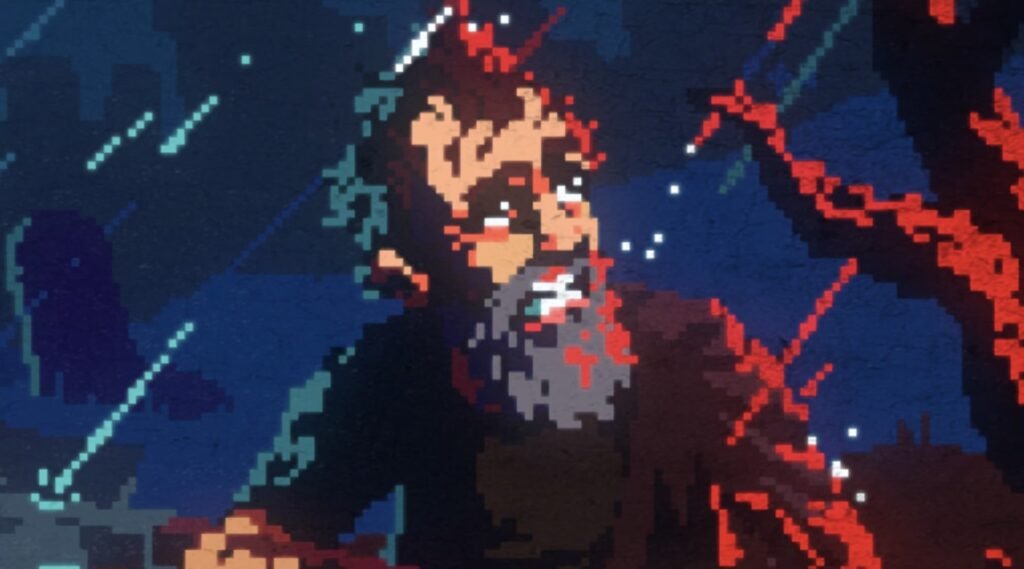
The Drifter’s chunky pixels might take you back to the ’90s, and its counter-culture antihero and grit might even spark memories of LucasArts’ Full Throttle, but this is not such a sanitised romp. This is not Steven-Spielberg-presents The Dig. The Drifter is sweary, violent and grotesque.
You play as Aussie low-life Mick Carter, drifting from place to place on the run from his responsibilities. He’s returning to his home town for his mother’s funeral, where he’ll be forced to face his family and their clean and wholesome lives. But when witnessing a shooting gets Mick embroiled in a string of murders and disappearances, it’s a journey that quickly fills with surprises.
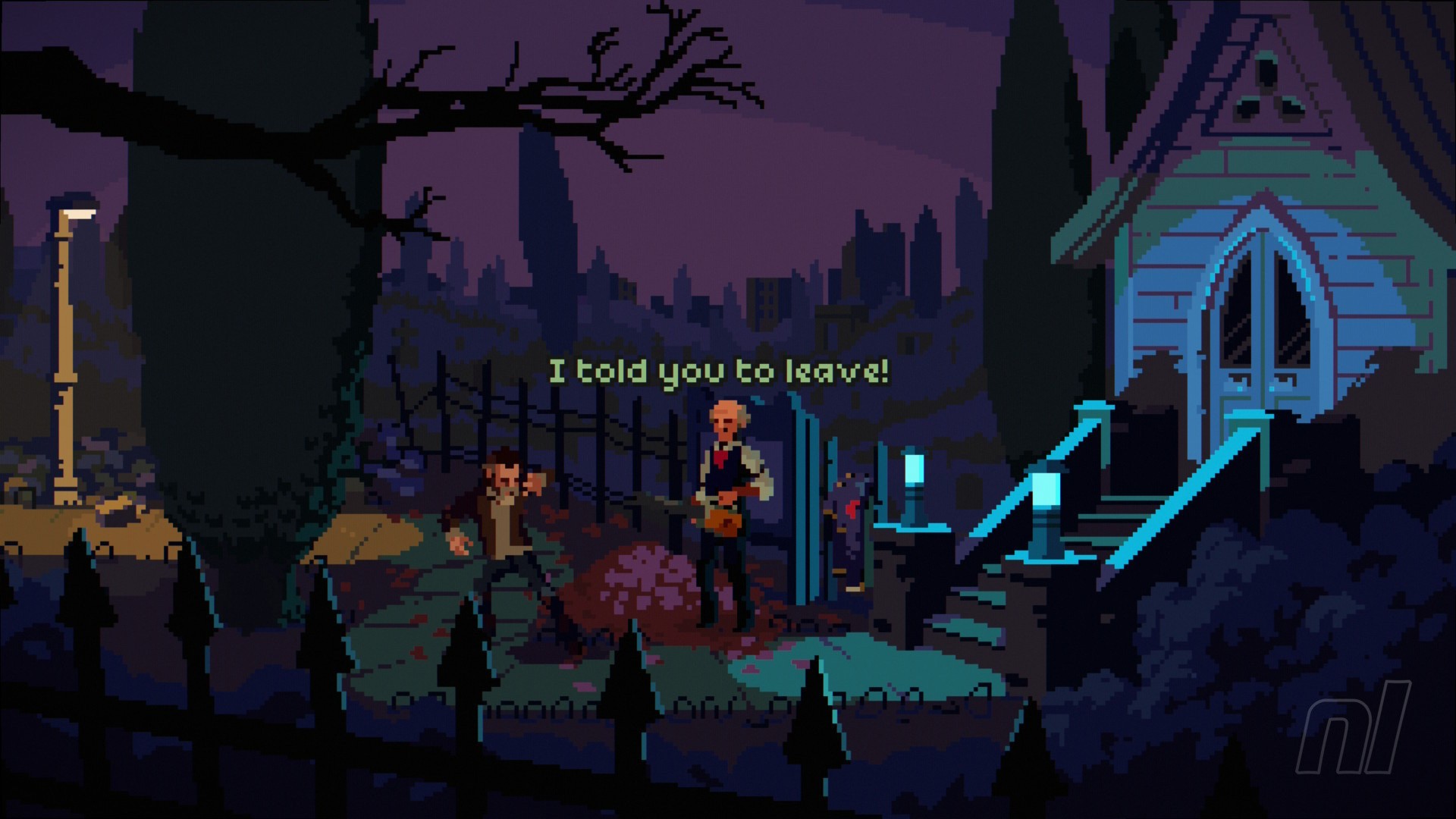
The writing starts with hard-hitting grit, before exploring surreal science fiction. This opens up a plot device that can excuse fail states and retries – a way of couching something often unwelcome in this type of game. There’s always a suspension of disbelief required in narrative games that require repetitive trial and error. Sometimes that’s masked with humour and silliness, as in the Monkey Island series or the wonderful Lost in Play. The Drifter’s serious approach is distinctive and keeps you involved in the story without shattering the illusion – at least for the first few tries.
There are one or two brief against-the-clock moments — another uncommon genre feature — so the game’s excellent control options are welcome. First thing to note is that yes, mouse mode is on the table (or the sofa cushion, or wherever). Popping the Joy-Con off lets you point and click like you’re playing on a beige CRT all over again. You can also connect a USB mouse.
Even though I was excited by how well mouse mode worked, I eventually landed on the controller, since it’s implemented very cleverly. The left stick moves Mick around, while the right stick pulls up an ellipse around his feet with little radar dots showing the location of interactive scene elements. Rotating the right stick to each dot puts the pointer on the item in question, and pressing the right shoulder button then interacts, equivalent to a mouse click. It’s smooth and free of pixel hunting. Overall, the controls provide multiple options that don’t feel compromised and let you crack on with the story.
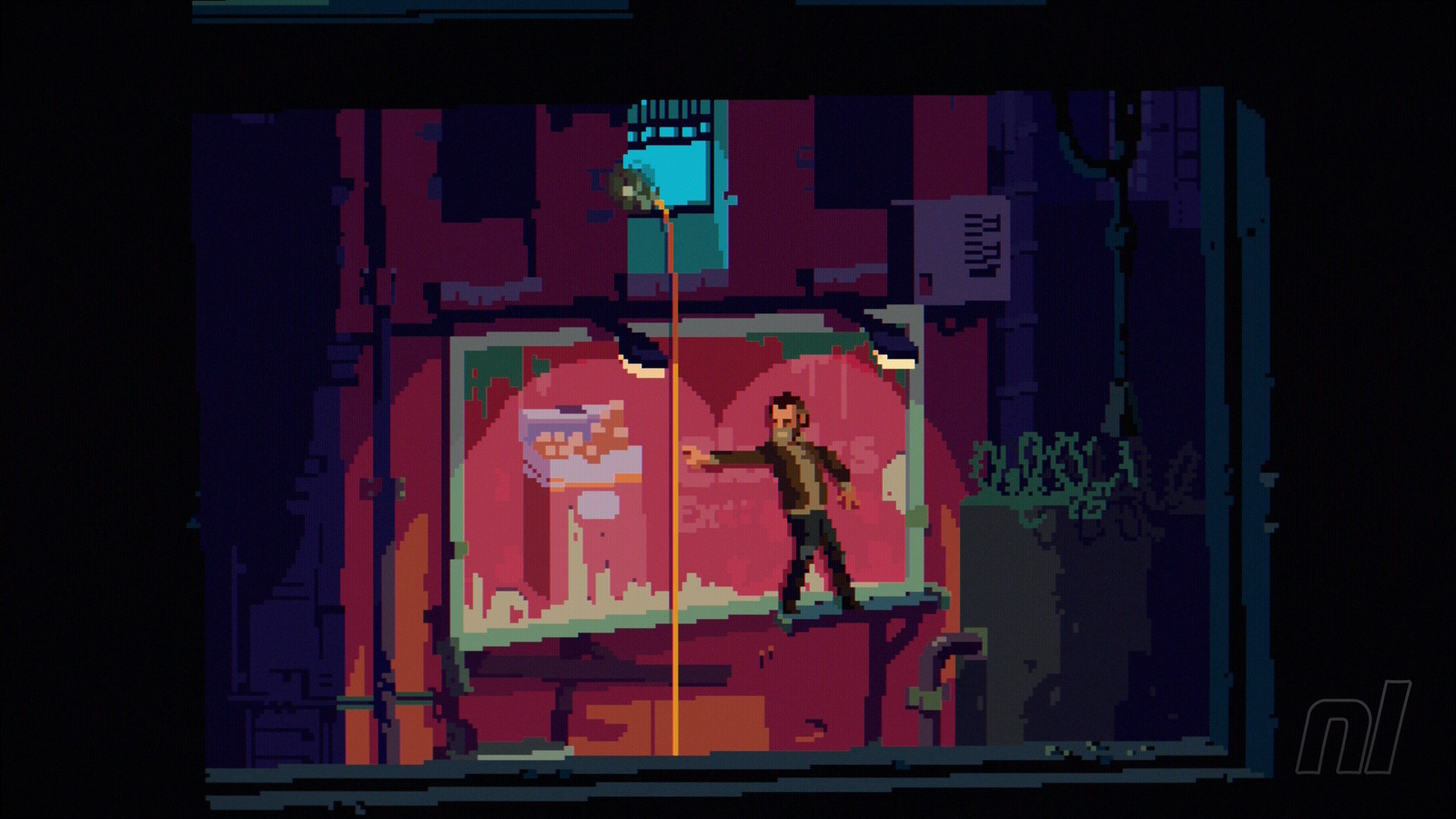
That story is populated by a fresh and memorable cast of characters. Of particular note are the other drifters – the homeless people who are key to the plot. Mick seems to be homeless by choice, so is not in the same boat as some of the people he meets, but he has a connection with his unhoused friends and acquaintances that feels genuine. His ability to slip easily from a fire barrel under an overpass to his sister’s comfortable family home plays to his charisma as a protagonist – one who is nonetheless deeply flawed, full of regret, and haunted by demons.
The Drifter deals with some heavy themes and doesn’t shy away from violence and gore, lurid against dark backdrops, but it nonetheless sustains a sense of humour. Mick’s Luddite efforts to interact with technology raised a smile, as did many of his and other characters’ animations, and a handful of dark jokes.
There’s also fun to be had in the artwork, which is at once grim and vibrant. Its enjoyably busy scenes have classically silhouetted foregrounds and almost everything parses cleanly so you’re not scratching your head about what you’re hovering over. One exception is the monochrome inventory wheel, where items look similar, and basic shapes like a card or a photo are hard to tell apart.

Great use is made of the blackness around each scene, too. Many are not screen-fillers, and the jagged shapes they cut out of the dark can be claustrophobic or expansive, and let the big backgrounds feel luxurious when they arrive. Crucially, the sets all do the vital point-and-click job of serving as reward for progress. Like all the best games in the genre, reaching a new area is a treat that drives you to keep playing just a little bit more. 10 hours or so of play time flew by.
The puzzles went down easily enough, too. They don’t lack imagination, with some multilayered conundrums and classic moves like manipulating NPCs and observing their behaviour. A sequence to distract a receptionist at a newspaper office was particularly memorable – if rather fiendish. Powerhoof could have chosen to explore some dream logic, given the light sci-fi elements of the plot, but the puzzles mostly ground things in the grit of reality, leaving the more fantastical elements to the narrative and setting them in contrast.
Puzzle design is rather linear, however. The repeated trial-and-error sections are closed boxes with no way to go and explore a different avenue if you’re stuck. I spent far too long at one point failing to notice a broom. It was broom or nothing – and I had to stomach a great deal of nothing.
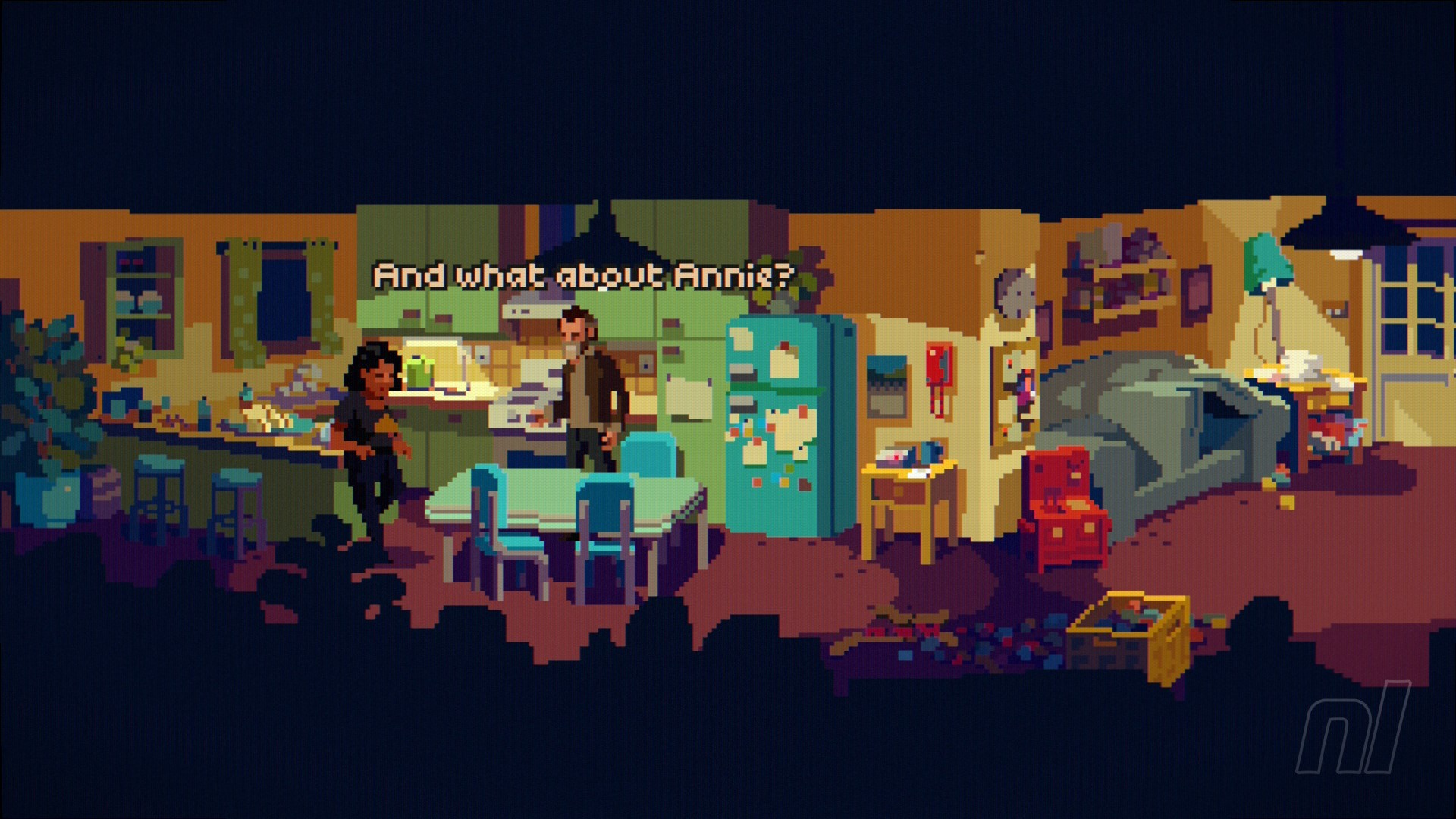
Thanks to fun, sometimes cartoonish, voice acting, characters are as entertainingly distinctive verbally as they are visually. Mick’s inner monologue sometimes blurs a bit with the spoken dialogue, but that’s a small quibble. Sounds bring the environments and inventory objects to life and play a key part in making puzzle solutions satisfying as items combine. The music is mostly ambient and strikes a perfectly ominous tone when the story turns dark.
The Drifter might hark back to 20th-century point-and-clicks with its pixel visuals, but its smart controls, streamlined interface and smooth scrolling place it firmly in the modern world. Its adult-oriented graphics and language combine with an undercurrent of humour to bring the schlocky plot to life, and joyful backgrounds and animations keep it fresh from beginning to end.
Powerhoof has provided yet more evidence that we’re living through the graphic adventure’s Golden Age.