




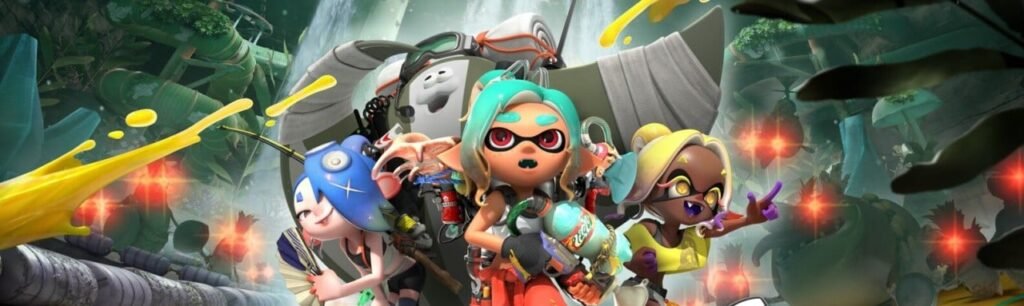
Whilst it wasn’t part of the original release 11 years ago (yikes), Salmon Run has become a core part of the Splatoon experience, as important as Turf Wars and bizarre single player adventures. Splatoon Raiders is Salmon Run to an extent, but it feels to me like a side mode from ‘Splatoon 4’ that simply… got out of hand.
If you’re unfamiliar with the general idea, Salmon Run is a mode where instead of fighting fellow Inklings and Octolings, you take on large and small (and physically varied) enemies called Salmonids; a naming convention so outlandish, so dangerous, so damnably curious, that it’s impossible to know precisely on what animal they’re based.

Unlike the typical arena-based structure of normal Salmon Run, Raiders uses a stage system more typically associated with Splatoon’s other single-player offerings, referred to as ‘dungeons’. Each dungeon broadly falls into one of a few categories; you’ve got your standard get-to-the-end kind, more non-linear environs that task you with collecting a set number of Power Eggs from fallen Salmonids, claustrophobic arenas that spawn enemies relentlessly, and mini gauntlets that teach you how to use the game’s various gadgets (more on those later).
A lot of dungeons don’t fit super neatly into these categories though, which I found a really nice way to play with expectations. Splatoon’s done this for a while, of course, but I was very pleased to see it maintained in this spin-off.
The biggest change over previous games, however, is the Salmonids themselves. Every Boss Salmonid and every Lesser Salmonid from previous games make a return – with the exception of the Snatcher, as they just wouldn’t work with Raiders’ new gameplay – but also new enemy types for both categories make their debut here.
Smokers will provide a protective, gaseous bubble that reduces damage dealt to any Salmonids within range, Salty Tongues will waddle over and try to nip at your entire being, and Salivators will lob horrible plastic bags full of gunk at you that throw out a vortex of pain and suffering. All good stuff, but the real intrigue for me as a long-time player was how they’ve adjusted the existing Boss Salmonids.

You see, the gadget system replaces the sub-weapon system of previous games, meaning there’s no guarantee you’ll have bombs at your disposal. This means that Maws and Flyfish can now be taken down with standard shots (although that was admittedly always the case with the former, you’d just be a fool to rely on that). At first, I felt this was a tiny bit disappointing, as it took away some of their uniqueness. Big Shots are also properly mobile now, bouncing around on large springs rather than sticking to shoals.
This disappointment held up until I reached some harder dungeons where these revised enemies were no longer being introduced, but being actively and viciously employed. It is indeed easier to take down the absolute hellspawn that is the Flyfish by just shooting the pilot as opposed to throwing a bomb in each bin, but that doesn’t stop it from being an absolute pain in my life when it launches its little missiles when I’m trying to focus on another 30 more immediate enemies charging towards me.
But it’s the new salt-encrusted Seasoned Salmonids that really take the proverbial biscuit, along with the award for best pun in a game full of puns. They truly are the Dark Souls of Salmonids, exaggerating their existing traits to the nth degree, and in a manner that I absolutely love.

The Big-Stack Stinger is at least three times as tall as a standard Stinger, and has three guns, and the Long-Line Steel Eel is a ruthless brute that makes me want to cry. It’s also really long.
I should probably say at this point that I played through the whole game (completed it, mate) on the hardest difficulty available, Survivalist. There are two other difficulties available for less try-hard overachievers, and the game does a really, really good job of balancing things to make everything fun and achievable no matter your skillset.
If things are too tricky, you can always replay previous dungeons in order to boost up your level and increase your stats, which means whilst it is possible to over-level yourself, it’s still a very welcome method of making sure the game doesn’t alienate newer players. You can even call on other players online to come and help you for a single Raid if it helps you make the progress you need.
Replaying levels does sound a little dull, though, doesn’t it? Well, fear not; after clearing enough stages, you’ll unlock the ability to replay your previously completed levels in ‘Spicy’ mode. This ramps things up enormously, meaning not only is it more fun replaying previous levels you’ve already smashed out of the park, but you’ll also get different rewards as a result. New enemy placements, more enemies, more variety in enemies, Spicy Raids are just one way Splatoon Raiders makes replaying endlessly enjoyable.
And if you’re a serious glutton for punishment like I am, don’t worry, there are plenty of ways the game hands your various body parts back to you. I’m not going to go into details, but let’s just say if you’re a hardcore fan of Splatoon, you’ll have plenty to sink your teeth into as things progress.
And frankly that’s the same no matter your skillset. Although you might not think it given its budget price point, there’s a hell of a lot of game in here. Again, I’m not going to go into specifics to make sure things Stay Fresh™ for you when you get the game for yourself.

But enough of that long ramble about the game as a whole, I did promise I’d talk about the new Gadgets system, didn’t I? Well, as I said, they replace subweapons (you know, bombs, sprinklers, all that stuff), and are absolutely essential to master and upgrade if you want to punch the biggest holes in the biggest Salmonids.
Each plays quite differently, and they’re tied to specific Ink Tank types, meaning you can’t just use any combination you like willy-nilly. Some are definitely more my cup of tea than others, to the point that I really wouldn’t mind some of them making their way to Splatoon 4, albeit probably with a bit of tweaking to make them less overpowered.
Because, you see, you can upgrade these gadgets to such an extent that they would absolutely break any normal game of Splatoon. A personal favourite is the Splatellites, which spawn a rotating array of globules that spread ink and damage enemies at first, but with the right Gadget Parts can be upgraded to hit flying enemies, set Salmonids on fire, or even stay in place if you wish.

The amount of customisation in how you play the game is absolutely staggering, to the point that I doubt you’re likely to bump into anyone in real life that would have had the same experience as you with the game. Just to be sure, though, you could always play the whole game online with a friend or three.
Yep, despite being a single-player game first and foremost, you can play almost every single level in multiplayer, and the way they’ve implemented this is simple, but so good. You can’t select a dungeon if someone within the party hasn’t unlocked it, but when you do complete a level, it counts as progress for everyone involved.
That means in theory you could play through all but the entirety of the game with friends, should you wish. And don’t worry about making things too easy, either. Multiplayer ramps up the levels of the enemy Salmonids, but in a delightful twist each player’s individual difficulty choice is maintained on a player-by-player basis, meaning newbies and seasoned experts don’t have to sacrifice their personal difficulty choices to play with chums.

But you won’t be alone even in single player, as you’ll have one of Deep Cut piloting a small walker tank to help you out. They’ll shoot, provide you with the ability to use a unique special move, and most importantly, let you bounce up into the air to gain a height advantage on those pesky Salmonids, a feature I didn’t think I’d use much, but have since absolutely abused in my time playing.
Everything about the gameplay is excellent, although truth be told whilst there is plenty of new stuff to enjoy, it’s not really pushing the boundaries of the series in any substantial way. Jumping into things for the first time felt immediately familiar, and although there are fun twists and turns to enjoy, the core gameplay is broadly what you’d expect from Splatoon. It’s evolutionary, not revolutionary in that sense.
The game looks pretty good on Switch 2 as well. It’s not strictly a showcase for some of the new tech that the system is capable of, but it’d be rude to not call it a looker at the same time. Graphics are crisp in docked mode, looking to my eye like a very solid 1440p with a rare instance of anti-aliasing for a Nintendo game, and a pin-sharp 1080p in handheld.

It doesn’t use any especially novel lighting for the most part, possibly to keep the chaos as easy to parse as it can be, but it manages to look pretty flipping tasty without dropping from its 60fps target. If it was ever dropping frames at any point, I couldn’t see it with my pedantic little eyes.
The music is spectacular, and I’d expect nothing less to be honest, and whilst the story isn’t pushing any boundaries, it’s a fun little narrative that gives us a bit more insight into Shiver, Frye, and Big Man that fans won’t have seen before.
But you know what warms my heart the most? It’s the little things (it’s always the little things). Practically all Salmonids, even Lessers, change their look depending on their effective level, becoming more and more encrusted with salt. The victory theme at the end of a Raid changes depending on your bot buddy, or if you’re playing multiplayer, reflecting each member of Deep Cut’s individual singing and musical style. The explosive Sparkys may somehow have the doppler effect programmed into their sirens, but I can’t confirm that for sure. I just know at one point it sounded like they sounded different when they were coming towards me as opposed to when I was running away.
Splatoon Raiders may be missing the series’ iconic Turf War, but what we have here is possibly the most variable and exciting game the series has ever offered. Regardless of your skill level or personal play styles, the game is able to cater to practically any taste, and all whilst delivering one of the most enjoyable gameplay loops on the console.
It looks good, runs fantastically, and you can play practically the whole thing with friends if you wish. Not only that, but Nintendo’s flogging it for a bargain price. It may not push any boundaries within the genre per se, but it’s difficult to find anything negative to say about it, it really is a must-play for almost anyone.