


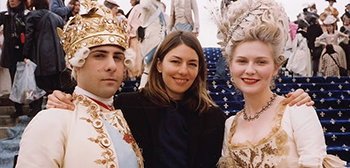

Few films offer the unique chance to pull back the curtain & reveal the immense labor & time a crew invests in the filmmaking process. Even rarer are those that provide an incredibly intimate portrait of the creators themselves, captured by someone with unprecedented access to both the professional & personal sides of the journey. In 2005, documentarian Eleanor Coppola followed her daughter, Sofia, during the chaotic and historic shoot of her film Marie Antoinette — the first movie production ever granted full access to the Palace of Versailles outside of Paris, France. The result of her shadowing Sofia was 80 hours of behind-the-scenes footage that Eleanor always dreamed of turning into a film. Following her mother’s passing in 2024, Sofia decided to honor that wish, shaping this unique material into an 86-minute documentary film titled Making Marie Antoinette. This new documentary just premiered at the 2026 Telluride & New York Film Festivals. The footage is accompanied by readings from Eleanor’s personal diaries, narrated by Diane Lane.
By 2005 when production was about to begin, Sofia Coppola already had two acclaimed films under her belt: The Virgin Suicides and Lost in Translation. For the latter, she won the Academy Award for Best Original Screenplay and received a Best Director nomination as well, becoming only the third woman in history to be nominated in that category. Known for specializing in low-budget, intimate dramas, her decision to take on a $40 million historical epic set in 18th-century France came as a surprise. Even though Eleanor possessed unparalleled access to her daughter and the processes on the set, Sofia’s creative vision proves to be just as much of a surprise and uncharted territory for her as it is for the audience. From the very beginning of the shoot, the director attempts to unravel Sofia’s mindset and understand what drew her to the story of an Austrian princess left alone at the age of 14 to navigate the stifling rules of the lavish French court.
For the younger Coppola, Marie Antoinette (played by Kirsten Dunst) was less a historical figure, more an ordinary girl trying to find her way far from home. Consequently, Sofia steers clear of many of the typical historical drama tropes, attempting to show us the past through the eyes of an ordinary modern teenager. Having spent her childhood on film sets, Coppola sees parallels with her own life, where she frequently felt like an outsider in new, exotic environments. She cuts an equally unusual figure amid the majestic interiors of Versailles and the chaos of the production—a small, fragile sight wrapped in a scarf, upon whom the fate of the entire film rests. In Making Marie Antoinette, Sofia’s unconventional directorial style becomes clear: always gentle, never raising her voice, and never asserting authority through pressure, yet possessing a clear vision of what she wants and how to achieve it. A solitary woman in a male-dominated industry.
Yet another aspect of Sofia Coppola’s directorial style came as a surprise to me. Storyboards are nowhere to be seen on this set; instead, the director constructs scenes based on the immediate space and environment, which becomes especially challenging given the massive number of extras and the long hours required for hair and makeup. Eleanor captures in detail how Sofia figures out camera movements and staging right on the spot with her cinematographer, Lance Acord, without a strict preexisting plan. This is unusual in itself, but given the scale of the production, it’s practically a high-wire act.
However, Coppola is not alone in the making of this one — the entire family enterprise rushes to her aid: her father Francis acts as executive producer and is often seen on the set; Roman Coppola appears as well and takes on the job as second unit director; Gia Coppola appears as an extra in a few scenes of the film; and the charming Jason Schwartzman (Sofia’s cousin) co-stars as Louis XVI in the film. Eleanor, acting not just as a documentarian but as the matriarch of the entire Coppola family, disarms her loved ones simply by her presence. But, of course, the central relationship of the film is the bond between mother and daughter. Watching Sofia, Eleanor cannot help but admire her own child, yet a sense of envy also slips through, along with a desire to understand what her own life might have been like had she been able to dedicate herself entirely to creative work, just as her daughter has.
At the same time as it captures this family, Making Marie Antoinette offers a unique chance to witness the work of dedicated professionals who are masters of their craft. Costume designer Milena Canonero and six assistant designers created the numerous gowns, hats, suits and prop costume pieces. Shoes were made by Manolo Blahnik and L.C.P. di Pompei; hundreds of wigs & hair pieces were made by Rocchetti & Rocchetti. Every flower on set and every dish enjoyed by the French court was real as well. Today, we are accustomed to costume dramas that disregard historical conventions and aren’t overly concerned with strict historical accuracy. However, barely twenty years ago, Sofia Coppola’s unconventional decision to shoot a period piece with a post-punk soundtrack, Converse sneakers, and a spirited disdain for tradition was met with confusion from audiences and critics alike. Yet Marie Antoinette became a cult classic, and Coppola single-handedly reinvented the rules of the genre. How fortunate we are to now be able to see exactly how that history was made with our own eyes. Mubi will release Making Marie Antoinette in theaters this fall.
Tamara’s Rating: 3.5 out of 5
Follow Tamara on Telegram – @shortfilm_aboutlove
More posts from: Documentaries, Review