




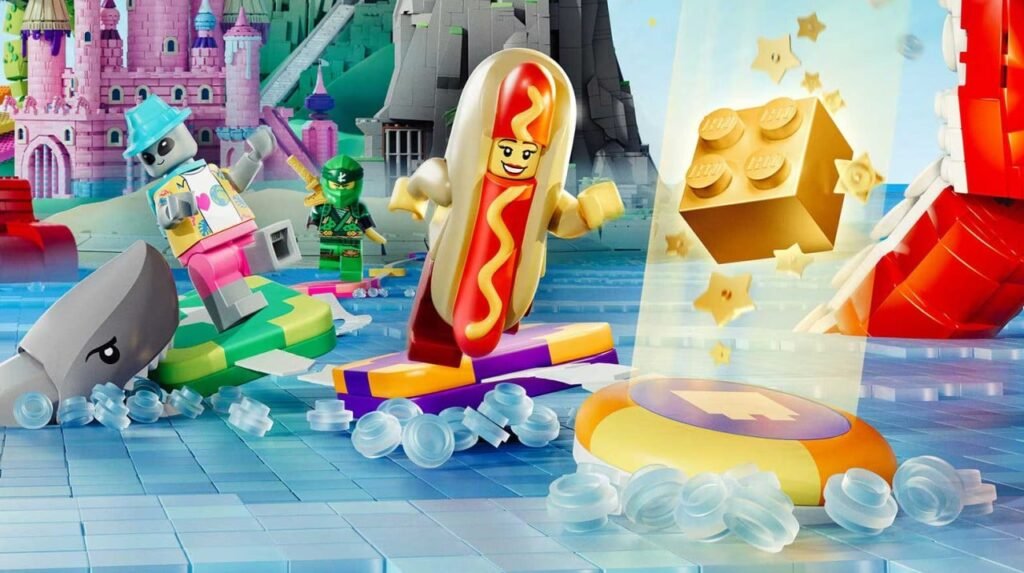

Like a beastly kraken ensnaring a ship in its countless tentacles, it’s getting harder to find a portion of the gaming landscape that Lego hasn’t infiltrated. From action-adventure offerings like LEGO Batman: Legacy of the Dark Knight to racing with LEGO 2K Drive and puzzle-platforming with LEGO Voyagers, the monolithic toy brick brand has demonstrated that it can be adapted to just about any genre out there — so perhaps it’s not too shocking that it would eventually try its hand at the multiplayer party game scene with the aptly-named LEGO Party.
Lego Party opts for a virtual board-game format, allowing up to four players to compete in minigames and take turns traversing a handful of perilous and prize-filled maps in hopes of collecting enough Golden Bricks to be crowned the victor. The game features a range of — okay, okay, I managed to get at least 100 words into this review without mentioning Mario Party. Surely that has to count for something, right?

Yes, Lego Party is unabashedly a Mario Party ‘clone’ from SMG Studio (Death Squared, Moving Out), borrowing its structure, gameplay loop, and various systems wholesale from Nintendo’s long-running series. If you have ever spent any amount of time in your life mashing buttons in minigames till your thumbs are sore or cursing out your friends for nabbing one of your precious Power Stars, this will be an immediately familiar offering.
That similarity is comforting in a sense, but it also means that Lego Party lives and dies by how it stacks up against its clear source of inspiration. “You come at the king, you best not miss,” or so the saying goes. Fortunately, Lego Party holds its own and then some, impressively mirroring classic Mario Party fun while introducing enough of its own tweaks to stand as a genre contemporary, rather than a budget knock-off.
Lego Party’s Challenge Zone mode includes four distinct game boards to compete in. That number may feel sparse (and I certainly wouldn’t have turned my nose up at another zone or two), but the game makes up for it by giving each one a slew of distinctive mechanics and visuals that make them all feel like unique, well-crafted experiences in their own right.

Each board is dynamic, with changes to the map and additional mechanics emerging as each game progresses. You may start a round in the Space Zone teleporting between interstellar bases to exchange Lego Studs for Golden Bricks, but by the end, you’ll be hopping through special pathways to blast down the health bar of an attacking alien.
Of course, boards are only one-half of the holy formula. True to convention, Lego Party punctuates the turn-based action with a slew of minigames that see you doing everything from driving a dirt bike over rocky hills to throwing ninja stars with pinpoint precision. They may not be quite as tightly crafted as the offerings over in the Mushroom Kingdom, but the vast majority of these games are a blast to play with friends.
There are plenty of new spins on classic ideas along with a good few original concepts that rival some of Nintendo’s finest. Many minigames also feature multiple rounds, avoiding that occasional feeling during a Mario Party session that the most fun ones are over before they really get started. Just don’t expect any 1v3 madness here — that style is disappointingly absent, leaving free-for-all and 2v2 as the only game types on tap.

Playing boards and minigames in Lego Party is generally just as entertaining as you’d hope, though I would have appreciated a bit more fanfare in the proceedings. Visual and audio cues for pivotal actions like grabbing a Golden Brick or winning a minigame don’t have much oomph behind them, which leaves these moments feeling less weighty and consequential than they should.
Lego Party includes a number of small tweaks to its borrowed formula, with one change in particular that stands out: minigames occur at the start of each round rather than the end, and each player’s placement decides their turn order for that round.
It may sound like an arbitrary shift, but this little modification keeps the progression of each round feeling dynamic, lends an additional urgency to minigame performance, and makes situations like when two players are racing for the same Golden Brick far more of a nailbiter. While Lego Party does a remarkable job of recreating Mario Party’s game loop, I would have appreciated more thoughtful alterations in this vein to give the former more of its own flavour.

SMG also places a refreshing (and fitting) emphasis on customisability. Boards often give you a choice on which event spaces you’d like to build in specific areas of the map, adding an element of variety to each playthrough. You also have a solid variety of options to tweak the game rules to your liking, from randomising the cost of Golden Bricks to enabling a special format where each board space changes every time someone walks over it.
You can also fully customise your minifigure avatar with a ton of unlockable parts and preset outfits. Lego devotees will no doubt get a kick out of seeing some of the iconic figures and themes from the toy franchise’s history represented here. You’d better believe my friends got to work on unlocking the Bionicle minifigure as soon as possible.
Speaking of features that are purely there for the sake of fun, Lego Party includes a voice-acted ‘live commentary’ system from two in-game hosts. These characters offer colour commentary throughout the entirety of the experience, providing quippy observations about whatever’s happening on screen. I fully expected to tire of this constant narration, but I ended up impressed by the sheer quantity of dialogue for niche scenarios and charmed by just how funny the writing could get. I genuinely laughed at a few of the lines here. Of course, the game includes an on-off toggle if the chatter isn’t your bag.

There are a couple of additional modes, including Minigame Rush with themed sets of minigames to compete through, a minigame free play option, and a single player-only mode that lets you chase high scores on a few specific minigames. As is often the case for games of its ilk, though, the big draw of Lego Party squarely remains playing through full matches with other people. Thankfully, it fully supports online play with friends in case you can’t gather your pals onto the couch.
It’s worth mentioning here that Lego Party is quite pleasant to look at, too, with boards and minigames holding true to that ‘everything is made of real Lego pieces’ aesthetic that consistently makes games from the franchise such a visual treat.
It also runs nicely on Switch 2, thanks to a free Switch 2 Edition upgrade that ups the resolution and frame rate from the base release. Visuals are crisp, and though I noticed some minor jitters during a cutscene or two, gameplay remains consistently smooth.
For a lesser game, hewing too closely to the formula established by other beloved giants of the genre often shines a spotlight on all the ways it pales in comparison. Lego Party tempts fate by being just a few bricks removed from the exact structure of classic Mario Party, but actually walks the walk with its own high-quality supply of intricate boards and delightfully wacky minigames.
It also adds some smart features and twists of its own, to the point where I reckon it could soar to even greater heights if it were a degree less beholden to its clear primary influence. Regardless, Lego Party offers one heck of a good time and deserves a spot in your multiplayer party-game rotation.