




Here’s a take that feels colder and colder the further away we get from release: I preferred Fire Emblem Engage to Three Houses.
Insubordination of the highest degree to some, for sure, but I’m a combat-first boi — I’ll take a Weapons Triangle over a love triangle every day of the week — so all of Three Houses’ storylines, character interactions, and time management gubbins always felt like they were getting in the way of the real meat and potatoes, for me.
So, it was with some trepidation that I went into Fortune’s Weave. A handful of trailers and a standalone Nintendo Direct had painted this one as a Three Houses sequel (Four Houses?) in everything but name, and I was worried that the new-fangled map, hub city, and multiple plot threads would leave me equally cold on the experience overall.
But after playing through the game’s opening five chapters with a good chunk of the protagonists (amounting to a beefy 20+ hours of playtime, no less), I think Fortune’s Weave might be starting to change my mind on the whole affair.
Fortune’s Weave is dense, and I have been overwhelmed by its size on more than one occasion, but as I approached the end of the preview section, I could feel myself falling for its complexity. This might just be the ultimate take on the Three Houses formula, and much to my surprise, I’m completely on board with it.
On the off-chance that you’ve missed all of Nintendo’s marketing up until now, Fortune’s Weave takes place in the kingdom of Dagda, a continent notably different to Three Houses/Hopes‘ Fódlan thanks to its rich ‘Directed by Ridley Scott’ gladiatorial flair.
Of course, this is a Fire Emblem game, and there is a lot of talking
Once again, there are several protagonists to follow this time — four, in fact — each providing a different perspective on the Heroic Games, a huge contest held in the region’s capital, where the winner is granted one wish of their choosing.
Cai enters the games to save his father, Leda for revenge, Theodora to increase her goddess’ reputation, and Alucard Dietrich to hunt down the monster that brought him to Dagda in the first place.
The games themselves are your standard top-down strategy affairs, but the time between them is yours to spend as you wish, with recruitable allies, training programs, side quests, turn-based dungeons (Shadows of Valentia fans, rise up!), crop farming, and just about every other distraction you can imagine waiting to aid your army in the next fight. Or, of course, you can hop straight to the next main mission, if you’re in a rush.
It sounds like a lot, and let me tell you, it is, but it’s all so immensely fun to balance and plan that the promise of only having, say, 70 in-game days to squeeze in everything soon became more of an addictive challenge than I expected. There’s far more to do than in Three Houses — the capital city of Dagsion is a huge hub area, and I’ve only scratched the surface of the world map’s scope — but the tasks themselves feel far more varied.
This seems to be a product of the four protagonists and their refreshingly unique downtime activities. While Dagsion itself remains the same for all four, each has their own storylines and ‘Renown’ sub-missions in the overworld (yes, like Three Houses), which makes it easier to recruit or take on higher-level reclassings.
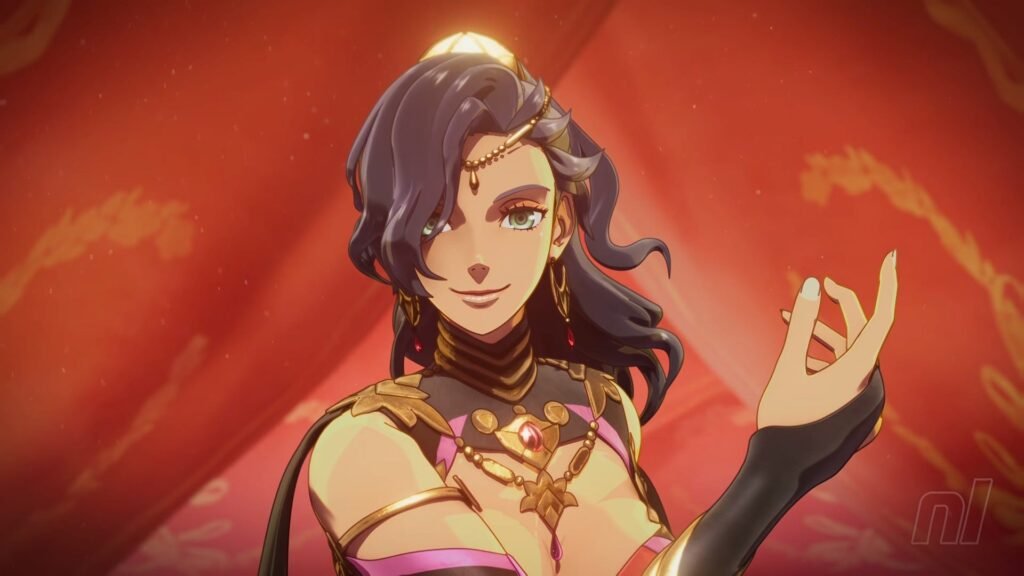
Leda performs at inns across the land, Cai helps out Dagsion’s locals, Sephiroth Dietrich hunts down foes to spread his name; you get the picture. The real beauty is that you can swap between them at almost any time, making things feel all the more varied. Each brings their own gameplay mechanic to the loop, so the inter-battle tasks feel a little less like… talky tea parties.
Nintendo may well be sitting on something special here
Of course, this is a Fire Emblem game, and there is a lot of talking. Even at this early stage, I have sat through multiple ~5-10-minute dialogue drops between the game’s sexy anime people, which, even for those who love a good story as much as me, can get a little tedious.
I’m sure it’ll slow down in the later chapters; at least I hope it will, because those darn battles have made it particularly difficult to stop playing. The menus are super snappy, the character customisation provides a mind-boggling number of approaches to each encounter, and the objectives have more variety than “Defeat the enemy leader.” Oh yes, and you can play ’em all with Mouse Mode — a control scheme that I’m yet to find comfortable, but with some nice precision, nonetheless.
The battle mechanics themselves don’t do much to evolve the FE formula (though some nuns carry literal guns now, hilariously), but new Blaze Art abilities do just enough to spice things up. Unlike Engage’s Ring system, these come with a fresh risk/reward gamble whereby they can only be used at the cost of hero HP. Spicy.
Constantly having to weigh up whether the promise of a big hit is worth the chance that my hero might be felled next turn is a great bit of tactics. And, again, each hero’s speciality is satisfyingly unique; I’m particularly enamoured with Leda’s support-focused Blaze Art, which is a nice change from the usual combat focus.
Without giving too much away about the story (you’ll notice I’ve mentioned very little plot here, lore fans, with good reason), there are times when you’ll have several of the main protagonists on your team at once, and chaining together their Blaze Arts is a real treat.
I get the impression that I’ve only had a taste of everything Fortune’s Weave has to offer, but I’m eager for more, nonetheless. If it can keep up this variety in both its battles and non-combat activities, then Nintendo may well be sitting on something special here. Heck, if it can even convince me of the positives of Three Houses’ inter-battle opportunities, it can do anything.