




People are usually surprised when they hear I’ve managed to stay close with my childhood friends after living overseas for the better part of two decades. I don’t think it’s particularly surprising. But perhaps for most people, great distances and long periods of time without meeting up almost inevitably lead to social bonds fizzling and eventually giving out.
Losing touch was always something I feared. Within my friend group, though, video calling and online co-op gaming over the years have been hugely important in closing the distance. In all that time, no other form of virtual gathering has hit quite like Big Walk, the recently released open-world co-op puzzler from Australian developer House House.
But before I get into my spiel about how good the game is, I want to spare a thought for the many who can relate to the statement ‘That looks like great fun, but I have no friends to play it with.’ If you’re in that boat, please, cast a wide net among the people you know to gauge their interest in a playthrough, because Big Walk truly has the sauce to turn acquaintances into friends.
Sure, you could jump into a game with randoms from Discord, but my hunch is that playing with someone you have a real-world connection with will pay higher dividends. With people you’re still getting to know, solving the game’s quirky communication puzzles while exploring its scenic bushlands and just chilling out works almost like an accelerant for bonding.
With people you already know well who are coming back for repeated sessions, Big Walk comes to feel like a genuine third space and shared hangout spot. It didn’t matter that I was on a Switch 2 in Singapore while my buddy was sitting in Los Angeles on a PlayStation 5. The cross-platform experience was essentially seamless for us from start to finish.
For Nintendo fans, Big Walk is going to resonate in a big way. House House is truly skilled in teaching players through play, not exposition, in the same way that World 1-1 in Super Mario Bros. acts as an ‘invisible tutorial’. The opening area lets you discover the vocabulary of its puzzles for yourself, then gradually asks you to apply it in increasingly novel ways.
Once its world opens up, there’s more than a little Breath of the Wild in the pleasure of organically discovering places during your trek to landmarks you spot on the horizon, and in tackling puzzles that trust you to arrive at emergent solutions in your own ways. Both games likewise share a reverence for the great outdoors and the meditative pull of nature.
Big Walk truly has the sauce to turn acquaintances into friends.
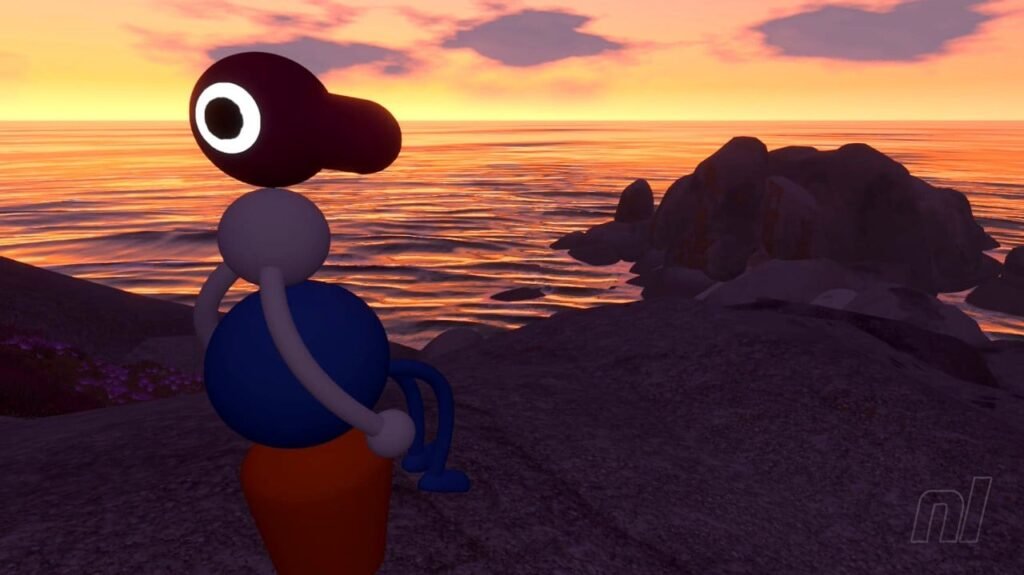
House House implemented some of Nintendo’s best design ideas as only the deftest students could and created something distinctly its own. Big Walk looks, sounds and feels utterly distinct. I love the aesthetic juxtaposition of natural terrain with its modernist architecture, bright colours, whimsical gourds, and glowing balls, and the toy-like quality of its objects.
Its eclectic soundtrack, with hypnotic ambience and world music influences, pairs perfectly with Big Walk’s gameplay as you unlock new tracks by activating the broadcasting stations you stumble upon. Every play session brought ‘aha!’ moments of discovery and delight as we found new gadgets, fired up the game’s transportation systems, and delved into hidden spaces.
Many puzzles function as little Rorschach tests. Two friends can interpret things like symbols in wildly different ways, and it reveals how people think. I was never bored replaying areas of the game with different friends because seeing them conjure up completely different solutions to puzzles I had solved earlier was just fascinating.
Some of the best moments in Big Walk happen when you’re just casually chatting, catching up and joking around during hikes between locations. It’s an experience deliberately designed around unhurried moments. You and your friends can pull up a couple of folding chairs on the beach, plug the in-game radio into giant speakers and banter the day away.
One of its most charming puzzles even has you sit together in a room and chat until a timer goes off, with conversation itself effectively becoming the objective. Fittingly, that same room now hosts Big Talk, a new player-created gaming podcast. The fact that players are using the game this way speaks volumes about how successfully it functions as a shared social space.
I wouldn’t be surprised if Big Walk proves as influential for co-op game design as Breath of the Wild has been for open worlds, particularly in its audio design and the many ways its proximity chat is treated as a game mechanic. The game has a rare sense of immersive physicality that makes you instinctively turn and actually face whoever you’re talking to.
House House deserves enormous credit for taking such a huge creative leap. Its previous game, 2019’s critically acclaimed Untitled Goose Game, was ingenious and charming, but comparatively modest in scope. Following it with something as expansive and technically ambitious was a genuine swing for the fences.
Big Walk gave my friends and me somewhere virtual to go together, and spending so much time there has left me eager for the real thing. I can think of no better way to bring the experience full circle than rounding up my friends and heading into the bush for a big walk of our own. Perhaps that’s exactly what the developers want us to do.