


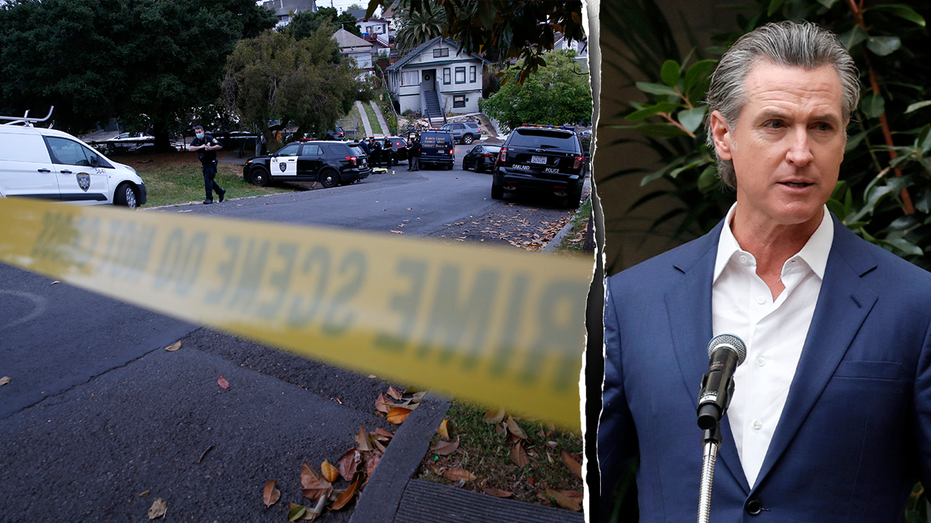
Gov. Gavin Newsom is taking fire from an unlikely critic in his own political backyard.
With roughly a month left for California lawmakers to send legislation to the governor’s desk, Sacramento County Sheriff Jim Cooper is accusing Sacramento of putting criminals ahead of victims, failing to fully implement voter-approved crime reforms and embracing policies that weaken accountability.
Cooper unloaded on California’s crime policies during a recent interview with KCRA 3’s California Politics 360, where he argued California leaders have not done enough to address crime despite voters demanding tougher consequences for repeat offenders.
NEW YORK BILLS COULD ABOLISH LIFE WITHOUT PAROLE FOR SERIAL KILLERS AND COP KILLERS, CRITICS WARN
When asked how he would grade Newsom and the Legislature’s response to crime, Cooper didn’t hesitate.
“Not enough. Not enough,” Cooper said. “It’s just frustrating that people are hesitant to do anything.”
🚨 Know something we should investigate?
📩 stepheny.price@fox.com
📸 IG: @fndstephprice
🎥 X: @StephenyPrice
Your tip could lead to our next story.
Although California recently announced its lowest homicide rate in nearly six decades, Cooper argued the numbers don’t tell the whole story, saying victims continue to pay the price for policies that emphasize diversion and early release over accountability.
A major focus of Cooper’s criticism was Proposition 36, the voter-approved initiative that passed in 2024 with nearly 70% support statewide and in all 58 counties.
The measure increased penalties for repeat retail theft and certain drug crimes while allowing eligible offenders to have felony charges dismissed after completing court-ordered treatment.
“Not one statewide official supported it. And that’s troubling,” Cooper said during the interview.
REPORTER’S NOTEBOOK: CHICAGO COP KILLED AFTER SUSPECT RELEASED UNDER SAFE-T ACT
While Cooper said the law is already showing results, pointing to retailers reporting declines in theft, he argued Sacramento has failed to provide the funding needed to make the initiative successful.
“The issue is no funding, no funding came with it,” he said. “It is working. But without funding, it doesn’t go anywhere.”
State leaders have said this year’s budget includes $375 million to help implement Proposition 36, though KCRA reported budget documents show $50 million is specifically directed toward Proposition 36-related court and pretrial services.
Cooper also blasted California’s expanding mental health diversion system, warning proposals to make more theft offenses eligible for diversion would undermine the very initiative voters overwhelmingly approved.
“It would water it down,” Cooper said, adding that some lawmakers “don’t want anybody held accountable.”
Although Newsom recently signed legislation adding new guardrails to the diversion program, Cooper argued it still allows offenders accused of shocking crimes to avoid traditional prosecution.
“Some crimes are so shocking … you shouldn’t be eligible for mental health diversion,” he said, pointing to offenses including felony child abuse and crimes involving sexually violent predators.
The sheriff also renewed his criticism of California’s domestic violence laws, arguing the state still refuses to classify many felony domestic violence offenses as violent felonies despite the devastating injuries suffered by victims.
“Domestic violence goes on every day. Doesn’t matter if you’re rich or poor. Happens in every neighborhood. We have to treat it seriously,” he said.
When asked why lawmakers continue opposing legislation to classify domestic violence as a violent felony, Cooper replied bluntly.
“They have no argument. They just vote against it,” he said.
The criticism is consistent with Cooper’s recent public campaign against California’s criminal justice policies.
In recent months, the sheriff has argued that “domestic violence is one of the most personal and devastating forms of violence, but California law can still classify felony domestic violence as ‘non-violent.’ That needs to change.”
He has also repeatedly criticized lawmakers over Proposition 36, accusing them of ignoring nearly 70% of California voters by advancing diversion programs for retail theft offenders instead of fully funding and implementing the initiative.
“Californians were fed up with retail theft and passed Prop. 36 in all 58 counties,” Cooper wrote in a recent statement, arguing lawmakers instead responded by proposing new diversion programs that allow some offenders to avoid convictions.
Cooper has also emerged as one of the state’s most vocal critics of California’s youth offender and elderly parole policies, arguing they have systematically reduced accountability for violent offenders.
After five young suspects were charged in the fatal shooting of an 18-year-old Sacramento State student who was struck while riding in the back of an Uber, Cooper warned that California law often places greater emphasis on the offender’s age than the severity of the crime.
He argued that changes stemming from Proposition 57, youth offender parole laws and elderly parole policies have created a system where serious offenders can receive earlier release based on age rather than the harm inflicted on victims.
“The law places limits on how long offenders can be held but takes zero ownership of the damage done to victims and their families,” Cooper wrote. “This is not a system failing. It is a system operating exactly as designed.”
Cooper has also criticized California’s compassionate release program after a convicted attempted cop killer, who had been released early after shooting at Stockton police officers, was later arrested on new weapons charges.
Following that arrest, Cooper accused lawmakers of ignoring warnings from prosecutors and law enforcement about expanding release standards.
“The experts in the room saw the risks and they were ignored,” he wrote. “This is what happens when ideology outweighs public safety.”
Cooper closed his latest interview with a message he says Sacramento has lost sight of.
“We’ve got to get back to the victims.”
Fox News Digital has reached out to the Sacramento County Sheriff’s Office and Gov. Gavin Newsom’s office for comment.