





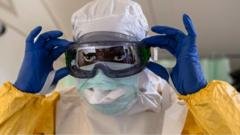
 Image source, AFP via Getty Images
Kenya has confirmed a second case of Ebola, 10 days after a businessman died of the virus after he had travelled to the East African nation from the Democratic Republic of Congo.
The new patient, a 39-year-old man, is a close relative of the first case and was already in quarantine when he fell ill on Tuesday, Kenya’s health ministry says.
The incubation period for Ebola ranges from two to 21 days, meaning those exposed to the virus may not become ill for several weeks.
Detecting his illness early had improved his chances of recovery and limited the chance of him passing the virus on to others, the ministry said, as it urged the public to “stay calm but vigilant”.
“Both cases are linked, and there is no evidence of spread in the wider community,” the ministry said.
“Kenya remains open, with no restrictions on travel, trade or public gatherings”, it added.
The 40-year-old Kenyan man who died on 5 October was diagnosed with Ebola shortly after being admitted to hospital in the capital, Nairobi.
A relative had taken him there shortly after picking him up at the airport. He had travelled from DR Congo, through Uganda to Kenya without his illness being detected.
Since his death, officials had determined that he had been in contact with 128 people – and since Tuesday 113 of them had been found, the health ministry said.
Of these, 108 were in quarantine in Kenya and tracing of the remaining 15 continued, it said.
More than 4,000 people have died from Ebola in DR Congo this year, in what is the second most deadly known outbreak to date.
The Ebola virus spreads through contact with infected bodily fluids such as blood or vomit.
“Anyone with fever, unusual tiredness, muscle or joint pains, vomiting, diarrhoea or unexplained bleeding should seek care promptly at the nearest health facility,” Kenya’s health ministry said.
The current outbreak in DR Congo, which began in May, has been caused by the Bundibugyo species of Ebola, which is relatively rare, with no approved vaccine or treatment – though trials are under way.
Shortly after DR Congo declared an outbreak of Ebola in May, it was also reported in Uganda, where two people died.
However, the World Health Organization (WHO) declared that county free of the disease in August.
The Africa Centres for Disease Control and Prevention, the continent’s leading public health agency, has reconstructed the Kenyan patient’s movements for the six weeks leading up to his death.
It revealed that he first started feeling unwell in DR Congo on 15 September – and showed how several opportunities to detect the infection were missed, including during several visits to Congolese medical facilities.
He then managed to travel through Uganda to Kenya – and was again not detected at airports screenings.
Health experts say it highlights the limitations of relying on temperature checks and self-declarations.
More from the BBC on the Ebola outbreak:

Go to BBCAfrica.com, external for more news from the African continent.
Follow us on Twitter @BBCAfrica, external, on Facebook at BBC Africa, external or on Instagram at bbcafrica, external
Related topics
BBC Africa podcasts