
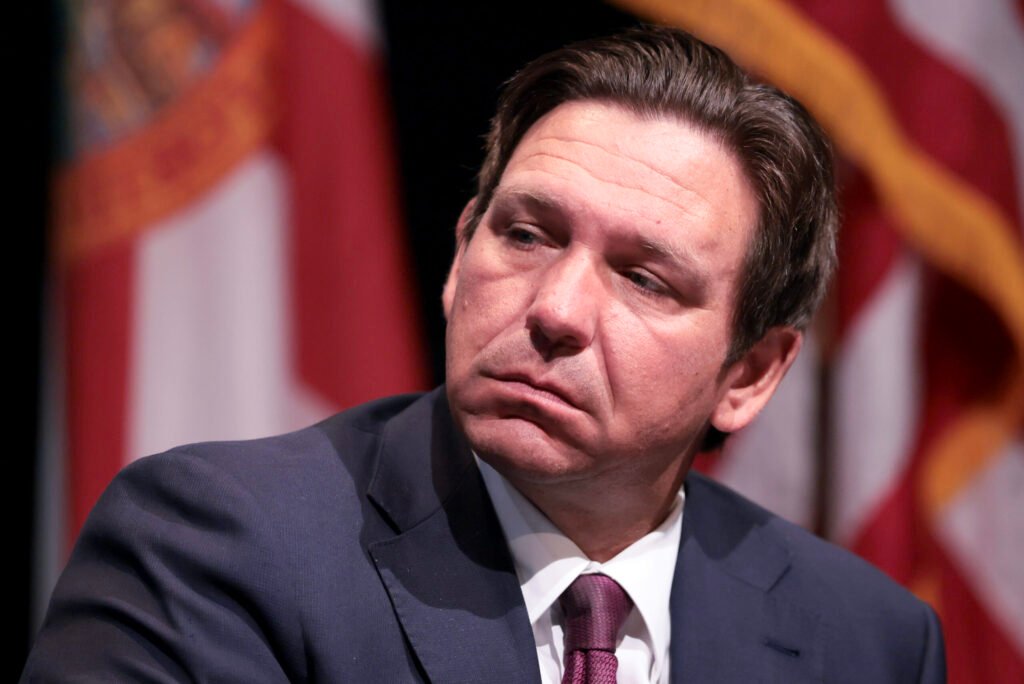
How Ron DeSantis Lost Control of His Own Succession
Florida is redder than ever, but what comes next won’t be for the governor to decide.
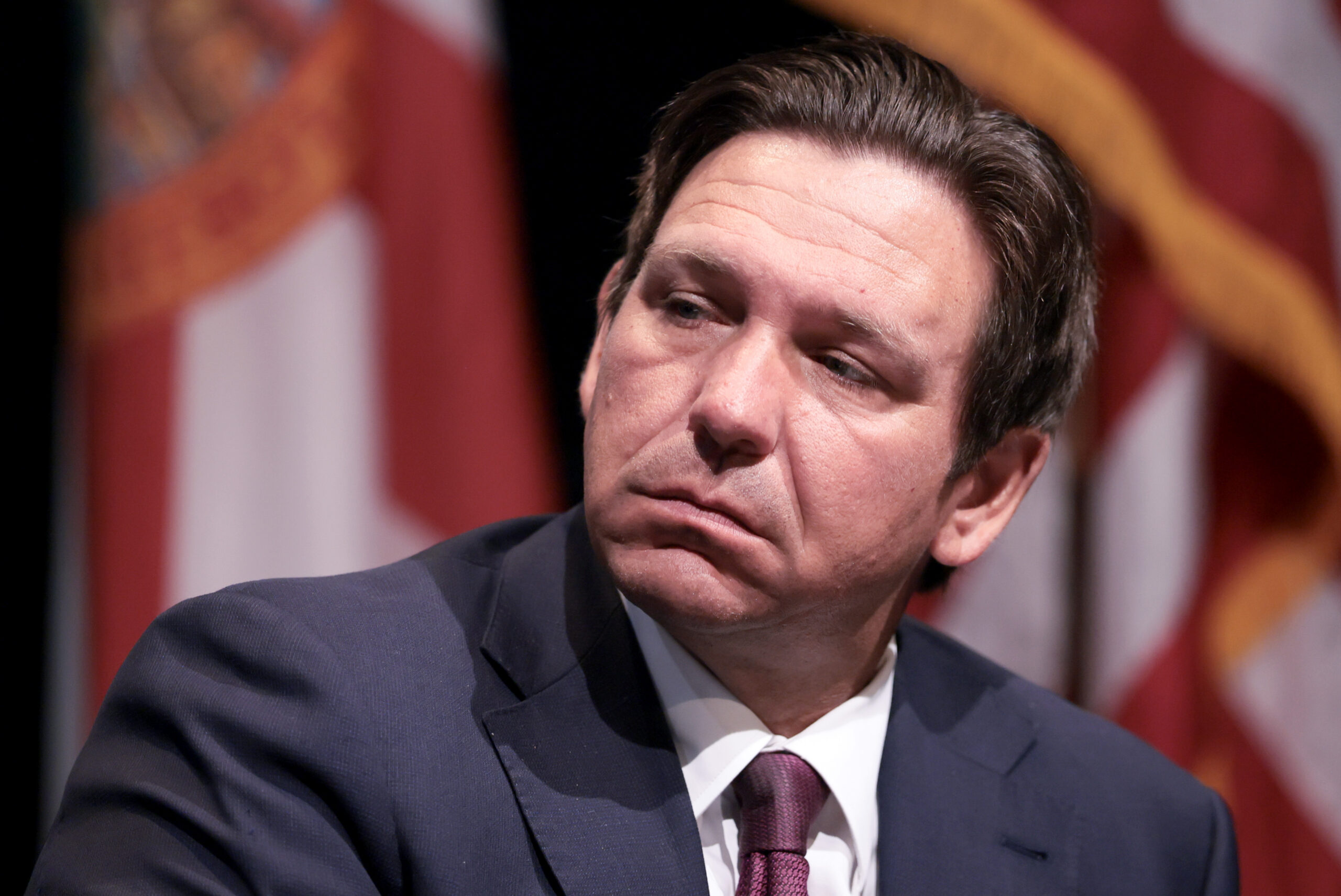
There was a moment, not too long ago now, when Florida Gov. Ron DeSantis was lord of his own private, eternal Republican fiefdom. In the era of Covid, which lasted nearly half a decade, DeSantis made Florida into his own image, a rebellious enclave on the outskirts of an institutionalized consensus that required forced masking, forced lockdowns, and the promise of a mandatory vaccine that would lead America and the rest of the world from the darkness. As a reward for his temerity, DeSantis was made king of the Sunshine State, an honorary position that he would later learn failed to earn the sort of national plaudits he so openly desired.
Despite landing on the receiving end of a devastating knockout in his headline brawl against then-candidate Donald J. Trump in the runup to the 2024 presidential election, DeSantis has continued to govern Florida in a manner that makes him a prince among paupers, the sort of streamlined, professional, all-business operator that few Republican politicians are capable of imitating. But even great empires have expiration dates, and DeSantis, who will be out of a job come January, is in the undesirable position of having built an empire without the reward of selecting its successor.
For a time, it appeared that Casey DeSantis, Ron’s wife and the first lady of Florida, possessed real momentum and perhaps an opportunity to solidify herself as heir to the throne. Though Ron was outwardly hesitant, and though Casey styled herself as a reluctant prospect, the wheels were already turning in the background as Republican donors in Palm Beach County began openly pushing her to run in early 2025. The momentum collapsed quickly, however, after Hope Florida, a program Casey created to wean people off government assistance by connecting them to faith-based organizations, came under heavy scrutiny.
Hope Florida had become Casey’s calling card of sorts. Casey distributed checks with her own signature across the state as Ron helped push forward the initiative. When the initiative’s foundation was accused of illegally diverting $10 million from a state Medicaid settlement by routing the money through two nonprofit intermediaries and into a political committee that successfully campaigned to defeat a 2024 ballot measure legalizing recreational marijuana in Florida, Casey’s political future darkened.
“I don’t know if she committed any crimes, but she certainly looks incompetent at running a small charitable organization,” said Republican state Rep. Alex Andrade, chairman of the subcommittee that investigated the scandal.
As Casey’s ambitions evaporated in real time, along came Trump, the sort of political beast who never allows a challenge to go unpunished. On February 20, 2025, barely a year after DeSantis had the audacity to run against him for the Republican presidential nomination, the president took to Truth Social to anoint a successor for the throne DeSantis had spent years building. Trump called Rep. Byron Donalds a “TOTAL WINNER” and left no doubt about his support for him. “Byron Donalds would be a truly Great and Powerful Governor for Florida and, should he decide to run, will have my Complete and Total Endorsement. RUN, BYRON, RUN!”
Though Donalds earned the backing of the Republican Party’s kingmaker, he is unlikely to earn the same backing from the man who built Florida into the kingdom Donalds now seeks to inherit. Though DeSantis and Donalds certainly agree on many issues, including the special relationship between the United States and Israel, there is real animosity between the two men that mostly centers on Donalds’ refusal to endorse DeSantis for president during the 2024 presidential election.
On top of that, Donalds, the sole black member of Florida’s congressional delegation, was a vocal critic of language in Florida’s middle school black history standards that suggested slaves “developed skills which, in some instances, could be applied for their personal benefit.” Donalds rejected the notion that slavery carried any personal benefit for the enslaved. DeSantis hit back hard, questioning Donalds’ conservative bona fides and framing his criticism as an attempt to appeal to the liberal media class. “Florida isn’t going to hide the truth for political convenience,” DeSantis’s then-press secretary Jeremy Redfern posted on social media.
But perhaps more than any singular policy division, the thing that has led DeSantis to stop short of an endorsement in the 2026 Florida governor’s race is likely the sort of personal politics that have marred his otherwise sterling political career. “This is a relationship business,” Republican political consultant Jamie Miller told CBS in a piece that highlighted the governor’s failure to make significant inroads with state legislators. “He is not good at the relationship side.” DeSantis’s reluctance to endorse his own lieutenant governor Jay Collins runs deeper than mere interpersonal friction. To back Collins openly is to declare war on Trump, and DeSantis, who is widely believed to be auditioning for a cabinet appointment or perhaps another presidential run in 2028, cannot afford that fight.
And then there’s James Fishback. The 30-year-old CEO of investment firm Azoria earned national attention as the architect behind the idea of sending $5,000 DOGE checks directly to American taxpayers, a proposal that briefly captured the public imagination and the attention of both Trump and Elon Musk. That moment of viral notoriety was enough to convince Fishback that Florida’s governorship was within reach, and he announced his candidacy in November 2025. Since then, Fishback has fashioned himself as the leading political provocateur on the groyper right, openly courting the more nationalist corners of the internet in an attempt to manufacture a leaner, sharper, and edgier right-wing movement that refuses to apologize for its openly aggressive and often transgressive ideology.
For DeSantis, Fishback represents something between a nuisance and a useful gadfly. Fishback has hammered Donalds relentlessly over his congressional record and his support for Israel, doing the kind of damage to the frontrunner that DeSantis himself cannot afford to do publicly. The governor has kept his distance from Fishback’s more incendiary commentary, calling Fishback’s decision to compare Donalds to a slave “gross” and having “no place in Republican politics.” But DeSantis has also joined calls for a debate that would force Donalds onto the same stage as his loudest critic, a debate the Trump-backed frontrunner has so far refused to participate in. It is, in the end, a tidy arrangement for a governor with nowhere left to turn.
It’s difficult to imagine a reality in which Donalds doesn’t waltz into the governor’s mansion in Tallahassee early next year. Collins and Fishback aren’t close to Donalds in the polls, and even if Donalds agrees to allow Fishback the opportunity to smear the congressman as a “slave to AIPAC” on the debate stage, the chances of Fishback posing any real, credible threat to Donalds’ ascension are close to zero. Fishback can generate millions of clicks, but there’s a reason Donalds has a 94 percent chance to win the nomination according to the prediction market Polymarket. As we learned with Rep. Thomas Massie’s GOP primary loss in Kentucky, Twitter is not real life, and the Republican Party, for better or worse, runs directly through Donald Trump.
In Donalds, Trump earns a significant ally in one of America’s most solidly-red states. And by staying out of the race, DeSantis keeps alive his reported desire to either serve in Trump’s cabinet or as a member of the U.S. Supreme Court, should a spot open up. Though DeSantis serving in Trump’s cabinet might appear an implausible outcome, the president has shown the flexibility to reincorporate former adversaries into his circle, such as current Secretary of State Marco Rubio, whom Trump once openly derided as “Little Marco.”
Should no opportunities emerge at the federal level during Trump’s presidency, DeSantis still retains his status as one of the finest Republican governors of the modern age. It’s a distinction that should place him in favorable territory if he decides to pursue the Senate or the Oval Office in years to come.
The post How Ron DeSantis Lost Control of His Own Succession appeared first on The American Conservative.