


As America inches closer to the big 2-5-0, Americans are contemplating how to mark this moment.
This July Fourth will celebrate a quarter millennium since the Founding Fathers signed the Declaration of Independence. America’s birthday is always celebrated with fireworks, parades and flag-flying pomp. Under President Donald Trump, the nation’s 250th also includes cage matches, a street race through Washington, a Christian jubilee and a “Trump rally.”
Smaller celebrations, too, are taking shape across the country, as documented by Judy Woodruff and the “America at a Crossroads” team.
PBS News asked you to share more from your own lives and communities, as well. We received dozens of responses on how you’re preparing for and thinking about the day.
For some, it’s a weighty milestone that stirs greater reflection about the ways the nation could learn from its past.
“We’ve certainly accomplished a lot,” said Richie Comia, who lives in Virginia Beach, Virginia. “This country has a lot to be proud of, but I think a large part of the country won’t acknowledge what the cost of that was.”
Comia, 58, is the son of Filipino immigrants. His father served in the U.S. Navy at a time when Filipino recruits in the branch weren’t given the same rank opportunities as their American counterparts and had to “start lower down on the rung than everybody else,” he said.
“My parents taught me when I was really young that we’ll never be 100% accepted in this country because we’re not white, we’re different,” he added.
Comia plans to cook some burgers on his George Foreman grill on July Fourth, but not much more. He said Americans need to consider, not dismiss, the full breadth of the country’s history, including how chattel slavery remained in place for many years after America’s founding.
Besides America’s 250th, Cindy Orban has another number in mind: 365.
She lives in Talbot County, Maryland, the birthplace of abolitionist Frederick Douglass that is celebrating its 365th year. As a member of the county’s Talbot250 Commission, Orban is also focused on sharing stories of people and events that occurred long before – sometimes thousands of years before – the founding of America.
“There is much of our local history, state history — and certainly national history — that goes well beyond these 250 years since the signing of the Declaration of Independence,” the 74-year-old said.
Located on Maryland’s Eastern Shore, Talbot County is a waterfront community with deep agricultural roots. Farmers have discovered Native American artifacts while tilling their fields. As part of its programming this year, the commission partnered with the county’s historical society to host exhibitors and speakers, including those from the Pocomoke Nation, to share the Indigenous stories and history embedded in these objects. Other endeavors include planned podcast episodes about the county’s history of segregation and civil rights, and the lives of Black watermen along the shores.
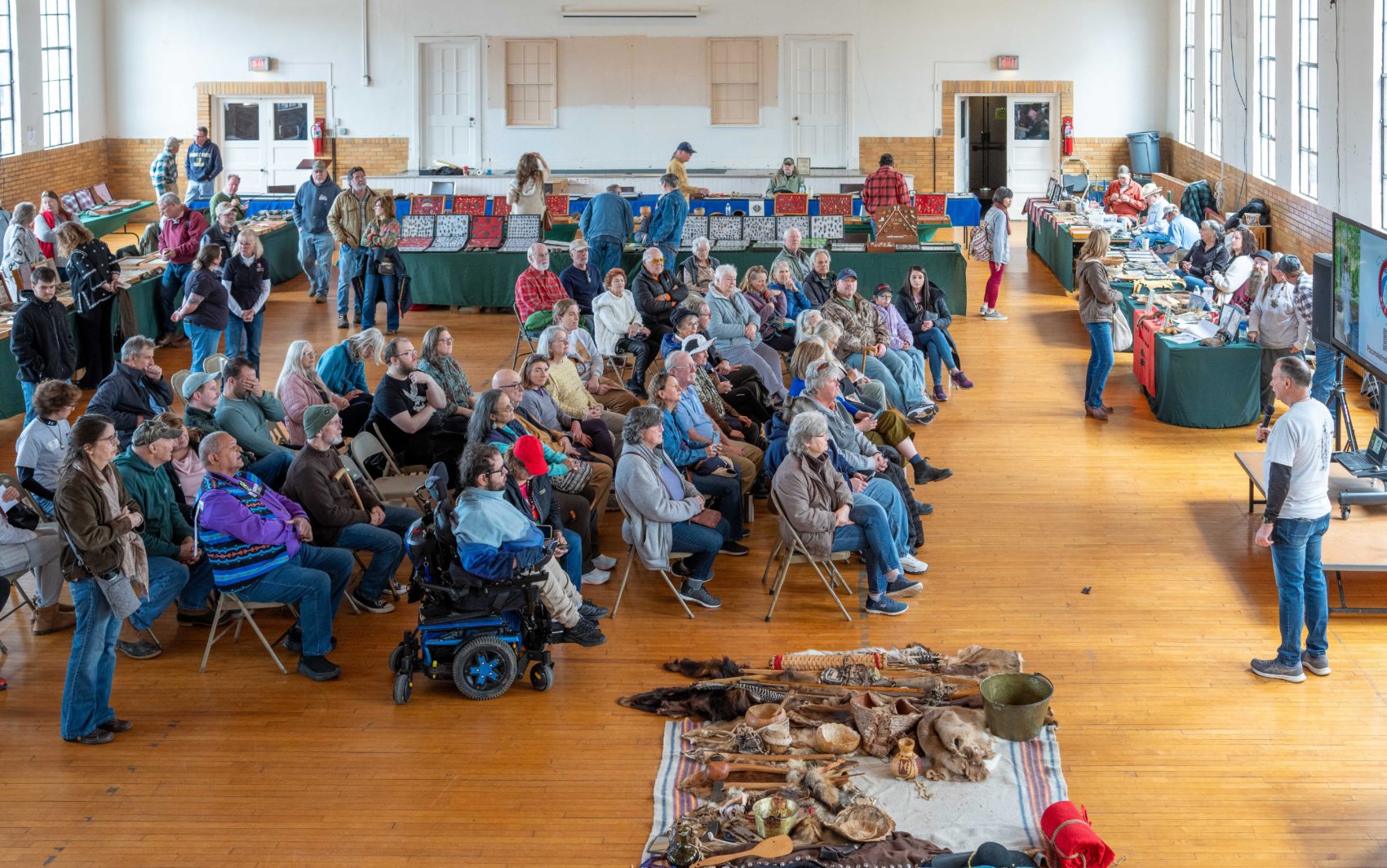
Dozens of people gather for a presentation during Talbot County’s Native American Heritage and Artifact Day, held in February. Photo by Ted Mueller Photography
The goal, Orban said, is to prop up communities “whose stories are not often known and told,” and hopefully, with that knowledge, “leave something lasting.”
“It’s not like, ‘250’s over. It’s done,'” said Orban, who was a school librarian for 33 years. “We really need to be able to leave things for the next 10 years, for the next generation, for our grandchildren.”
For Madeline Troche-Rodriguez, 250 is nowhere near as significant a number as 128, or the number of years ago the U.S. invaded and took control of Puerto Rico.
Troche-Rodriguez, who has called Chicago home since 1996, has little desire to celebrate America’s birthday.
“I’m a colonial subject no matter how long I’ve lived in the United States,” the 55-year-old said. “It seems a little contradictory and hypocritical to be here and celebrate the United States’ independence when my country hasn’t been independent.”
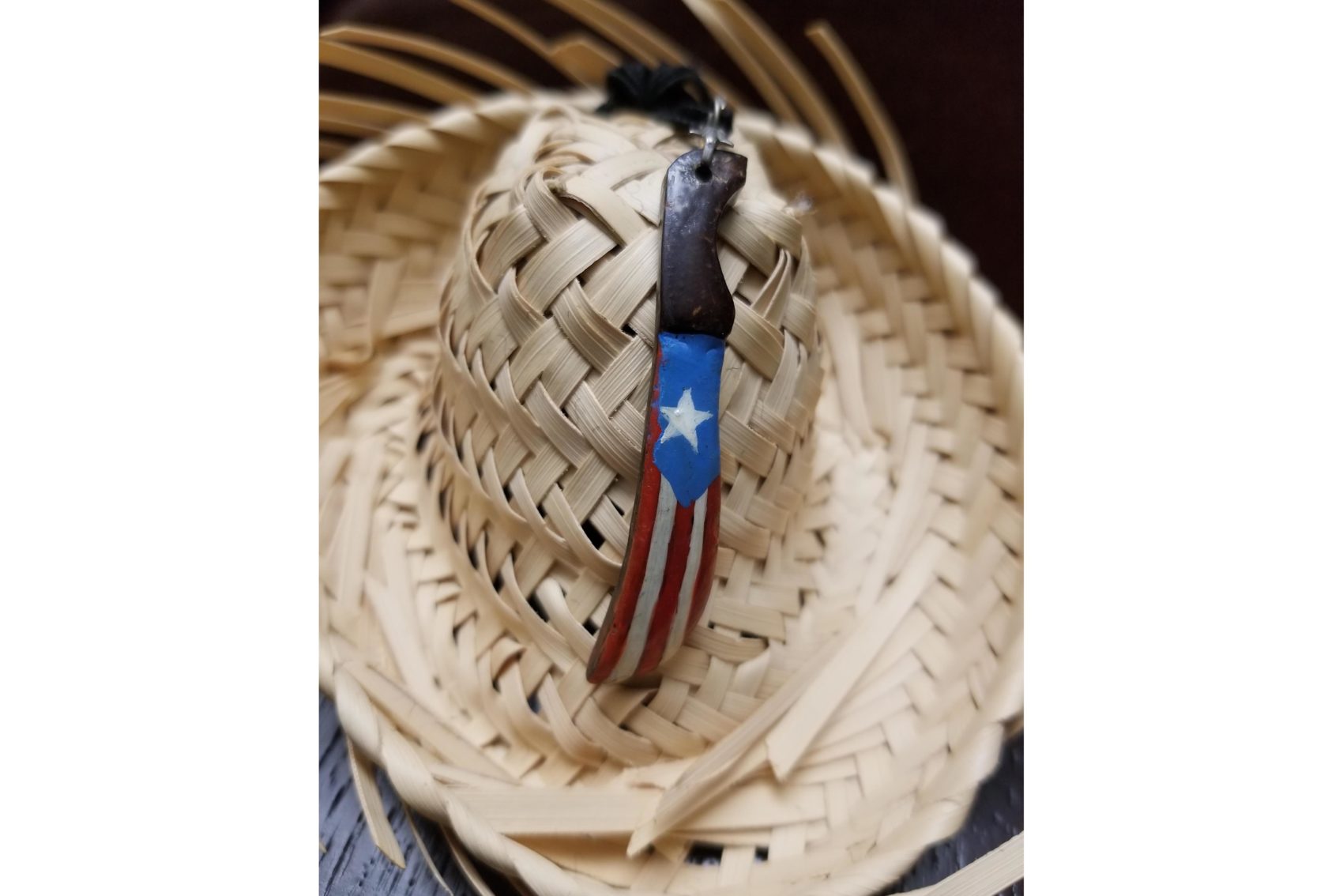
Troche-Rodriguez’s mother gifted her a decorative necklace with a Puerto Rican flag on a machete, a symbol of resistance. It sits on a pava, the traditional hat worn by jíbaros, or rural farmers, who worked in the fields. Photo courtesy of Troche-Rodriguez
Troche-Rodriguez’s home is decorated with La Monoestrallada, or Puerto Rico’s one-starred flag. Born and raised in Puerto Rico, she came to Chicago with the intention of completing grad school and then returning to the island. But that dream of returning hasn’t happened for her and other Boricuas, as political and economic conditions have deteriorated in the U.S. territory.
“I’m not resentful and not angry,” she said. “It’s just these are the historical facts.”
For July 4, Casey Brennan’s cul-de-sac in Pittsburgh is planning a block party. He’s not yet sure which dish he and his wife will bring, but is looking forward to all the neighbors getting together, big birthday bash or not.
We’ve reached a point, the 55-year-old said, where we need to go back to human connection, away from the devices.
“When you talk to people, people are more authentic, and you just realize whatever your political persuasion, we’re all trying to do the same things,” whether it’s doing our jobs, raising families, and more, he added. “There’s more that connects us.”
Michael Robinson, 84, said being American means being in a country “made up of a variety of humans, animals and geographic realities that shows we can work together for the good of all.”
Though there’s a “downward spiral of mismanagement at the highest levels of government,” the Washington state resident believes “the spirit of this great country is alive.”
“I feel it building day by day,” he wrote.
Catherine Hutchison, 73, wonders how different the July Fourth celebrations will be in her city this year with the Memphis Safe Task Force still there.
Trump ordered several law enforcement agencies, including Tennessee’s National Guard, to assemble last fall to tamp down crime in Memphis. The state’s Bureau of Investigation is looking into five incidents involving federal agents, which have resulted in two civilian deaths. Some residents have sued the task force for harassing and abusing them while they were exercising their First Amendment rights. Hutchison is anxious that the U.S. will face “more and more of that.”
“I live in a city under siege,” she said, “and it’s a very uncomfortable way to live.”
Nearing this Fourth of July, she’s thinking of a story about the nation’s earliest days that her husband, a history buff, once told her.
On Dec. 23, 1783, inside the Maryland State House in Annapolis, General George Washington delivered an emotional speech that moved many in the room to tears, and resigned his commission. Giving up his power as commander-in-chief of the Continental Army, Washington bowed to Congress and returned to Mount Vernon as a private citizen.
“It’s a really good example of a leader knowing his lane and knowing what is best for the country,” she said.
Hutchison plans to remember Washington’s patriotic act while she enjoys the fireworks.