




Disclaimer: Early release articles are not considered as final versions. Any changes will be reflected in the online version in the month the article is officially released.
Household Transmission of Enterovirus D68, Washington and Oregon, United States, 2022–2024
Author affiliation: Fred Hutchinson Cancer Center, Seattle (P. Roychoudhury); University of Washington, Seattle, Washington, USA (P. Roychoudhury, E. Wetzler, A. Elias-Warren, K.L. Hoffman, A. Harteloo, H.G. Kim, K. Kong, H. Xie, J. Gov, M.G. Mills, C. Frivold, M. Hollcroft, M. Drummond, T. Hatchie, E. Clark, B. Ehmen, P.D. Han, L. Gamboa, S. Grindstaff, J. Stone, A.L. Greninger, L.M. Starita, C. Lockwood, J.A. Englund, M. Carone, A.A. Weil, H.Y. Chu); Brotman Baty Institute for Precision Medicine, Seattle (L. Gamboa); Seattle Children’s Research Institute, Seattle (J.A. Englund); Kaiser Permanente Center for Health Research, Portland, Oregon, USA (S.L. Reich, R.A. Mularski, M.A. Schmidt, J.L. Kuntz, A.L. Naleway)
Suggested citation for this article
Abstract
During 2022–2024, a total of 35 of 1,040 households had a distinct symptomatic index case of enterovirus D68; estimated symptomatic secondary infection rate was 13.6%. Sequences from patients within households clustered closely; we observed 0–2 pairwise nucleotide differences between household cases 6–14 days apart.
Enterovirus D68 (EV-D68) typically causes respiratory illness with symptoms such as difficulty breathing, fever, wheezing, and respiratory distress (1). Interest in EV-D68 has grown since 2014 because of associations with acute flaccid myelitis in children (2) and recent outbreaks in the United States and Europe (3). In a descriptive epidemiologic study of the 2014 US outbreak of medically attended EV-D68, children <16 years of age accounted for >80% of severe respiratory illness cases (4); however, community-based assessments of EV-D68 incidence and age distribution remain limited. In congregate settings like homeless shelters, EV-D68 transmission occurred primarily in adult and not family shelters (5). No specific treatments or vaccines are available for nonpolio enteroviruses, and the epidemiology of EV-D68, including risk factors for household transmission, are not well understood (6).
Few studies have incorporated genomic sequencing to confirm transmission patterns or quantify viral evolution between transmission events (7,8). Our study aimed to characterize the epidemiology and household transmission of EV-D68 using specimens and data collected as part of a community-based prospective CASCADIA cohort (9).
The Study
The CASCADIA study included active surveillance for respiratory viruses among enrolled households with children and adults in metropolitan Seattle, Washington, USA, and Portland, Oregon, USA during June 2022–March 2024 (Appendix). Participants completed surveys and self-collected nasal swab samples weekly, regardless of symptoms. We subsequently tested swab specimens from participants who reported symptoms <72 hours of collection (Appendix), as well as specimens with a positive or inconclusive result for SARS-CoV-2, influenza, or respiratory syncytial virus (RSV), by using a multiplex assay for 26 targets, including EV-D68. To rule out false-positive results caused by cross-reactivity of the multiplex assay target described previously (5), we selected specimens that tested positive for EV-D68 with relative cycle threshold (Crt) <28 for EV-D68–specific reverse transcription PCR. We sequenced samples by hybridization probe capture using a panel that covers ≈80 viral targets (Appendix).
After excluding 179 single-person households, we included 1,040 multiperson households in our analysis (Appendix Figure 1). We detected a distinct EV-D68 index case in 35 (3.4%) households (Table 1, 2). We identified potential secondary transmission, defined as detection of EV-D68 in a symptomatic household contact 1–14 days after a distinct index case, among 7 (20%) households. Those households included 15 household contacts, 14 of whom were tested because they reported symptoms. The 28 households with unlikely secondary transmission included 51 household contacts, 21 of whom were tested because they reported symptoms. Among 66 household contacts of the 35 identified index cases, 9 contacts were infected; we estimated the symptomatic secondary infection rate for EV-D68 as 13.6% (95% CI 6.8%–27.5%). Median detection interval between index and secondary cases was 7 (range 6–14) days. Households with secondary transmission (n = 7) were less likely to have children <5 years of age than households without secondary transmission (n = 28); 28.6% of the households with secondary transmission had young children, compared with 39.3% of those without secondary transmission (p = 0.38 by Fisher exact test). Compared with households with unlikely secondary transmission, index cases in households with secondary transmission were older (median age 11 vs. 9 years) and more frequently reported >2 acute respiratory illness (ARI) symptoms (100% vs. 68%; p = 0.01 by χ2 test). Among households with secondary transmission, median age of household contacts was older (42 vs. 26 years of age) than in households with unlikely secondary transmission. Households with secondary transmission had lower household income than those without (42.9% vs. 78.6% had income lower than the median income threshold). A greater percentage of contacts reported underlying conditions in households with secondary transmission than in households with unlikely secondary transmission (67% vs. 45%). We conducted sensitivity analysis including only households with complete enrollment of all members; we observed no difference (Appendix Table 3).
Samples from adults with either a primary or secondary infection (n = 18) tended to have lower minimum Crt values (mean 16.3, SD 4.27) compared with children 6 months to 4 years of age (n = 11; mean Crt 17.5, SD 3.73) and children 5–17 years of age (n = 15; mean Crt 17.1, SD 3.74). Participants who reported >2 ARI symptoms (n = 35) had similar Crt values (mean 16.8, SD 4.12), compared with those reporting a single symptom (n = 9; mean Crt 16.8, SD 3.11). Household contacts with >2 ARI symptoms (n = 9) had lower Crt (mean 16.4, SD 5.17) compared with index cases (n = 26; mean Crt 17.0, SD 3.81) (Appendix Figure 2).
Figure
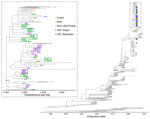
Figure. Maximum-likelihood time-resolved phylogenetic tree from study of household transmission of enterovirus D68, Washington and Oregon, United States, 2022–2024. Tree shows study samples from Washington and Oregon and publicly available global…
We recovered high-quality EV-D68 whole-genome sequences for >2 persons within a household in a total of 11 households. All sequenced samples in this study (Appendix Table 1) fell within the B3 clade with other GenBank sequences from the United States and Europe; sequences from the same household clustered closely (Figure; Appendix Figure 3). Among those 11 households, 6 had samples collected from different members (co-primary cases) on the same day and the within-household pairwise nucleotide (nt) distance between sequences was 0–1 (median 0.5) nt. In 4 households, samples were collected 6–14 days apart; the within-household pairwise distance was 0–3 (median 1) nt. In 1 household with samples collected 148 days apart, sequences confirmed distinct introductions into the household. Among the 10 households with samples collected 0–14 days apart, sequences from children tended to be more basal in the tree relative to the sequences from adults in the same household; adult sequences contained >1 additional nucleotide substitutions (Appendix Figure 3), suggesting transmission from child to adult. Because we used a hybridization capture–based method for sequencing, enriching for respiratory viruses (Appendix), we identified a coinfecting pathogen in 3 samples: SARS-CoV-2 in a sample from an adult and adenovirus and human parainfluenza virus in 2 samples from children <5 years of age.
Transmission of symptomatic infection appears to be from younger school-aged children (5–12 years of age) to adults, suggesting introductions to the household from children attending school; however, we are limited by our small sample size. Other limitations of our study were the inability to precisely measure the duration of viral detection or to detect asymptomatic shedding because we collected specimens weekly and tested only swab specimens from symptomatic participants. Because participants swabbed weekly and we did not collect symptom onset dates, we were unable to report serial interval, and we could not determine the exact illness onset date. The estimated median detection interval of 7 days is slightly higher than reported serial intervals for other viruses; a reason could be that our study used weekly sampling, compared with other studies that conducted daily sampling. Our threshold of 14 days for identifying symptomatic secondary infections is supported by our genomic analysis and consistent with other studies that have estimated the duration of EV-D68 shedding in the respiratory tract (8); in rare cases, it might miss late transmission events.
Conclusions
In our 2-year community respiratory virus surveillance study, we found relatively few cases of symptomatic EV-D68 in households compared with other respiratory viruses, such as RSV, in the same cohort of households during an overlapping timeframe, July–November 2022 (10) (Appendix Figure 4). Overall, our work adds to the body of literature on enterovirus household transmission and confirms that in households with young children, EV-D68 is a less common source of symptomatic respiratory viral illness than other pathogens such as RSV, influenza virus, and SARS-CoV-2.
This article was preprinted at https://doi.org/10.64898/2026.02.16.26346322.
Dr. Roychoudhury is a research assistant professor in the Department of Laboratory Medicine and Pathology at the University of Washington and affiliate investigator in the Vaccine and Infectious Disease Division at the Fred Hutchinson Cancer Center. Her primary research interests are pathogen genomics and mathematical models of viral evolution and host-pathogen interactions.
Acknowledgments
The authors thank the following individuals for supporting this study: Deralyn Almaguer, David Amy, Britt Ash, Allison Bianchi, Cassandra Boisvert, Stacy Bunnell, Joseph Cerizo, Evelin Coto, Phil Crawford, Robin Daily, Lantoria Davis, Stephen Fortmann, Kendall Frimodig, Lisa Fox, Holly Groom, Tarika Holness, Matt Hornbrook, Terry Kimes, Keelee Kloer, Dorothy Kurdyla, Bryony Melcher, John Ogden, Jennifer Rivelli, Katrina Schell, Emily Schield, Meagan Shaw, Martin Simer, Britta Torgrimson-Ojerio, Alexandra Varga, Mica Werner, Neil Yetz, Rebecca Ziebell (Kaiser Permanente Center for Health Research); Ariana Magedson, Denise McCulloch, Natalie Lo, Kyle Luiten, Devon McDonald, Sarah Cox, Jenni Logue, Melissa MacMillan, Grace Marshall, Jean Mernaugh, Daniel Nguyen, Zarna Marfatia, Amanda Casto, Chidozie Iwu, Julia Bennett, Jordan Opsahl, Kathryn McCaffrey, David Reinhart, Ben Cappodano, Sarah Heidl, Zack Acker, Lani Regelbrugge, Leslie Rodriguez-Salas, Ailyn Perez, Sean Ellis, Hanna Edgar (University of Washington); Dallas Haws, Hanna Grioni, Josh Sanders, Irem Onalan, and Laura Ostrina Restrepo (Seattle Children’s Hospital).
The CASCADIA study was funded by the Centers for Disease Control and Prevention (research contract no. 75D30121C12297 to Kaiser Foundation Hospitals). The funders were not involved in the design of the study and do not have any ownership over the management and conduct of the study, the data, or the rights to publish. Computational analyses were supported by Fred Hutch Scientific Computing (National Institutes of Health Office of Research Infrastructure Programs grant no. S10OD028685) and University of Washington Laboratory Medicine Informatics. This analysis was funded by the Washington State Department of Health Northwest Pathogen Genomics Center of Excellence (WA DOH contract no. HED29377-1, federal grant no. NU50CK000630).
H.Y.C. reports consulting with Roche and Vir, outside of the submitted work. P.R. reports contracts to University of Washington from Aicuris and Arisan Therapeutics outside of the submitted work. J.A.E. reports consulting with Abbvie, Ark Biopharmaceuticals, Sanofi Pasteur, Moderna, Meissa Vaccines, AstraZeneca, and Pfizer, Inc. outside of the submitted work, and has received research funding from AstraZeneca, Merck, GlaxoSmithKline, and Pfizer. J.L.K. reported research funding not related to the submitted work from Pfizer, Novartis, and Vir Biotechnology. A.L.G. reports contract testing to UW from Abbott, Cepheid, Novavax, Pfizer, Janssen, and Hologic, and research support from Gilead, outside of the described work.
References
-
Clopper BR, Lopez AS, Goldstein LA, Ng TFF, Toepfer AP, Staat MA, et al. Enterovirus D68–associated respiratory illness in children. JAMA Netw Open. 2025;8:e259131. DOIPubMedGoogle Scholar
-
Dyda A, Stelzer-Braid S, Adam D, Chughtai AA, MacIntyre CR. The association between acute flaccid myelitis (AFM) and enterovirus D68 (EV-D68)—what is the evidence for causation? Euro Surveill. 2018;23:17–00310. DOIPubMedGoogle Scholar
-
Park SW, Pons-Salort M, Messacar K, Cook C, Meyers L, Farrar J, et al. Epidemiological dynamics of enterovirus D68 in the United States and implications for acute flaccid myelitis. Sci Transl Med. 2021;13:eabd2400. DOIPubMedGoogle Scholar
-
Midgley CM, Watson JT, Nix WA, Curns AT, Rogers SL, Brown BA, et al. EV-D68 Working Group. Severe respiratory illness associated with a nationwide outbreak of enterovirus D68 in the USA (2014): a descriptive epidemiological investigation. Lancet Respir Med. 2015;3:879–87. DOIPubMedGoogle Scholar
-
Cox SN, Casto AM, Franko NM, Chow EJ, Han PD, Gamboa L, et al. Clinical and genomic epidemiology of coxsackievirus A21 and enterovirus D68 in homeless shelters, King County, Washington, USA, 2019–2021. Emerg Infect Dis. 2024;30:2250–60. DOIPubMedGoogle Scholar
-
Cassidy H, Poelman R, Knoester M, Van Leer-Buter CC, Niesters HGM. Enterovirus D68—the new polio? Front Microbiol. 2018;9:2677. DOIPubMedGoogle Scholar
-
Grunnill M, Eshaghi A, Damodaran L, Nagra S, Gharouni A, Braukmann T, et al. Inferring enterovirus D68 transmission dynamics from the genomic data of two 2022 North American outbreaks. Npj Viruses. 2024;2:34. DOIPubMedGoogle Scholar
-
Nguyen-Tran H, Thompson C, Butler M, Miller KR, Pyle L, Jung S, et al. Duration of enterovirus D68 RNA shedding in the upper respiratory tract and transmission among household contacts, Colorado, USA. Emerg Infect Dis. 2023;29:2315–24. DOIPubMedGoogle Scholar
-
Babu TM, Feldstein LR, Saydah S, Acker Z, Boisvert CL, Briggs-Hagen M, et al. CASCADIA: a prospective community-based study protocol for assessing SARS-CoV-2 vaccine effectiveness in children and adults using a remote nasal swab collection and web-based survey design. BMJ Open. 2023;13:e071446. DOIPubMedGoogle Scholar
-
Cox SN, Roychoudhury P, Frivold C, Acker Z, Babu TM, Boisvert CL, et al. Household transmission and genomic diversity of respiratory syncytial virus in the United States, 2022–2023. Clin Infect Dis. 2026;81:1159–69. DOIPubMedGoogle Scholar
Figures
Tables
Suggested citation for this article: Roychoudhury P, Wetzler E, Elias-Warren A, Hoffman KL, Harteloo A, Kim HG, et al. Household transmission of enterovirus D68, Washington and Oregon, United States, 2022–2024. Emerg Infect Dis. 2026 Jul [date cited]. https://doi.org/10.3201/eid3207.251733
Original Publication Date: June 23, 2026
Table of Contents – Volume 32, Number 7—July 2026