



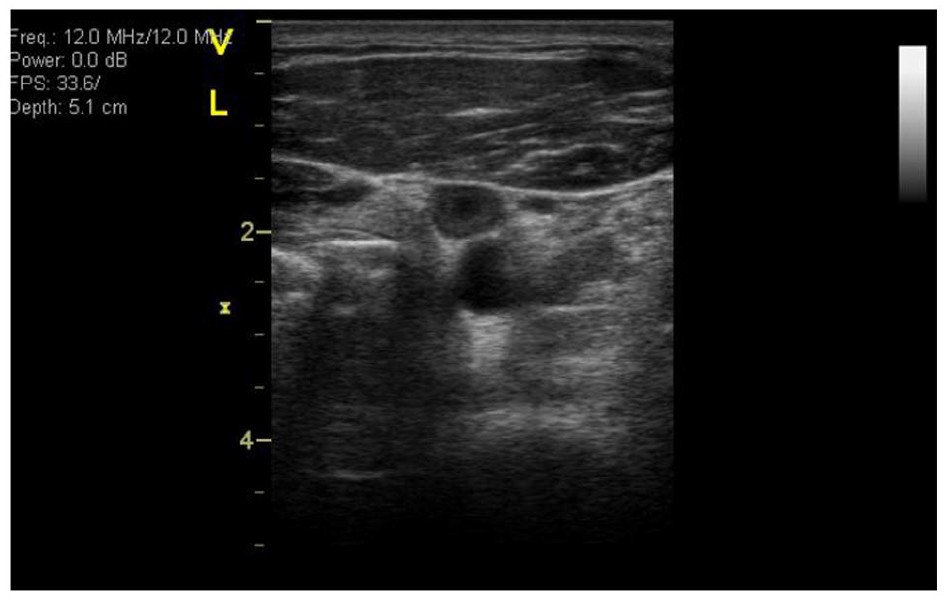
Spontaneous echo contrast (SEC) grade 3 with peripheral echogenicity.
NASA/Pavela
In April 2026, NASA’s Office of the Chief Health and Medical Officer (OCHMO) initiated a working group to review updated VTE case information, additional data gathered revealing altered blood flow status within a cohort of astronauts, and discuss progress of research and clinical activities intended to mitigate the risk of VTE during spaceflight with new evidence-based clinical practice recommendations.
Recommendations
The following is a summary of the working group’s recommendations:
- The working group’s conclusions emphasized that stasis in the left internal jugular vein (IJV) is consistently viewed as a dominant risk factor for VTE in microgravity, though there is active debate regarding the relative contributions of slow qualitative flow, endothelial factors and/or retrograde flow.
- Limitations of current in-flight ultrasound capabilities to accurately measure stasis/slow flow was cited as a concern, especially if using only stasis as a factor for indicating the need for prophylaxis.
- Additional review of assessing stasis with ultrasound in-flight was recommended.
- After reviewing the risk factors, additional discussions following the working group led to the majority of the panel agreeing that stasis and retrograde flow warranted use of prophylaxis.
- The working group also recommended assessing all other risk factors other than stasis to also determine when prophylaxis is warranted.
- Based on a literature review and summary of the panel contributions, a VTE Risk Score for Astronauts Algorithm was developed, which includes providing anticoagulation prophylaxis for stasis alone, or a combination of other thrombosis risk factors that are weighted by terrestrial literature.
Risk of Venous Thromboembolism During Spaceflight
NASA initially formed a working group in October 2024 after diagnosing venous thromboembolisms (VTEs) in astronauts during ISS missions. Experts reviewed case data, updated Clinical Practice Guidelines, and examined possible causes.
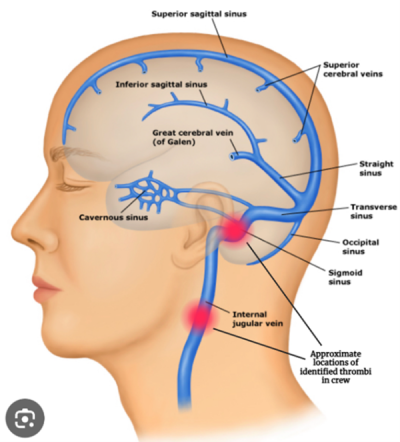
Approximate location of identified thrombi in crewmembers.
Source: Modified from Cerebral Sinus Venous Thrombosis – University of Colorado Denver
Share
Details
Last Updated
Jul 17, 2026