




Digger opens in theaters on October 2.
“Gentlemen, we find ourselves in a dildo of a pickle,” says the President of the United States as he comes to grips with the fact that a US oil-drilling mishap has split off a city-sized ice shelf that’s on a path of destruction toward Europe and will trigger tsunamis, causing untold death and destruction. That line, exquisitely delivered by John Goodman and imposingly photographed by director Alejandro G. Iñárritu (Babel, Birdman, The Revenant) in his signature low, wide-angle style, also sums up my complex feelings toward a film whose reach far exceeds its grasp and whose satire—while funny—would have felt fresher a decade ago.
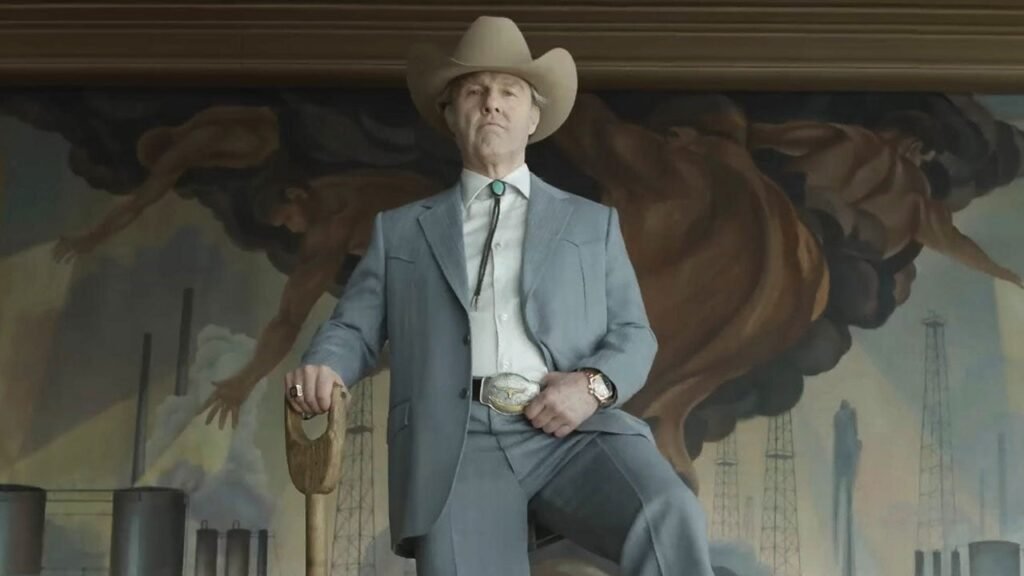
Starting with an ice fracture “10 times the size of his own dick,” Digger follows Digger Rockwell, the oil tycoon responsible for the ice shelf debacle mentioned above, who finds himself on the defensive as he works with the president, advisors and generals to try to stop the impending doom brought on by our insatiable appetite for fossil fuels—and when that fails, at the very least, to “control the narrative.”There’s a twist that the marketing seems to be deliberately trying to avoid, so I won’t directly mention it in this review. However, it fundamentally affects my opinion of the film. I’ll talk around it and also fence it in with “Possible Spoiler” warnings.But let’s get right to the best part of the show: Tom Cruise.The Tom of It AllIt’s been a long time since Tom Cruise has taken on a role that required zero action. I was excited for him to enter his post-Mission: Impossible era and was delighted to see elements of Digger Rockwell echo Tropic Thunder’s Les Grossman.Digger ImagesFor Digger Rockwell, Cruise dons heavy prosthetics to fully transform into the wily old oil tycoon. His look may be more Ross Perot, but it’s still clear an action star is under all that latex, climbing mantles and dancing with his shovel. Whether he’s bickering with Riz Ahmed about his annoying scientific ethics or lecturing world leaders on why he’s necessary—the latter of which is one of the best scenes in the film and might be worth the price of admission alone—Cruise’s performance is both focused and kinetic.Digger lecturing a United Nations-type body is Cruise’s “you can’t handle the truth!” monologue and might be one of the best of his career. His “You demand. I supply” rhetoric echoes Colonel Jessup’s “[you] sleep under the blanket of the very freedom I provide, and then you question the manner in which I provide it” speech. Instead of Nicholson’s fierce but measured delivery (which Nerdwriter expertly broke down in his Jack Nicholson: The Art of Anger video essay), Digger delivers this whole speech while pacing the set and even physically fighting with some listeners in one unbroken take.For every Tom Cruise action movie, there’s some featurette of the filmmakers marveling at his ability to deliver a line while he’s dangling from a building or strapped to the side of a plane. Digger’s monologue, where he conjures up an almost 1,000-word lecture without cutting, all while hitting the constantly moving camera blocking, is as stunning an accomplishment and as mesmerizing as any of those action scenes.This scene isn’t just Tom at his best; it’s also Iñárritu and longtime collaborator, cinematographer Emmanuel Lubezki, upping their game too. This Digger oner combines the complex blocking of background and extras from Birdman’s Times Square underwear jaunt with the more dialogue-heavy long shots Iñárritu and Lubezki experimented with in The Revenant to create a stunning one-shot that showcases Cruise’s acting chops in a way we haven’t seen in decades, if ever.Digger’s monologue is as stunning an accomplishment and as mesmerizing as any of Tom Cruise’s past action scenes.“Thematically, this monologue is one of the few times the satire actually says something pointed. Most of the film relies on a Looney Tunes-esque, Yosemite Sam diplomacy: We need oil at any cost and American weapons and brute force can solve any problem nature presents.Digger’s speech provides a smart contrast to the President’s mean-spirited, selfish, extremely aggressive, and idiotic decisions. His monologue deftly navigates a complex and evolving argument that starts with that “You demand, I supply” line before chastising the attendees for profiting royally from his companies, explaining that the masses are too poor to care, and finally lecturing them that they’ve inadvertently chosen his side in these matters, so they better pray he wins.Digger represents the status quo, personified. Iñárritu uses this monologue as the film’s sharpest argument for how Digger and company’s poor decision-making got them into an environmental catastrophe that these fossil fools are too ill-equipped to solve.The Politics of It AllThis is a film about how methane leaks caused by the prolonged burning of fossil fuels, combined with an oil-drilling fiasco, created an environmental catastrophe that the film’s clearly conservative leadership is ill-equipped to deal with. To avoid bringing politics into this review is a diplomatic exercise that only John Goodman’s president would be stupid enough to pursue.Political satire doesn’t need to be subtle, but it does need to illuminate something beyond the obvious by pushing story elements like recognizable characters, plots, and events to their logical extremes. Unfortunately, the script by Iñárritu, Alexander Dinelaris, Nicolás Giacobone, and Sabina Berman fails to provoke any profound truth or unique thinking. The end of this global-warming disaster satire lands exactly where you think it will. Regrettably for Digger, there are other films like Adam McKay’s Don’t Look Up that have tackled the same topics, but in more interesting ways.There’s been a lot of reporting on the mixed early impressions of Digger. Don’t Look Up’s reaction was also mixed. It currently has a 56% on Rotten Tomatoes. But IGN gave it a 7/10, and I more or less agree with our review. McKay’s different, and in my opinion, smarter approach to the topic—using an asteroid impact as a metaphor for global warming—created a more nuanced take on the subject. He used an objectively obvious catastrophe to contrast our society’s inability to do anything to stop it because of our culture’s unholy mix of greed, politics, and misinformation.