




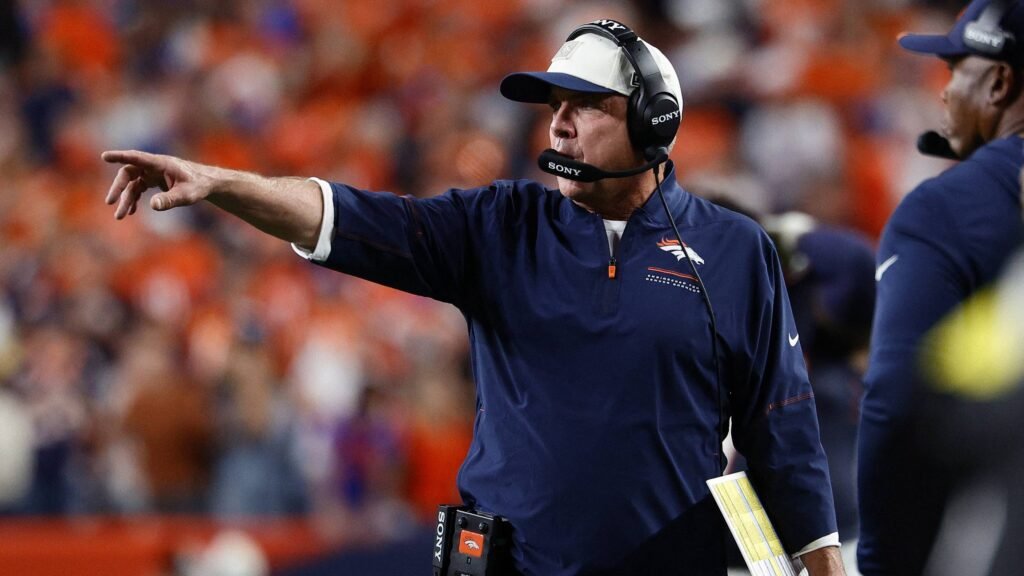

Part of the Bo Nix roller coaster experience is that slow starts are going to happen. Sure, maybe they shouldn’t happen as often as they have so far this season. But perhaps the consistency of inconsistency is what has helped Davis Webb find a rhythm in his first season as an offensive play-caller.
While everyone is caught up in what Broncos coach Sean Payton is thinking regarding another slow start for the offense, Webb has played the long game and leaned on the likelihood that Nix will eventually find his accuracy. It happened in the second half against the Jaguars in Week 2, then again after halftime in the bonkers come-from-behind 30–26 victory over the Rams on Sunday Night Football in Week 3.
Maybe it’s time to stop treating Webb as if he has a week-to-week job with the possibility of his play-calling responsibilities being yanked at any moment by his impulsive coach. Yes, Payton probably misses the control that comes with calling the plays, and I’m sure there has been a time or two when he has wondered to himself whether he made a mistake in giving up the responsibility. But having patience for the long-term vision is easier when the team is winning games even if the product isn’t always pretty.
After all, by no means were the Broncos winning games in style last season. Many of their 2025 victories played out like what occurred Sunday night against the Rams. Let’s not forget Denver’s 33–32 victory over the Giants in Week 7 last season. Mistakes happen and the offensive play-caller, regardless of who it is, will likely want to break a tablet after every head-scratching Nix interception. Nix had one of those throws early in the fourth quarter Sunday; his interception to Rams cornerback Josh Wallace stopped momentum for his team after erasing a 16–0 deficit. Nix probably should have been picked off a few more times Sunday night—and maybe was late in the Broncos’ final drive, but the penalty call went in Denver’s favor—but that’s all part of the Nix roller coaster. He finished 17-of-34 for 186 yards, two touchdowns and one interception.
Payton knew what Webb was getting himself into with Nix before handing him the reins of the offense. Also, Webb, a hot commodity in the latest coaching hiring cycle, didn’t need a reminder of what coaching Nix entails. He was Nix’s quarterbacks coach in Nix’s rookie year and the pass-game coordinator last season.
As it is, the 2–1 Broncos are right on track toward finishing what they started last season when they lost the AFC championship game to the Patriots with backup Jarrett Stidham filling in for the injured Nix. A year ago, the Broncos were 1–2 and no one seemed to be screaming for Payton to give up play-calling duties.
What makes Rams coach Sean McVay a special play-caller is that he usually has a response for what’s not working. Payton had many responses in his many successful years of calling plays. Sometimes the adjustments become corrections and other times you end up calling yourself a big dummy for whiffing on the travel plans strategy to Australia, as McVay did last week.
Regardless of whether the coach was wrong or right the prior week, adjustments are always going to be needed. It’s a week-to-week league, and it’s a game filled with counter moves. That’s what Webb has learned the hard way with the Broncos.
In Week 2, it was rookie running back Jonah Coleman who gave the Broncos a spark and validated Webb’s patient game plan in the win over the Jaguars. But Coleman, who’s now on injured reserve with an ankle injury, wasn’t around Sunday night to help Nix find his accuracy against the Rams.
Webb needed a different solution for a similar problem this season: How can he help Nix find the strike zone? It took him some time, but Webb eventually found the answers in Denver’s rally against the Rams. Meanwhile, on the other sideline, McVay had trouble finding corrections for the pressure that Broncos defensive coordinator Vance Joseph was sending at Matthew Stafford for most of the second half.
The better-late-than-never method for making adjustments has likely helped Payton find patience with his rookie play-caller, because if you think about it, it’s probably better to have the answers in the second half rather than the first two quarters.
However, there are going to be wild games like Sunday night in which the second-half corrections might not be enough. It seemed the Broncos were going to lose control of the game when the Rams had a three-point lead midway through the fourth quarter, then Talanoa Hufanga helped Stafford make history with his record-setting 33rd interception returned for a touchdown. Denver is often going to have a chance to overcome slow starts thanks to its stellar defense, another aspect Webb likely has in mind when calling plays.
Webb knows there will be times when Nix can’t hit his pass catchers, then there will be throws where he has no idea how he got it through a tight window, like the one over a defender’s head that found Jaylen Waddle for the two-point conversion that erased the 16-point deficit with 2:15 remaining in the third quarter. It also helps that Nix offers mobility, which helped on the game-winning one-yard rushing touchdown with 47 seconds left in regulation.
Plenty comes with the Nix experience, good and bad. Webb has done a fine job planning and adjusting around the roller coaster that is his third-year quarterback. The Broncos are right where they need to be. Now maybe we can stop asking about Webb’s job status.
 Add us as a preferred source on Google