


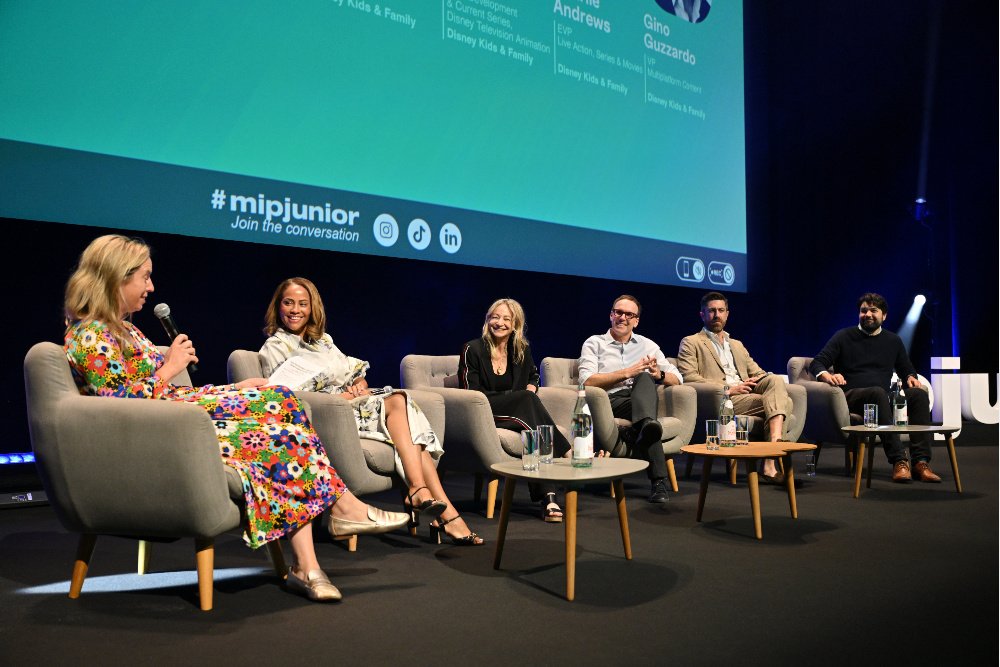
During a panel discussion at MipJunior in Cannes on Sunday, Ayo Davis, president of Disney’s Kids & Family division, reflected on how the studio was responding to the disruption in viewing habits among younger viewers, including working with some of the same creators who are contributing to that disruption.
“I think we can all probably acknowledge that there’s been a lot of disruption, especially in the kids space,” Davis said. “We talk about it a lot. Kids are watching anything and everything. I experience it in my own home with a 12 year old. I like to say, they’re watching everything from ‘Bluey’ to ‘Squid Game.’ So it was clear that we had to activate quickly. This audience is really important to us. We had to step outside of ourselves and take a look at how we were approaching our strategy.”
She added, “So what did that mean? It meant looking at how we told stories with our beloved franchises, how we were connecting with our audience around originals, how we were actually connecting with our audience through new formats, and taking a look at how our content showed up across our platforms – we couldn’t do it the same anymore – and really thinking about how we were working with our partners across the industry. Ultimately, we had to really think about how we were going to connect with our audiences through stories that were fresh, that were relevant, authentic for them, while keeping them connected and growing with the brand.”
Popular on Variety
Davis added later, “It’s easy to rinse and repeat, but I think in order to evolve and be able to expand – especially at a company that has such a rich history and legacy – you have to be willing to take chances, you have to be willing to expand, and you have to love what you do because you’re going to be pivoting on a regular basis in order to try to meet kids where they are.”
Working With Creators
The Disney execs on the panel spoke about how the studio works with creators, such as Nastya and Dhar Mann, who delivered the opening keynote at Mipcom on Sunday.
“Creators are important. We know that they’re important to our audience. It is literally where they are engaging all day long,” Davis said. “The thing to highlight is that we’re not just connecting with creators for creators’ sake, right? We are connecting with creators that actually bring something to the table, that actually align to our values, and the way we are telling our stories.”
She added, “Dhar Mann and Nastya are great examples of that. What I am excited about with Dhar Mann is that at its core, his stories are about good and evil, and so we took the thematic around good and evil, which is what we do so well, and the teams have found such great ways to apply the storytelling through those core themes that are so universal.”
Alyssa Sapire, head of original programming and strategy at pre-schoolers network Disney Jr., said, “Nastya is, as most know, hugely popular with preschoolers. What she does is she really leans into imaginative play, which really speaks to so much of what is important for preschoolers and what we infuse in our storytelling.”
Charlie Andrews, executive VP, live action, Disney Kids & Family, said he was also working with Nastya. “Nastya is also, you know, ageing and her interests are changing, so [we are looking to create] content that is also for herself and her demo as they age with her on the live-action side. So we’re really strategic on that.”
He added, “We just got the scripts for the two series we’ve greenlit with Dhar Mann. They are excellent. They meet kids where they are, just from a dialogue perspective. Everything is so 2026. Maybe it’s already 2027. That’s how ahead of the curve he is and meeting kids exactly where they are, and it’s so refreshing to read, but still has those incredible Disney tenets of friendship and fantasy and magic and wonder, wish fulfilment.”
Zack Olin, senior VP, development and current series at Disney Television Animation, Disney Kids & Family, said, “Our goal hasn’t changed, which has consistently been: We want to be in business with the world’s best storytellers. We have to listen to our audience because they are really responding to these storytellers.”
Keep It Short
Gino Guzzardo, VP, multiplatform content at Disney Kids & Family, spoke about the importance of short-form content to Disney. “Some people say that it was all started by a mouse. I would counter it was all started by a short. So, shorts are very much in Disney’s DNA. It’s what we’ve always done, and cut to today, it is a multifaceted, multi-platform, fractured media landscape, but we’re still following that same tradition of using shorts to get our characters out there to as many screens as possible. If it has a screen on it, we can throw a short on it. We can get our characters out there where people want to watch.
“A recent example of that is we have a new anthology, a short-film series called ‘Locker Diaries.’ So these are vertical shorts shot through characters’ lockers. Thankfully, a lot of our properties have high-school hallways in them. It feels organic. There’s a reason for being. It gives you a real immersive experience into a character’s world. You get to know them.”
Fresh Original Content
One aspect to the studio’s approach to kids content that the Disney execs on the panel were keen to emphasize was the importance of fresh original content, alongside the legacy franchises.
Sapire said, “We’re always looking for new stories, new storytellers, new formats based on what we know about preschoolers. We’re all pretty obsessed with knowing our audiences well, their passions, their interests, and, for preschoolers specifically, it’s about knowing where they are developmentally and finding those fresh stories to tell with those relatable, connected themes.”
She added, “ ‘SuperKitties’ is a great example of that. It has all the indicators of becoming a great franchise for us. The fandom is real. We’re finding kids don’t just love dogs, they adore cats too. Over the last three years, we’ve seen ‘SuperKitties’ grow and build. So, we are in it for the long game and building out the whole ecosystem of 60-minute specials, shorts, a regular long form, and also we’re looking to extend their play with toys and other extensions.”
Kids Love Vampires and Witches
Davis said that Disney Jr. can be seen as “a gateway” for their audience. “It’s the introduction to the company, the introduction to the characters,” she said.
Andrews added, “My job is to take Alyssa’s demo’s hand and bring them into live action for the first time. She’s saying mermaids, witches, vampires, and I’m like, great, ‘Vampirina’ really worked for you … what about a live-action version? And we had huge success in doing that because we know kids love vampires. They love Vampirina, but then they start ageing, and so when they want to start watching a sitcom five years later, then we have something ready for them, but with the familiar IP they love, with the kind of characters they love, but reinvented for them at that age.”
He added that it also applied to an original that Disney launched last week, “Coven Academy.” “It’s vampires and witches, and as Alyssa has been pointing out to us for years, those are things that kids love, and they love to watch, and as I bring them into live action, it’s with a little bit more emotion and that authenticity of their relationships and where they are at on an emotional level, and a little more sophisticated storytelling.”
Olin said that the studio’s animation output was also tailored to the various age groups. “Six to 12 is such an interesting age. It’s where kids are starting to define their own tastes, and there’s a broad spectrum of things that they’re interested in. And, coming out of peak television and more choices than ever, we know we have to deliver choice for audiences,” he said. “So we’ll start with shows like ‘Big City Greens,’ and as they evolve and are seeking out slightly more sophisticated themes or serialization then we’ll follow up with shows like ‘Dragon Striker.’”
Olin said that their decision-making is shaped by “the necessity to understand the audience.” He added, “It’s not about delivering what we think they want. We have to listen to them and respond to them. I spent a lot of time when I joined the company thinking about the long, successful history of animation at Disney, and just reinforce that if we tell compelling stories, we not only reach the hearts of kids, but we can reach a broad audience, and that’s something that I really aspire to do.”
Researchers Are the Bosses Now
Sapire pointed to the importance of research. “From the preschool side, we have touch points with preschoolers literally every week because we have an internal educational resource group, so we go and we sit with kids, we share the stories that we are bringing into our series and getting that direct feedback, having an understanding of what they comprehend. And then we bring that back to our writers, our showrunners, to help them evolve the stories based on that feedback. They are our bosses!” she said with a laugh.