




Read My Lips: ‘Christ Is the World’s Redeemer’
In the pews, a manly example is indispensable.

When I used to try to sing in church, I would picture in my mind the public figures I admired most making a joyful noise from the pews.
Two decades ago, during my first sojourn into church life in my early 20s, I strained to overcome my complete inability to carry a tune—and my admittedly prideful and sinful embarrassment at singing words that so plainly confessed my faith—by thinking of the various churchgoing notables who, in my imagination, easily overcame such trepidations.
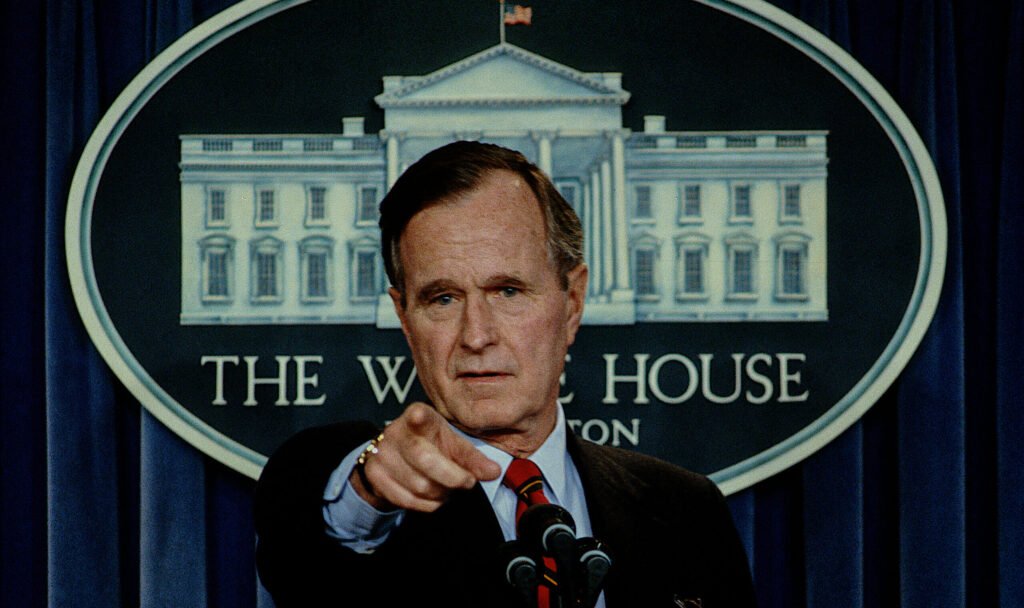
Because the first church I entered as a young adult was the Episcopal Church, my hymn-singing role models were along the lines of the former Republican presidents George H.W. Bush and Gerald Ford, Episcopalians both.
If I imagined these solidly conservative and thoroughly gentlemanly presidents robustly but reverently singing, say, “Eternal Lord of Love, Behold Your Church,” I found that I could more confidently sing it myself.
Don’t get me wrong: I loved, without apology or qualification, much of the music in The Hymnal 1982, the denomination’s book of sacred songs. Taking my bulletin home with me, I adopted the practice of placing checkmarks beside hymns I especially liked. On the basis of the handful of bulletins from those days that I have hung onto, I must have been especially fond of “My Faith Looks Up to Thee” and “O Love, How Deep, How Broad, How High.” (I just listened to them again on YouTube—my taste has not changed much in 20 years.)
Yet I clearly remember that I could only summon the nerve to boldly sing these songs by telling myself those ex-presidents would have done the same (and I still often failed to sing boldly enough). I even remember telling myself that George Plimpton, the then-recently deceased writer and Paris Review editor, would have been a hardy hymn-singer. I reckoned that the classy, well-connected Plimpton had surely been an Episcopalian, though, upon reading a book about his life years later, George, Being George, I encountered the following discouraging admission by his sister about their rather cursory religious instruction as youths in New York:
We always had Sunday lunch after church, St. John’s Episcopal Church in Cold Spring Harbor on Long Island in the summer, the Presbyterian (the Brick) Church on Park Avenue in the winter. I’m not so sure they were believers. Daddy thought it was a good thing to do. There was always the social aspect to it.
This would be comical had I been using Plimpton as a spiritual role model, but in this case, I should give myself a bit more credit than that. Although my 20-something self certainly selected the Episcopal Church with the understanding that it was an upmarket denomination—the kind that someone like Plimpton would indeed have attended on a seasonal basis—I think I was simply trying to identify a man I admired who would have sung in church. And I certainly did admire Plimpton and that pair of former GOP presidents.
But why did I need to look to them in the first place? Alas, the problem was that my own father, a strong, virtuous, admirable man in all other ways, was a resolute nonchurchgoer. His influence was such that his views eventually parted my mother from the church, something that I am sure she would have considered inconceivable in her pious youth. When I finally decided to go to church, I did so with my mother and sometimes with my brother but never with my father. Thus, in my young adulthood, I had no man to look to who sang with the strength needed to praise Our Lord.
Several years ago, now in my very early 40s, I found my way to confessional Lutheranism, the religious heritage of my mother, who had just recently died. In musical terms, I had joined a church that invited even more vigorous singing than the Episcopalians (something I am reminded of yearly on Reformation Sunday when the Divine Service begins with Martin Luther’s “A Mighty Fortress Is Our God”). By this time, though, the chance that my father would or could ever provide an example in manly hymn-singing had long evaporated. He had died over a decade earlier.
So I find myself in the pews, week after week, warily warbling music I have come to love: “Creator Spirit, by Whose Aid,” “Come, Your Hearts and Voices Raising,” “All Glory, Laud and Honor,” “Christ Is the World’s Redeemer.” My bulletins are still full of checkmarks each week. Yet, in what I take to be a sign of spiritual progress, I no longer boost myself up by imagining celebrities, even relatively noble or faithful ones, singing in my place. If I am ever to sing at the top of my lungs, it will be with God’s help alone.
Sometimes, on those occasions when I faintly murmur the words, I imagine the day when I will not look to others to carry my singing but when I—at last rectifying the sin of omission of my dear father’s stubborn irreligiosity—will lead a family of my own in these hymns.
I always remember my mother remarking that Prince Charles picked some of the hymns at his wedding to Lady Diana Spencer, and though that union was famously corrupted by all-too-human sin, it is somehow undeniably fitting that a man should select the music at the wedding to his bride. And if I choose “Lord, When You Came as Welcome Guest,” whose text concerns the wedding at Cana, I promise you, dear reader, that I will sing it with all my heart.
The post Read My Lips: ‘Christ Is the World’s Redeemer’ appeared first on The American Conservative.