



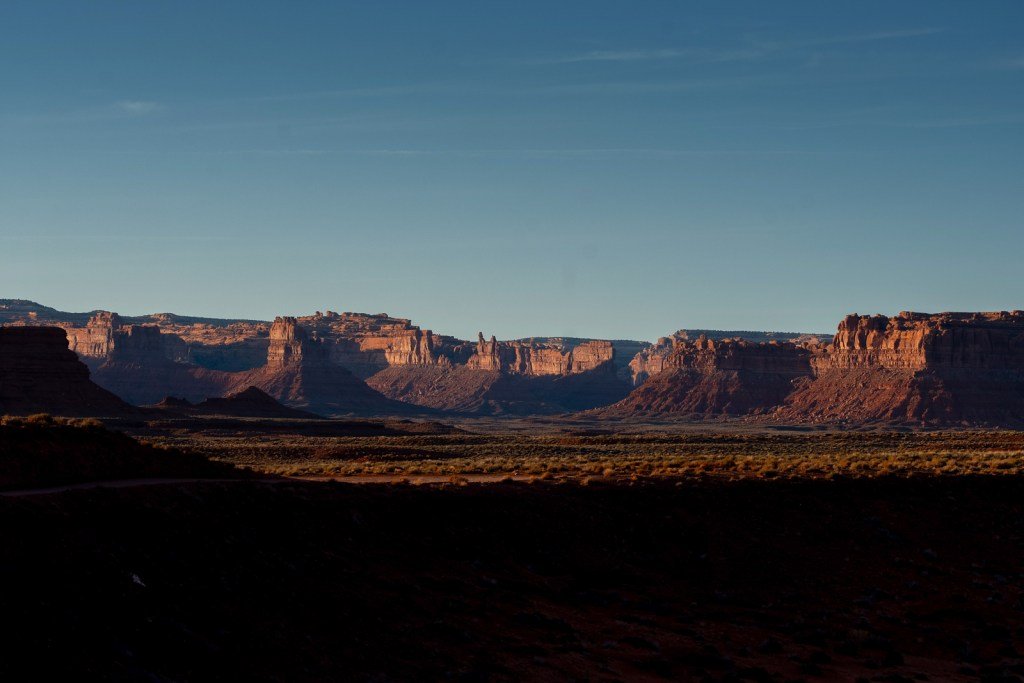

The Ancestral Puebloan “Et Al” site nestles amid thick piñon and juniper on Cedar Mesa in southeastern Utah. Archaeologists have found that the village, which was inhabited up until the early 1200s, was home to a two-story “great house” similar to those in New Mexico’s Chaco Canyon along with two kivas, shrines and other important architectural features. Another great house, the Owens site, sits farther to the north. The two pueblos are larger and more elaborate than surrounding structures from the same era, and the Owens site also features a great kiva — used for major ceremonies — suggesting that these places were gathering sites for the larger Cedar Mesa community.
Radiating out from both sites are linear, human-built swales that continue in nearly straight lines for more than a mile. The actual function of these “roads” is unknown, though they are thought to be ceremonial or symbolic constructions that not only linked communities but also led to sacred mountains or prominent landforms. The connections span generations: Hopi pottery from the 1400s — centuries after people left Cedar Mesa — has been found along the Et Al “roads,” indicating that the original inhabitants’ descendants returned to visit their ancestors’ home. The “roads” make clear that these ancient structures cannot be understood in isolation because they are an inextricable part of the region’s cultural and natural landscape.

Readers of Landline will know the history well, but for those who need a refresher: In 2016, at the request of five sovereign tribal nations with ties to the region, President Barack Obama established the landscape-scale Bears Ears National Monument on Cedar Mesa and beyond, protecting thousands of sites like those described along with the surrounding lands. A year later, President Donald Trump shrank the boundaries of both Bears Ears and the nearby Grand Staircase-Escalante National monument. They were later restored by President Joe Biden, but on July 13 of this year, Trump renewed and broadened his attack, reducing Bears Ears and Grand Staircase-Escalante by about 90% each and removing protections from more than 2.9 million acres of public lands, including nearly all of Cedar Mesa and the Et Al and Owens sites.
And these cuts are much larger than the last ones. At Grand Staircase-Escalante, Trump removed 1.69 million acres from national monument status, reviving the prospect of coal mining on previously leased areas on the fossil-rich Kaiparowits Plateau as well as uranium extraction in the historic Circle Cliffs mining district and oil and gas drilling throughout the once-protected area. Trump also eased restrictions on motorized travel, vegetation clearing and livestock grazing on what little remains of both monuments.
Trump’s order also terminated the Bears Ears Commission, which represented the five tribal nations that helped develop the monument’s management plan. As if to drive home the White House’s clear hostility to tribal sovereignty, federal agencies also removed the five tribes’ seals from official signs at what remains of Bears Ears, according to the Salt Lake Tribune.
The proclamations were purportedly issued by the authority of the 1906 Antiquities Act, which allows presidents to set aside federal land to protect natural landmarks, archeological sites and “other objects of historic or scientific interest.” However, it does not directly give a president the power to rescind or reduce a national monument; according to legal scholars, that authority is reserved to Congress. It’s a question that the Supreme Court is expected to tackle as soon as the parade of lawsuits filed by tribal nations and advocates make its way up the legal ladder.
The administration’s proclamations also argue that national monument status was unnecessary because the lands in question were already protected by other federal laws and regulations.
Of course, Trump, in his constant pursuit of “energy dominance,” is doing everything he can to diminish those same rules and regulations. One particularly underhanded move would incapacitate Section 106 of the National Historic Preservation Act, the law that theoretically protects cultural sites from development and requires consultation with tribes whose sites may be impacted.
But beyond its openly destructive deregulatory agenda, the White House’s legal justification for its monument cuts displays a notable misunderstanding of the area’s landscape and history. The administration claims that the original boundaries encompassed too much land, and thus did not comply with the Antiquities Act requirement that they be confined to the “smallest area compatible with the proper care and management of the objects to be protected.”
In its recent lawsuit seeking to eviscerate both monuments, the state of Utah acknowledged that they each contain a handful of “objects” that are worthy of protection but distinct from the surrounding landscapes and therefore should be protected on a strictly individual basis.
Trump’s redrawn boundaries follow this reductionist approach, drawing lines around the most well-known landmarks and historic sites while dismissing everything else as merely “generic topographic and geologic features.”

In Grand Staircase-Escalante, for example, Trump annihilated virtually all of the monument’s west side, leaving a tiny square and a similarly sized strip near the community of Big Water. The latter was preserved because it was where paleontologists found the bones of Sarabosaurus dahli,a new taxon of the sea-going dinosaur Turonian mosasaurid. We know that this ancient creature and its contemporaries did not restrict themselves to this tiny area; in fact, important fossils abound across hundreds of thousands of acres of the Kaiparowits Plateau. But this area is also rich in coal, oil and gas, and so, naturally, it has lost its protections.
Bears Ears, meanwhile, has been reduced to two primary units, Shásh Jáa’ and Indian Creek, along with a handful of tiny discrete units that extend national monument status to Doll House, Moon House and the Citadel, all Ancestral Puebloan sites. The proclamation also protects the Scorup Cabin, which was inhabited by the “Mormon Cowboy,” A.J. Scorup, as well as an oil well drilled in 1926. (Yes, Trump is protecting an ancient oil well from oil and gas development.)
Had Teddy Roosevelt followed similar logic when he first established Grand Canyon National Monument in 1908, he would not have protected the original 800,000 acres but rather have designated a bunch of much smaller “units,” each containing a landmark of some kind — Havasu Falls, for example, or Mather Point, Vishnu Temple or Bright Angel Point.
Roosevelt, however, understood the West better than Trump and company: He realized that sacred and significant landscapes are much more than the sum of a handful of discrete “objects.” Can you take the Vishnu Temple out of the Grand Canyon? Such so-called discrete “objects” — whether landforms, dwellings or other cultural sites — cannot be separated from the landscape itself, because doing so would rob them of their context and meaning. So, in order to protect them, as the Antiquities Act authorizes the president to do, one must also protect the landscapes that define and connect these so-called discrete objects.
The Supreme Court has previously ruled in favor of this concept. After Roosevelt wielded the newly written Antiquities Act to establish the Grand Canyon National Monument, someone with mining claims in the canyon sued, taking his case all the way to the High Court. But the justices ruled against the mining interests, writing in their opinion that the law empowered the president to “establish reserves embracing ‘objects of historic or scientific interest.’ The entire Grand Canyon, as stated in his Roosevelt’s proclamation, is ‘an object of unusual scientific interest.’”
Trump annihilated virtually all of the monument’s west side, leaving a tiny square and a similarly sized strip near the community of Big Water.
Obama brought this holistic concept to fruition on an even larger landscape when he established Bears Ears, which aimed to protect not only prominent sites like Et Al, but also the “roads,” shrines, agricultural fields and natural landforms that surround them. The “objects of historic and scientific interest” in these cases are more than discrete landmarks, as the land itself — and particularly the Puebloan sites, with their synthesis of natural form and human community — makes clear.
“Here, the human landscape is meaningless outside the natural context — human constructions are not considered out of their relationship to the hills, valleys and mountains,” wrote Santa Clara Pueblo artist, architect and scholar Rina Swentzell in a 1991 paper on Ancestral Puebloan architecture.
The material village, Swentzell wrote, “constitutes one place within the whole. The web of human existence is interlaced with what happens in the larger natural context and therefore flows into the adjacent spaces, hills, and mountains.”

We want to hear from you!
Your news tips, comments, ideas and feedback are appreciated and often shared. Give Jonathan a ring at the Landline, 970-648-4472, or send us an email at landline@hcn.org.