


A 6:40 Wake-Up and a Broken Wrist
By 7 a.m., Barrett Kitrell is already in the weight room. He does not have far to go. Kitrell lives right across the street from Ashland-Greenwood High School, where summer weights start early, and the routine has become part of his everyday life.
Even with a broken wrist, the Nebraska commit has not stopped working. He has simply adjusted. “So right now I have a broken wrist,” Kitrell said, “and that kind of hinders it a little, but not too much.” That answer says a lot about Kitrell’s offseason.
The cast has changed what he can do, but it has not changed how he approaches the summer. He is still waking up around 6:40 a.m., still getting to school for 7 a.m. weights and still preparing for one final season at Ashland-Greenwood before he enrolls at Nebraska as part of the 2027 recruiting class. “So I wake up at around 6:40. I live right across the street from the school, so our weights start at 7,” Kitrell said.
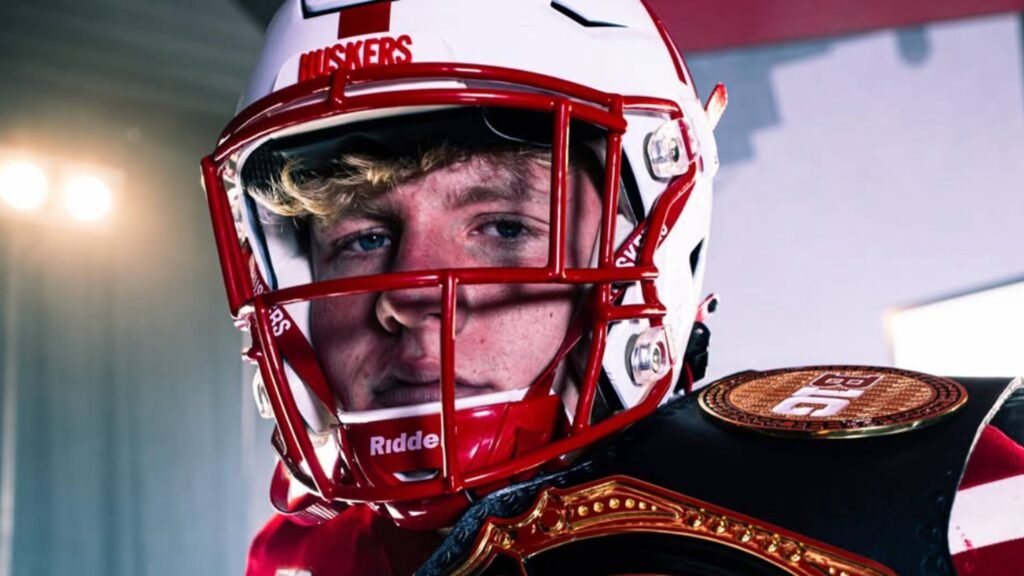
Kitrell is 6-foot-4, roughly 270 pounds and an offensive lineman at Ashland-Greenwood. He plays tackle in high school but projects as an interior guard or center at Nebraska. He is a three-star prospect, one of the top in-state recruits, a 4.0 student and a multi-sport athlete in football, basketball and track. But those are just labels. They do not explain who he actually is.
The bigger picture comes from how he spends his days: training through an injury, eating to maintain his size, stretching at night, working out at his dad’s gym and learning from his brothers, all while still trying to be a kid in Ashland, Nebraska.
Finding Ways to Train
The broken wrist has forced Kitrell to adjust, especially on days when his high school team is doing lifts that require wrist involvement. Instead of using the injury as a reason to sit out, he has found other ways to keep training the same athletic traits. “When we’re doing hang clean days, I’ll just do other plyometrics, like we have VertiMax and I’ll do, you know, other jumps, so still trying to get more explosive,” Kitrell said.
The lower-body work has stayed mostly intact. “And then on squat days, I can hold the bar, I can squat, so I can do legs.” Kitrell said. That explosiveness matters for Kitrell’s future.
Recruiting services list him around 265 to 275 pounds, but part of what makes him an intriguing prospect is how well he moves at that size. He plays tackle now, but his combination of strength, mobility and physicality projects well inside on the offensive line at the college level.
After weights, the routine moves back home. “And then after that, I go home, I eat a big breakfast,” Kitrell said. “You know, eggs, something with eggs, kind of try to vary so I don’t get sick of it.”
Then comes recovery for his wrist. “And after that, I do my bone stimulator for my wrist, try to heal that up as best as we can.” he said.
The routine is simple, but it is very much intentional. Lift. Recover. Eat. Keep stacking days.
Brick House and the Family Standard
After Kitrell gets home and refuels from his morning workout, the work is not done for the day. Kitrell heads to Brick House, the gym owned by his father. It is part training facility, part family foundation and part workplace.
“My dad owns a gym,” Kitrell said. “So I lift at the gym, and then I work a couple hours, just kind of, you know, doing maintenance stuff.” Brick House has also helped him work around the cast.
One of the best adjustments to his routine after the injury has come from a simple piece of equipment. “One thing that we’ve done that I think has been really beneficial is we got these straps on Amazon that strap on your wrists, and it’ll go over my cast,” Kitrell said. “And so we have a cable machine at Brick House, which is my dad’s gym, and you can attach the straps to the cable machine, so I’ve been able to hit pretty much every muscle group.”
Kitrell knows it is not a perfect replacement for everything he would normally do, but it has helped him keep building. “Obviously nothing substitutes for a bench press or, you know, dumbbells,” Kitrell said. “But I think I maintained a little bit of muscle and strength and haven’t really lost it all.”
The work does not stop there. Kitrell is the youngest of five brothers, and athletic standards have always been part of the household. His brother Brett played Division I offensive line, and Kitrell trains position work with him three times a week.
Another brother, Bryce, handles a different part of his development. “And then my brother Bryce, really fast guy, really into speed training,” Kitrell said. “And so I speed train with him three times a week.” The two types of work give Barrett a balance that matters for an offensive lineman: power, technique, footwork, explosiveness and speed.
By early afternoon, most of the structured work is done. “All those activities get done around like 1 or 2.” Kitrell said.
The Influence Family Has on Him
His family influence goes deeper than training partners. His father, Barry, played at Nebraska, walking on before earning a varsity letter as a fifth-year senior on a Big Eight championship team.
But Barrett said his dad’s impact has never been about forcing football or any sport on him. “I think that it’s a mixture between, you know, pushing us and preaching hard work and also allowing us to want it for ourselves.” Kitrell said.
The message is simple. If you want something, the work has to match it.
“He’s never been a guy who’s like, ‘You have to do this, you have to do this,’” Kitrell said. “It’s like, ‘Hey, you say you want to do this? The only way you can do this is hard work.’” The gym gave the family access. The mindset gave the work meaning.
“Him owning a gym has been huge. So we can go down there anytime we want to lift.” Kitrell said. His dad also preached more than lifting. “He played at Nebraska, so he knows what it takes from a physical standpoint. Also just like the nutrition. He preaches sleep a lot too.” Kitrell said. For Kitrell, that helped build a foundation that he and his brothers lean on every day. Fueling, Stretching and Staying Mobile
The most important thing Kitrell knows is that the training only works if he can fuel it. At his size, with the workload he carries, eating is part of the job. “I just eat really pretty clean.” Kitrell said. That does not mean eating small. It means trying to get enough calories from the right places. “Last night for dinner I had four chicken breasts.” he said.
The main focus is simple. “Protein and carbs mainly.” he said. For Kitrell, nutrition is not separate from football. It is part of the process of maintaining the size, explosiveness and strength he needs to play offensive line while also managing the demands of being a three-sport athlete.
Chicken comes up often in his routine. So do carbs. “For lunch, try to have chicken as much as I can, you know, clean carbs, while still eating a lot of calories, but, you know, getting the protein up.” Kitrell said.
Different Sports, Different Weights
Football, track and basketball each ask something different of his body. “Football obviously in the fall, try to be, you know, around 270, 280, kind of fluctuating in those,” Kitrell said. Basketball has usually meant dropping weight. “Basketball, I try to cut down a little bit to like 250,” Kitrell said. The reason is practical. “Just for a little bit on my knees to stay quicker,” he said. Track puts him somewhere in the middle. “With track, yeah, so try to get around 260 and 270 mark just to stay strong and explosive and to be able to lift as heavy weight as I can.” Kitrell said.
The ability to adjust his body across sports has helped him become more than just a big offensive lineman. It has helped him build quick feet, body control, speed and explosiveness. His track background also carries a family connection. His brother Brett once held Ashland-Greenwood’s discus record, and Barrett broke that record in 2026.
But during the summer, the priority is focused on one thing. “The summer is offseason for football,” Kitrell said. “That’s how we take it.”
One of the most important parts of his routine happens at night. It is not another lift. It is not another meal. It is one simple thing. Stretching. “I would say the biggest thing for maybe my getting to be where I’m at today is stretching at night,” Kitrell said. The nightly mobility work is something he believes has helped him immensely as an athlete, especially for an offensive lineman trying to stay low, bend and move. “I stretch, you know, my whole lower body. Then my upper body a little bit when it’s healthy.” he said.
The focus is detailed: quads, hips, hamstrings, calves, groin and deep squat positions. For Kitrell, it is about keeping his body loose enough to move the way he needs to at the line of scrimmage.“I just try and stay as mobile and stay as elastic as I can,” Kitrell said. He believes that has helped him play lower and stay more explosive.
“I think it has been a huge thing and just being able to get low.” he said. That ties directly into what he wants to prove as a senior. He wants to improve his pass protection technique and stay lower in the run game, especially when fatigue sets in. “Honestly, I just want to kind of improve my pass protection technique and then staying a little lower on run blocks,” Kitrell said. “Sometimes I stay a little higher when I get gassed.” Pass protection has been a major focus this summer. “I worked on it with my brother Brett a lot this summer on pass pro, and I think my technique has been a lot better.” Kitrell said.
He knows he has the athletic ability. “I have quick feet and I know that,” he said. But he also understands that offensive line play is more technical than many casual football fans realize. “The technique is really hard,” Kitrell said. “Like it’s harder than it looks.”
Still Finding Time to Be a Kid
For all the structure, lifts, eating, stretching and training, Barrett still tries to find a way to just be a kid in Ashland. After weights, Brick House, extra training, food and recovery, he wants to get outside and be with his friends. “After that, try to just, you know, be outside, do some activities with my friends, play pickleball, swim. You know, just try to, you know, be a kid, fish,” Kitrell said. That balance matters.
Kitrell’s schedule is serious, but he still talks like someone who enjoys the regular parts of being a 17-year-old. That includes video games. He likes the college football video game, although the wrist has made it tougher to play right now. He and his friends still jump on older favorites. “Sometimes we hop on Star Wars Battlefront II.” he said. Fortnite also makes its way back into the rotation from time to time. “When Fortnite gets good, we’ll play Fortnite.” Kitrell said. But like a lot of players his age, he said games tend to come in phases. “Minecraft’s got that two-week phase, and I always kind of do those,” Kitrell said. “But I feel like Fortnite has now gotten like a two-week phase.”
That is something people can forget. Yes, these are Nebraska football commits. Yes, they are living the dream for a lot of kids across the state. Yes, the expectations are real. But they are still kids. Kids who want to go fishing. Kids who want to play video games. Kids who want to enjoy summer nights in their hometown.
Why Ashland Matters
When asked about his favorite part of the Ashland-Greenwood area, Kitrell did not start with football. He started with the people.
“My favorite part about Ashland is just, you know, everyone. ” Kitrell said. The small-town atmosphere is something he values. Whether he is walking down the street, eating at a local restaurant or spending time around town, he feels connected to the people around him. “Everyone’s so friendly and you just, you know, can have conversations with anyone.” Kitrell said.
To him, Ashland feels like more than a place to live. “It’s just like a super tight-knit community,” he said. “It’s almost like a family.” That same community is part of what motivates him heading into his senior year. It is also where he spends time with friends when football and training are done for the day. “Fishing’s a big one. But I would say probably the biggest one is Frisbee golfing.” Kitrell said. Ashland has an 18-hole course that has become a regular stop for him and his friends. “Ashland’s got a nice 18-hole course that we play all the time.” he said. Yes, Kitrell is chasing big dreams and has a bright future. But he still knows where his roots are.
How Nebraska Became the Fit
Barrett Kitrell committed to Nebraska on June 22, 2026, choosing the Huskers after a recruitment that came down heavily to Nebraska and neighboring Iowa, with Tennessee also pushing late. He also held offers from Kansas, Kansas State, Minnesota and Iowa State.
But his connection to Nebraska goes deeper than a recruiting board. Kitrell did not describe himself as someone who had a dream school growing up the way many kids do. His family had connections to different programs, and he watched a lot of college football.
“Honestly, I didn’t really have like a dream school growing up,” Kitrell said. “It was probably the Huskers because I watched them the most.” His brothers’ paths exposed him to other teams. He mentioned watching different programs on Saturdays because of where family members played.
But Nebraska was always different. “Obviously my favorite school was Nebraska,” Kitrell said. Looking back, he knows what the answer really was.“ Deep down, my favorite dream school was definitely Nebraska.” he said. That made the commitment mean more. It was not just about choosing a school. It was about staying home and becoming part of the program he grew up watching and loved.
Kitrell is set to become the third member of his family to wear the Nebraska uniform, following his father Barry and brother Bo. “That’s been really cool to kind of, you know, fulfill my dream as a Husker football player.” Kitrell said.
A major part of the decision came down to offensive line coach Geep Wade. Wade offered Barrett shortly after arriving at Nebraska, and the relationship continued to grow through multiple visits. Kitrell visited Nebraska five times, including his official visit weekend in June. He also took an official visit to Iowa, but Nebraska’s staff, family feel and development plan ultimately helped close the door. What stood out most about Wade was not a sales pitch.
It was honesty. “The thing I like about him the most is that he’s just like no bull crap,” Kitrell said. From the first time Wade offered him and laid out a plan, Kitrell felt the relationship was real. As the visits continued, it only grew stronger. “I can just ask super hard questions and he’ll tell me the honest truth,” Kitrell said. He also saw another side of Wade during his official visit. “Just kind of seeing his goofy personality on the official visit. Him doing stuff that I didn’t think he’d ever do,” Kitrell said.
But the biggest football reason was Wade’s track record. Kitrell paid attention to what Wade accomplished at Georgia Tech. “What he’s done at Georgia Tech, what he did with less resources than Nebraska is, you know, incredible,” Kitrell said. He liked the way Georgia Tech’s offensive line played. “Their offensive line last year was just a bunch of dogs,” he said. That made him excited about what Wade could build in Lincoln.
“I think him being at Nebraska, having more resources is insane,” Kitrell said. For Kitrell, Wade’s personality, honesty and development plan all connected. “I just think that, you know, he’ll bring the Pipeline back.” Kitrell said.
‘A Super Tough Decision’
Recruiting can look easy from the outside. But Kitrell saw both sides of it. The visits were exciting, but they also made the decision harder. “The most fun and the toughest part was the official visits,” he said. “You get treated like a king, whatever. But it was a super tough decision.”
Once he made his choice, there was no hesitation. “I’m 100 percent into Nebraska because I made that decision,” Kitrell said. Getting to that point was not always easy.
He had to build relationships with coaches at other schools, and saying no was difficult. “Telling coaches no is kind of tough because you built that relationship with them for, you know, months on months.” Kitrell said.
The winter was another challenging part of the process. He had not narrowed things down yet and wanted to keep as many doors open as possible, which meant constant communication with coaches across the country. “I was just so busy texting and calling coaches and getting texts all the time,” Kitrell said. “And so that kind of weighed on me.” He never lost sight of the fact that it was a good problem to have, but it was still a lot for a kid to handle. “It’s obviously a blessing and a good thing, but sometimes it just becomes a lot,” he said.
When he announced his commitment, Kitrell led with his faith, saying, “All glory to my Lord and Savior Jesus Christ.” The decision connected faith, family, football and home. And in many ways, that is what makes Kitrell’s summer different. The early mornings, the modified workouts, the VertiMax jumps, the bone stimulator, the straps over the cast, the clean meals, the stretching, the time at Brick House and the training with his brothers are all part of the same story.
Kitrell is preparing for Nebraska, but he is also still living the life that helped get him there. He is a 17-year-old trying to enjoy summer in Ashland with his friends. He is the youngest brother in a competitive family. He is a three-sport athlete learning how to manage his body. He is a Nebraska commit working through an injury without letting it slow him down.
His future is waiting in Lincoln, but his foundation is still right there in Ashland.
Stay up to date on all things Huskers by bookmarking Nebraska Cornhuskers On SI, subscribing to HuskerMax on YouTube and visiting HuskerMax.com daily.
 Add us as a preferred source on Google