



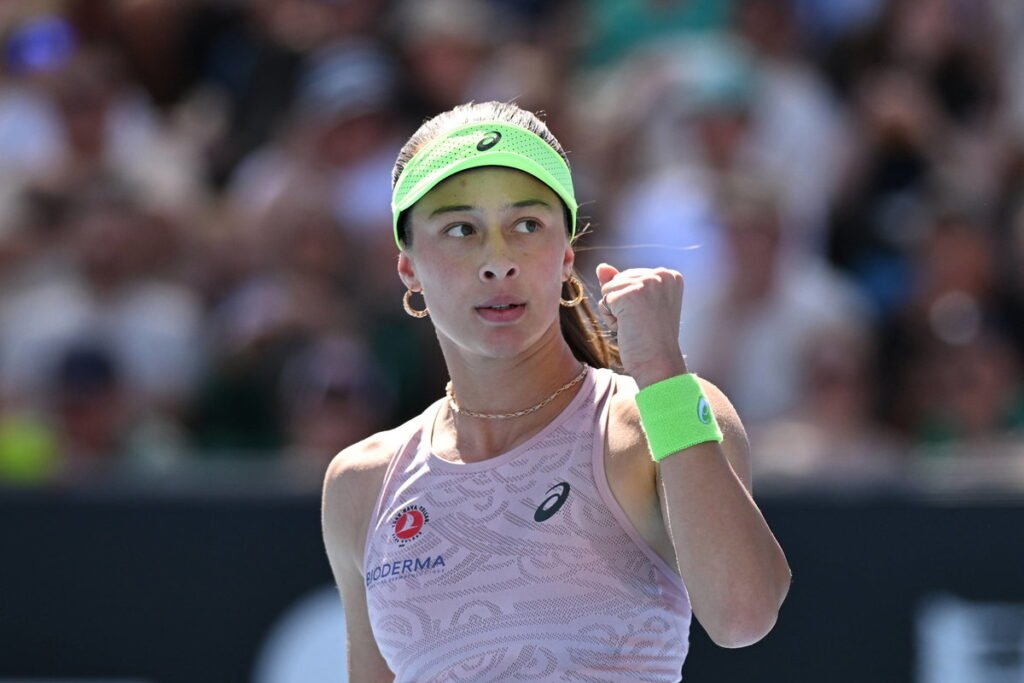
Zeynep Sonmez did not get the pin she wanted, so she found another way to make her point. The Turkish number one revealed she clashed with tournament organizers after being told she could no longer wear a pin supporting Palestine, a rule she says was applied inconsistently compared to other symbols on tour.
“I used to wear a pin. Tournaments no longer allow me to wear it,” explained Sonmez, speaking to Anadolu. “We had a discussion with the organizers because the Ukrainian flag is allowed but Palestine is not.”
“They ultimately told us they definitely would not allow it,” she added. Rather than let the matter drop, the 24-year-old pointed to a loophole in the rules governing her equipment. “I can use the vibration dampener, and they can’t object to that. That’s why I put the watermelon symbol on my racket,” she said.
Just days before Wimbledon started, she climbed to a career-high world No. 51, becoming the top-ranked Turkish player in WTA history. Twelve months earlier, she had already made history at the All England Club by becoming the first Turkish player, man or woman, to reach the third round of a Grand Slam in the Open Era. It was coming after a series of breakthroughs, first WTA Tour title in Merida in 2024 and a fourth-round finish at this year’s Australian Open, where she defeated world No. 11 Ekaterina Alexandrova in the first round.
Since November, she has also had former world No. 2 Ons Jabeur working alongside her as a mentor, with Jabeur’s long-time coach Issam Jellali now leading her team full-time. Sonmez was eliminated in the second round of this year’s singles campaign when she lost to Claire Liu of the United States 7-5, 6-3, but the dispute about the pin had already become a subject of discussion about her games by that time.
In recent years, the watermelon has been adopted as a symbol of Palestinian solidarity, especially because of the fact that its color resembles the Palestinian flag without featuring it directly. Sonmez leaned on that association once the pin itself was off the table. It also meant that even when officials closed one door, her racket still had the message she wanted to convey every time she walked out to compete.
Reflecting on the second-round defeat itself, Sonmez was candid about where things went wrong against Liu. “I didn’t play very well. I couldn’t play according to the game plan I wanted. It wasn’t a day when I played good tennis or felt the ball well,” she said.
She acknowledged her opponent’s strong performance at crucial junctures, suggesting she herself would have needed to match that intensity in key moments rather than allowing Liu to gain an advantage through unforced errors. It was a rare off day in what has otherwise been a career-best season, and one Sonmez seemed to view as a blip rather than a pattern.
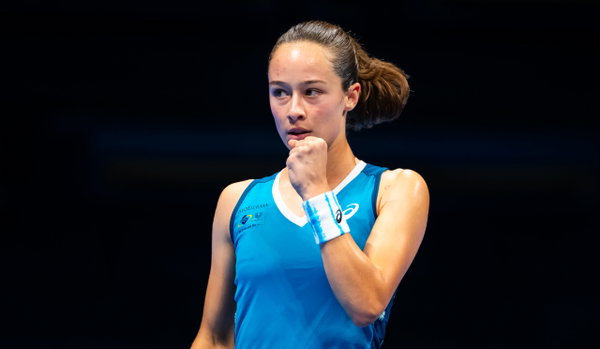
Even in defeat, she was quick to point to the reception she received throughout the fortnight. “I never felt alone at this tournament. I felt as though we were all playing together and all together on the court. That means a great deal to me. So I thank everyone very much,” she said, referencing the Turkish supporters who had followed her progress through the draw.
With her singles run over, Sonmez had hopes in the doubles draw, but that also did not end in her favor. She was partnered with Spain’s Jessica Bouzas Maneiro and lost in the first round against Shuko Aoyama and Liang En-Shuo in three sets. This concludes her days at the All England Club, but not before making a statement she wanted to.