



Staying cool during a heat wave is vital. If you don’t have an air conditioner, a good tower fan is a cheaper alternative and can go a long way to improving your comfort. Tower fans can even provide effective cooling in milder weather, allowing you to save energy by turning up the thermostat or skipping the AC entirely. Their tall, slim form makes them suitable for most rooms without taking up valuable space — some models even come with smart features.
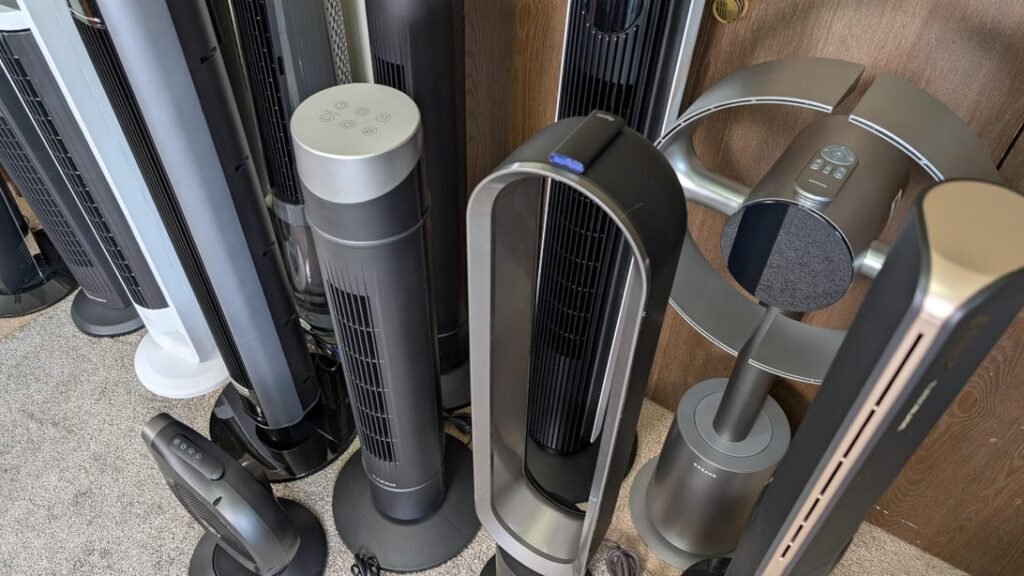
Tower fans seem deceptively simple, but they’re a surprisingly complex balance of airflow, air texture, loudness, sound quality, energy efficiency and convenient features. I dug deep into 14 of the latest tower fan models to see which has the best balance of these attributes through rigorous testing. While my testing is far from lab-controlled conditions, I used an anemometer to measure airflow, a sound meter and energy-tracking smart plugs, along with some help from my own senses, to explore what makes an outstanding tower fan.
What is the best tower fan?
My top pick for the best overall tower fan is the Zafro Smart Tower Fan 36, which balances airflow, air texture, loudness, white noise, energy efficiency and excellent features exceptionally well — and for a very competitive price. It’s not the most powerful or quietest model out there, but it’s near the top of the class in almost every way.
Best tower fans
Pros
- Excellent user experience for the price
- Excellent airflow
- Reasonably quiet on most speeds
- Great energy efficiency
- Adjustable oscillation range
Cons
- Moderately clicky remote
- No mesh screen filter
- Oscillation hums on lower settings
- Good air texture, but could be better
Why I like it:
When I began my research, I knew nothing about Zafro, so it was a pleasant surprise to see it perform so consistently well, despite not being as powerful, quiet or energy efficient as rival tower fans. This makes it the ideal tower fan for this list because it doesn’t seem to sacrifice any particular feature to make another one better. For example, it has respectable airflow, ranking fifth out of the 14 fans I tested in terms of median airflow and fourth most powerful overall. This means it’s more than capable of moving air within a room.
I also appreciate the thoughtful design, including one of the very few adjustable oscillation ranges in the lineup — from as little as 30 degrees to 120 degrees in 30-degree increments — which acknowledges that not everyone wants a typical 90-degree oscillation range. And other than the massive asterisk that is OmniBreeze, Zafro 36 stands alongside the Dreo 554S as the most affordable smart tower fan on the market.
Who is this for:
Zafro 36 is a great all-rounder for people who want a rich set of features, including smart home controls, without busting their budgets. At $90, it’s pricier than non-smart tower fans, but not by so much that it feels excessive.
Who shouldn’t buy it:
The reasons why you wouldn’t want Zafro 36 mostly stem from its not dominating any testing categories. For example, it has good air quality and white noise, but it doesn’t deliver them as well as the Levoit Classic 42-Inch. Likewise, it lacks the mesh-screen filter that makes the Shark TurboBlade and OmniBreeze Wi-Fi much easier to maintain. Plus, it’s nowhere near as compact and affordable as the Vornado Strata 8 Omni. Additionally, its one-year warranty is rather anemic compared to most rivals.
… Show more
Pros
- Most efficient fan on this list
- Panoramic oscillation, horizontal and vertical
- Exceptional quietness
- Great for small spaces
- 5-year warranty
Cons
- Confusing display
- Average airflow
- Hum, wobble and slight whine spoil otherwise excellent white noise
- Requires a screwdriver to assemble
Why I like it:
The Vornado Strata 8 Omni’s compact design doesn’t scream “tower fan,” but its 180-degree adjustable panoramic oscillation — with a vertical mode — makes it just as suitable for the floor as a table. Having this level of flexibility is key to the Strata 8 Omni’s position as my budget pick. The small size also means you’re getting impressive energy efficiency for the airflow. For example, Vornado Strata produced a median airflow of 335 feet per minute, the same as Midea Detachable, while using a fraction as much energy — only 13 watts on high.
In terms of quietness, only the Shark TurboBlade comes close to matching the Vornado Strata 8 Omni, with the former slightly quieter at low speeds and the latter at maximum power. Vornado also has an unmatched five-year warranty, placing it far ahead of the two-year coverage offered by Dyson, Dreame, Lasko, Levoit, Midea and Shark.
Who is this for:
You might want the Vornado Strata 8 Omni if you live in a small home or tiny house. It’s easy to store and fits almost anywhere you need it. It also has an outstanding air texture that feels great in small rooms. $75 is a fantastic price for this kind of performance.
Who shouldn’t buy it:
I still haven’t mastered the panoramic oscillation controls or the on-device display, which uses a system of numbered codes to indicate which oscillation mode is active. I’m sure I’ll figure it out given enough time. The airflow for this unit isn’t low by any means, but you should expect it to be as powerful as something like Dreo and Zafro.
There are a few minor quirks that detract from the white noise — a wobble and slight whine — but nothing annoying. Lastly, you’ll need a screwdriver for assembly, as the base doesn’t attach with a simple locking system like other brands. And unlike the Dreame MF10, which also requires a screwdriver, it doesn’t include one in the package. You could say this is a win for reducing potential waste, but it slows setup time.
… Show more
Pros
- Outstanding energy efficiency
- Outstanding air texture
- Adjustable louvers to redirect airflow
- Excellent white noise profile
- Great smart home features
Cons
- Odd remote control storage slot
- Above-average price
- Average airflow
Why I like it:
Levoit is a frequent top contender in many product comparisons, so unsurprisingly, the brand makes a strong showing here with the Levoit Classic 42-Inch smart tower fan. It’s second only to the Vornado Strata in terms of energy efficiency, sipping between 2 watts and 19 watts. I’m also a huge fan of its air texture — it’s the only traditional tower fan that earned a perfect score and felt as good as bladeless models from Dyson, Dreame and Shark.
While it lacks vertical oscillation, I appreciate Levoit’s inclusion of adjustable louvers that you can use to direct air circulation up or down, achieving a similar effect to Shark TurboBlade’s, albeit less extreme. I love the whooshing sound of Levoit’s white noise on the highest speed, and its low-speed hum isn’t distracting enough to dislike.
Who is this for:
The Levoit Classic 42-Inch is every bit as capable as the Zafro and the Vornado Strata, and has the best app and smart home controls in this comparison. It’s a little pricier than average — $130 — but worth the investment for most people.
Who shouldn’t buy it:
Although I found no major issues with this fan’s lower airflow relative to Dreo, Zafro and OmniBreeze, it may not work for people who want raw power. My biggest complaint is that the remote slot on the back of the machine is a little finicky, and you have to remove the remote to access the fan’s carrying handle.
… Show more
Pros
- Unmatched, powerful airflow
- Comfortable indoor misting function that doubles as a humidifier
- Outstanding white noise
- Persistent mute
- Smart home controls
Cons
- The loudest tower fan on our list
- Very heavy, almost 18 pounds
- Relatively expensive
- Moderate energy efficiency
Why I like it:
The Dreo TurboCool Misting Fan 765S exceeded every expectation I had from its name — it was the only tower fan to surpass the 1,000 FPM barrier during max-speed testing. Only another Dreo fan even came close, the 554S, but still lagged. Dreo’s decision to integrate ultrasonic misting tech also gives the 765S a real cooling advantage over other indoor tower fans, bringing evaporative cooling into the equation rather than relying solely on airflow. The misting tech doubles as a humidifier and shouldn’t make any surfaces wet unless you place objects closer than the recommended 5-foot distance.
Dreo TurboCool leverages the unit’s inherent loudness and high airflow to create some of the most satisfying white noise in a tower fan. But the brand also has a persistent mute setting that remembers to turn off interface sounds until you want them back.
Who is this for:
If you want powerful cooling with a side of humidification, then the Dreo TurboCool Misting Fan 765S is unbeatable, especially in bigger spaces. Still, at $200, it’s more expensive than most tower fans, which is normally the realm of bladeless tower fans like the Dyson Cool and Dreame MF10.
Who shouldn’t buy it:
High airflow comes with a significant downside: loudness. Dreo TurboCool registered a maximum of 59 dBa during testing, about 8 decibels louder than the quietest fans, such as the Vornado Strata and Amazon Basics. Due to the logarithmic nature of sound measurement, it’s much louder than it seems on paper. Still, 59 dBa isn’t dangerous or overly disruptive, but you’ll need to use a lower speed for the Dreo TurboCool to be quiet enough for sleeping.
The misting tech also presents challenges, including increased weight (to prevent tipping) and more frequent cleaning. While not the worst offender in fan-only mode, the TurboCool uses a fair amount of electricity and certainly uses extra when misting is active.
… Show more
Pros
- Affordable for a bladeless fan
- Outstanding air texture
- Extremely quiet
- Silent, strongly magnetic remote
- Excellent oscillation options
Cons
- Expensive, compared with most tower fans
- No smart home controls
- Low airflow
- Loses some energy efficiency at higher settings
Why I like it:
Shark TurboBlade proves that you don’t need to spend $400 on Dyson Cool to get an outstanding, sleek bladeless fan. Like all of the bladeless models on this list, the Shark TurboBlade has such a pleasant, smooth air texture and good white noise. It’s also one of the quietest tower fans I tested, topping out at a relatively low 53 dBa, though not as quiet as Vornado Strata’s 51 dBa. However, the 39 dBa noise level on medium speeds is the quietest in that category. It’s also one of the few models with a mesh filter screen to reduce dust and keep cleaning simple.
The TurboBlade has my favorite remote-control storage option: a relatively strong magnet that keeps the remote easily accessible on top of the central column, so it’s not in danger of falling off when you move the fan to another location. While not as versatile as the automatic dual-oscillation on Dreame MF10, Shark’s ability to rotate the tower sideways — as well as each side blade — and adjust the height offers a huge amount of flexibility. Like with Zafro and Vornado Strata, you can adjust Shark’s oscillation range.
Who is this for:
Bladeless tower fans like the $200 Shark TurboBlade are at the upper end of the price range compared with most fans, so they’re not budget-friendly. Still, it’s a great option if you want an excellent air texture and modern design.
Who shouldn’t buy it:
None of the bladeless tower fans were particularly powerful in terms of airflow, and Shark’s energy efficiency dips drastically at higher speeds. Shark also lacks smart home features.
… Show more
Pros
- Outstanding value
- Smart home controls
- Excellent airflow
- Removable mesh filter screen
Cons
- Seasonal Costco exclusive
- Relatively loud with a whiny white noise profile
- No persistent mute setting
- Relatively high energy usage
- Poor air texture
Why I like it:
The OmniBreeze Wi-Fi is a unicorn among tower fans. It packs in almost every modern feature you can imagine, like smart home controls, a mesh filter screen, and reasonably powerful airflow. Better yet, it does this for $40, nearly half the price of Vornado Strata and Lasko WhisperForce, and only $10 more than the bare-bones Amazon Basics 28″.
More than half of the tower fans on this list have smart home capabilities, but they tend to cost $100 or more on average. For comparison, you can buy the OmniBreeze for $50 less than the next-cheapest smart tower fans from Dreo and Zafro — making its $40 price less than half as much. While the reasonably affordable Lasko WhisperForce has a mesh screen filter, it’s more difficult to remove for cleaning, but the only other filters on this list are available on pricey bladeless fans from Dreame and Shark. In terms of power, the OmniBreeze ranked fourth overall. Only the Dreo models and the Zafro 42 surpassed it.
Who is this for:
While OmniBreeze Wi-Fi makes a few trade-offs to achieve its low price, I’m happy to look the other way on most of them — and none are particularly egregious. The best value for anyone looking to save cash on a great tower fan.
Who shouldn’t buy it:
The downsides of the OmniBreeze Wi-Fi are many. Perhaps the biggest is that you need a Costco membership to buy one. (It may be available elsewhere, but Costco is the most consistent and affordable.) Costco exclusivity also means you’re less likely to find it in stock during the off-season, like the competition. Additionally, the fan is fairly whiny at any speed, but especially when oscillating. This is because it uses internal oscillation: it’s the only fan in our lineup where part of the body rotates instead of the whole thing. It’s one of the loudest fans on low and medium speeds, but both Dreo units I tested are still louder.
Speaking of loud, the control beeps are a bit obnoxious, and you need to silence them every time you turn the fan on — it doesn’t remember the mute setting once powered off like most tower fans. OmniBreeze Wi-Fi doesn’t use as much energy on low as the Vornado OSCR37 AE, but it’s still the second least-efficient tower fan I tested. It’s tied with Dyson Cool and Vornado OSCR37 AE for the most power-hungry on its highest setting. Lastly, the air texture isn’t great — it feels very turbulent compared to other fans, only the Amazon Basics 28″ felt worse.
… Show more