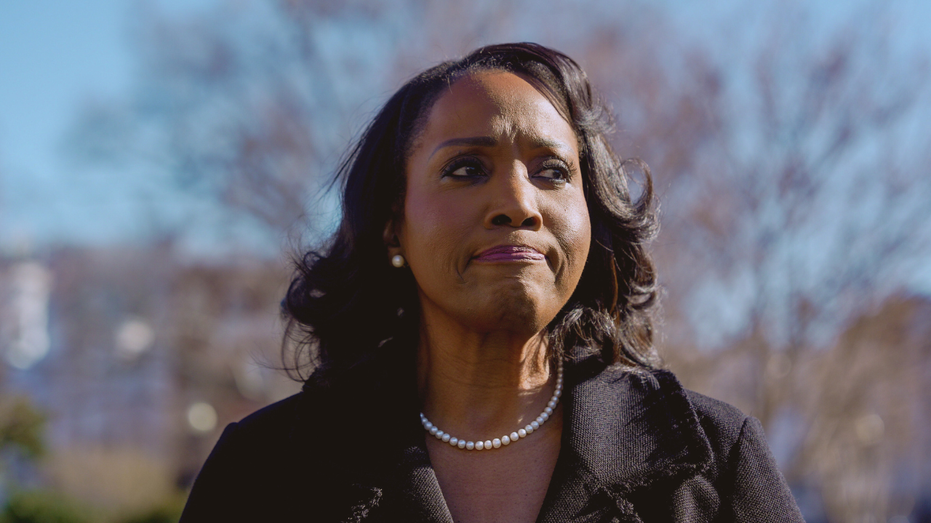


Sylvie Andrews and her partner didn’t just lose the new house they’d helped build when the Eaton Fire ripped through Altadena, California, in January 2025. They lost an entire decade’s worth of sacrifices they’d made to put down roots in their hometown, and the community they’d created. “We put a lot of blood, sweat and tears into it,” Andrews said. “That’s what we lost in the fire.”
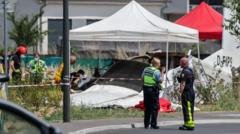
That fire, along with the Palisades Fire to the north, destroyed over 16,000 structures and killed 31 people. But while Andrews and thousands of Angelinos were racing to evacuate, other people saw a financial opportunity. Using Polymarket, the world’s largest prediction market platform, they made bets on the fires — how they would grow, how long they would last and how much they would destroy.
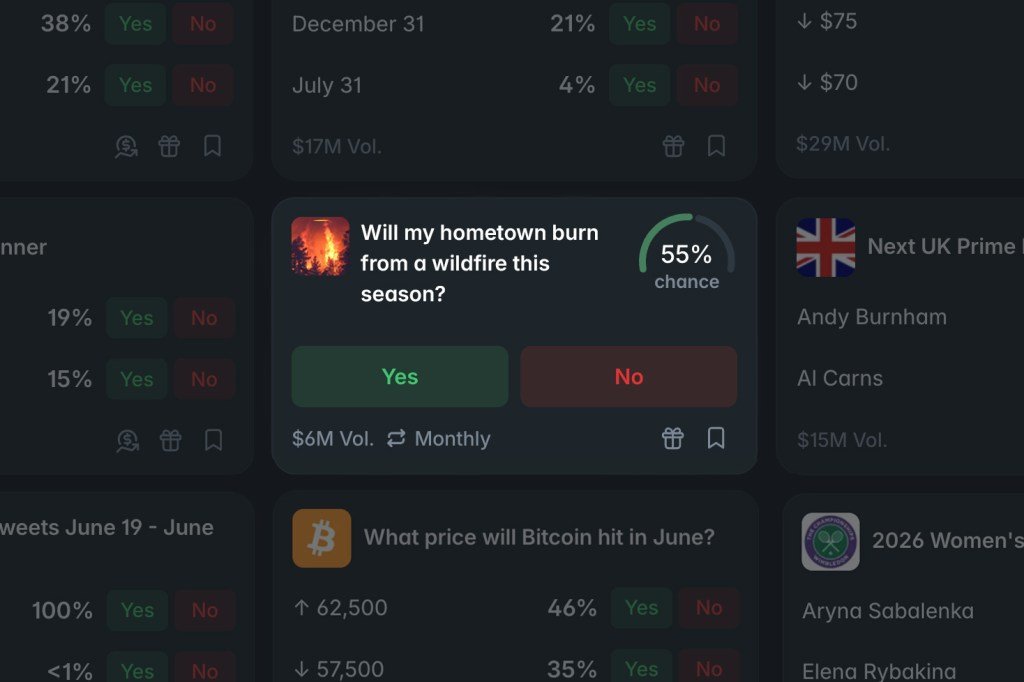
Prediction markets are essentially gambling websites where people bet on the outcome of events, including elections, sports, the weather and more. Anything is fair game, from oil prices and the spread of infectious diseases to international incidents. Markets usually frame questions in a “yes” or “no” fashion, with the price of a “contract” fluctuating between $0 and $1. A price of 50 cents on a “yes” contract means that the people doing the betting collectively believe the event has a 50% chance of happening. Market hosts make money by charging a fee on wagers.
In January 2025, Polymarket listed almost 20 questions, created by the platform’s “markets team,” related to the wildfires burning up Southern California. How many acres will the Palisades Fire burn by Friday, three days after it ignited on a Tuesday? Will the Palisades Fire reach Santa Monica by Sunday? When will the Palisades fire be 50% contained? Will the Palisades and Eaton fires be contained before February?
People spent $1.2 million betting on these queries, according to Aeon Magazine. “Wow,” Andrews said repeatedly when she learned the figure. “My first take is that it’s morally reprehensible,” she said. “The fact that someone would feel OK doing that flabbergasts me.”

“The prediction markets are just the wild, wild West,” said Susan Sherman, who grew up in the Pacific Palisades. She lost her childhood home in the Palisades Fire; her late parents had owned it since 1963, and now, it was gone. She sold the empty lot a few months ago. “I look at (betting on the fires) as just being very crass and heartless.”
As prediction markets boom and a new wildfire season begins, fire survivors and ethicists say that the betting encourages and rewards callous thinking — and dangerous behavior, too.
ONE MAJOR CONCERN stemming from wildfire prediction markets is arson. “That’s what has me nervous,” Sherman said. Theoretically, making a bet could give someone the perverse incentive to start a fire, or help one grow. Unlike other disasters, such as hurricanes, flooding or extreme heat, a fire can be manipulated in minutes by just one person. “Systems that tie financial gain to wildfire outcomes risk encouraging misuse, including arson, and are not compatible with our mission,” a spokesperson for the U.S. Forest Service said.
“Imagine what a bad actor might do,” said Ann Skeet, the senior director of leadership ethics at the Markkula Center for Applied Ethics at Santa Clara University. “A market that might support that kind of activity, I think, is a dangerous market.” Firefighters or land managers with exclusive information about a fire’s behavior or an agency’s firefighting plans could even be tempted to bet on a fire, which would be considered insider trading.
But the biggest dilemma is largely an ethical one. “When you start gambling on somebody’s potential death or harm, you’re really diminishing the value that you’re placing on human life,” Skeet said.

BETTING ON A WILDFIRE’S OUTCOME isn’t just limited to general prediction market platforms anymore. This year, ahead of what’s likely to be a busy fire season in the West, a new prediction market specifically focused on California fires was launched. Called “Wyldfyre,” it bears the tagline: “You can’t predict wildfire. But you can trade on it.” High Country News was unable to determine the platform’s owner or the owner of its website’s IP address; the website is opaque, with no contact information listed.
Currently, Wyldfyre users can only simulate trading, but according to the site, the ability to bet with real money is “coming soon.” The platform purports to be the first prediction market of its kind, pricing county and city wildfire risk in real time. “California burns. Every year. And it’s getting worse. The question isn’t if — it’s where and when,” the site reads. It includes hotspot data from NASA and National Interagency Fire Center fire perimeters to help gamblers make predictions.
Proponents of prediction markets say the platforms generate useful information through crowdsourcing. Wyldfyre frames its platform as providing a public good. “Wyldfyre turns collective intelligence into better wildfire forecasting — one trade at a time,” the site reads.
But entities with a real need for wildfire forecasting, including federal and state firefighting agencies, say they aren’t interested in prediction market data. “The Forest Service does not use information from prediction markets for wildfire forecasting, and we do not rely on any system that treats wildfire as an event for speculation,” an agency spokesperson told High Country News. “Our priority is protecting firefighters, communities, and public lands, and our fire analysts use validated science, proven predictive tools, and data from federal partners such as the National Weather Service, NOAA, and the National Interagency Fire Center.”
“The Forest Service does not use information from prediction markets for wildfire forecasting, and we do not rely on any system that treats wildfire as an event for speculation.”
California’s state firefighting agency has a similar policy. “CAL FIRE does not use prediction‑market-derived data in wildfire forecasting or operational decision‑making, nor are we currently evaluating that type of system,” said Phillip SeLegue, staff chief of CAL FIRE’s intelligence program.
The agency uses a “scientifically based fire-behavior modeling” program to generate a fire-spread prediction when a 911 call for a wildfire is processed, SeLegue said. The automated program uses weather observations, forecast data, fuel and vegetation conditions, topography, location data and information on available resources. “Our modeling is deterministic and physics‑based; it is not informed by markets, wagering systems, crowd predictions or any other form of prediction‑market mechanism,” SeLegue said.
AS PREDICTION-MARKET BETTING soars in popularity, politicians are beginning to try to rein it in. Representatives from Utah and California introduced federal legislation in March that would prohibit betting “related to terrorism, assassination, war, gaming, or illegal activity,” according to a press release. A California senator introduced companion legislation that would also prohibit contracts about “an individual’s death.”
Meanwhile, Minnesota just became the first state to outlaw hosting or advertising (though not betting on) prediction markets; the federal government promptly sued the state for over-stepping its authority. None of the proposed restrictions at a state or federal level explicitly include wildfire — at least not yet.
While state and federal governments struggle to control prediction market betting, Andrews has an idea. “If someone won money in gambling with our fate, I would hope that they might be ashamed of themselves,” she said, “and take that money and donate it directly to fire survivors.”
We welcome reader letters. Email High Country News at editor@hcn.org or submit a letter to the editor. See our letters to the editor policy.