



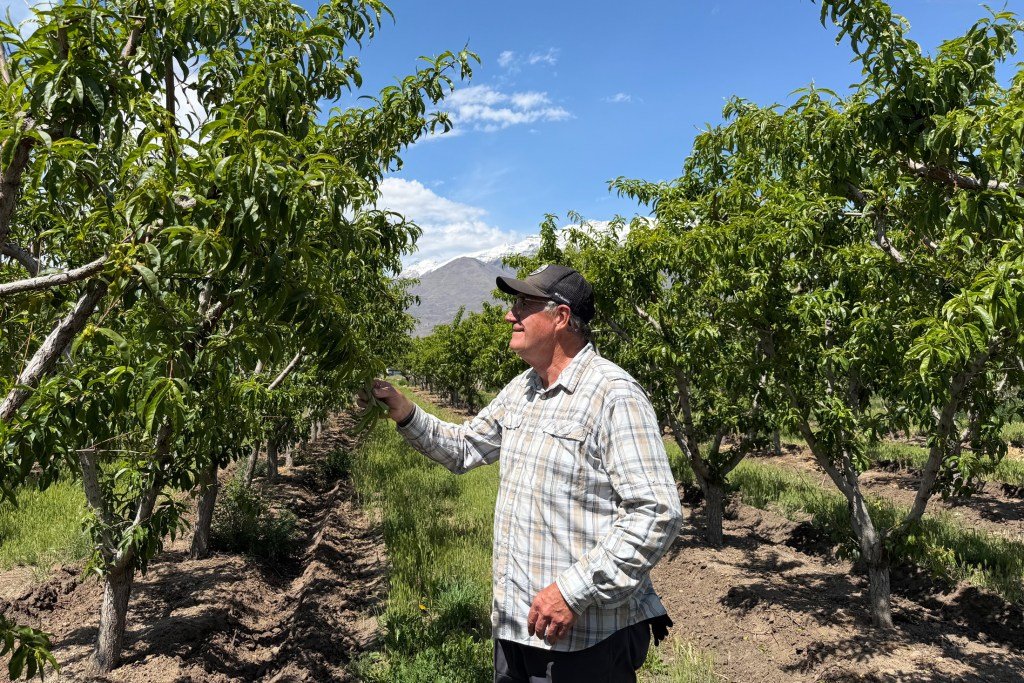
On a sunny day in May, Tim Crandall should have been thinning peaches.
It was a clear, windless afternoon in Utah County, the kind of deceptively cool spring weather that turns hot after a few minutes in the sun. Leafy fruit trees stretched around us in tidy rows, casting mottled shadows beneath their squat canopies. The snow-capped Wasatch Mountains rose in the distance.
Crandall’s eyes crinkled with avuncular warmth underneath his baseball cap as he approached the peach trees in his family’s nearly 150-year-old orchard. But instead of culling an overabundance of downy green fruit, he was searching for survivors. “In a normal year, you would just go up to a limb like this, and there would just be peaches and peaches,” he said, gesturing to a leafy branch the length of his forearm. “I’m still looking for one.”
All across Utah this year, tree fruit growers are reporting near-total harvest losses. After one of the warmest, driest winters in state memory, a record-breaking spring heat wave pushed orchards into bloom three weeks early — then a series of April freezes followed, devastating much of the state’s crop.
Matt Hargreaves, vice president of communications for the Utah Farm Bureau, recently toured orchards around the state and spoke with nearly a dozen growers. “It’s around 95% crop losses statewide,” he said, a figure echoed by three Utah fruit farmers High Country News interviewed.

Crandall farms 20 acres on the Orem benches, a strip of land his great-grandfather homesteaded in the 1880s. The area has historically been considered the best in the state for fruit growing, according to Hargreaves, who comes from a family of fruit farmers himself. The winds that blow from nearby Provo Canyon circulate warm air around the trees. The elevation is ideal, just above the valley floor, where the coldest air settles. And the soil is rich and loamy, a remnant of the primordial lake that once filled the valley. Before subdivisions spread across Utah Valley, orchards covered much of Orem and Provo.
Despite his optimal real estate, Crandall said he lost “100%” of his peaches. He’s unsure whether he’ll open his fruit stand this year; he still hopes that some apples will make it, but peaches are his most popular fruit by far. Some larger farms, including Allred Orchards, a 600-acre multigenerational operation that deals primarily in peaches and apples, have announced that they will stay closed all year.
Late frosts have always been a risk of fruit farming, but the scale of this year’s loss was nearly unprecedented, growers said. On May 15, Utah Gov. Spencer Cox declared a state of emergency to open access to financial resources, such as low-interest disaster relief loans, for agricultural producers. Other fruit farmers in the West have also felt the impact. Colorado’s Western Slope saw substantial freeze damage in some peach orchards, while California’s Central Valley growers are expecting an unusually early peach harvest after record spring heat.
IN NORTH-CENTRAL UTAH, peaches are among the first tree fruits to blossom each year, blazing to life in bright pink tides. A dozen varieties ripen in waves beginning in August, a six-week rush of rosy blond orbs spilling from roadside farm stands. Redhavens are typically first, with vermillion skins and soft melting flesh, followed by candy-like John Boys, firm Diamond Princesses, and golden Lemon Elbertas, favored for canning. O’Henrys, perhaps the most highly sought-after eating variety, close out the season.
But peaches’ precocious blooming makes them more vulnerable to cold weather than other fruits, like apples and pears. Blossoms and already formed fruits begin to die at 28 degrees Fahrenheit; a drop to 25 can wipe out a crop in a matter of hours.
This year, all of his fruit trees were already in bloom when freezing temperatures hit, Crandall said. Cherries had reached the size of peas. He saw the warning signs early: “In January, you could see buds coming out,” he said. “We knew that it would be almost a miracle for us to have a full crop.” Before a final mid-April freeze, he estimated that the orchard still had half a peach crop and healthy apples. “Then, in two hours, most of it was gone,” he said.
“Then, in two hours, most of it was gone.”
Plants rely on temperature cues to flower and grow leaves, so trees are awakening earlier as climate change brings more heat to Utah and the greater West. That’s lengthening the time when they are exposed to potential damage. “This has been observed in thousands of plant species by now,” said William Anderegg, a climate scientist at the University of Utah and the former director of the Wilkes Center for Climate Research and Policy. Scientists can’t attribute a single frost-caused crop failure to climate change, he said, but warming springs are changing the odds — this “loads the dice” for damaging frosts in the near term.
When frost is forecast, fruit farmers can try to buy themselves a few degrees. Large orchards use wind machines to pull warmer air down toward the trees, along with propane heaters to augment their effects, and irrigation at the base of trees: As the water freezes, it releases heat, helping to warm the orchard.

Chris Riley, a 39-year-old farmer whose family grows 200 acres of fruit and vegetables at Riley Orchards in Genola, Utah, employed all those methods. “We were trying everything we had to try and warm it up just enough,” he said. “But Mother Nature’s in control.” He estimated that he lost 95% of his fruit, including peaches, cherries, nectarines, pluots and apples.
Both the economic and human consequences have been significant. Riley Orchards relies on the federal H-2A visa program to bring in seasonal workers, largely hiring the same farmhands each year. After this year’s crop failure, Riley said he had to send 11 of 15 workers back to their home countries. He has taken a summer job, delivering equipment for a local John Deere dealership, hoping to support his family without drawing income from the farm in order to keep on remaining employees. Sending workers home “really, really bothered me,” he said. “But we just weren’t going to have work for them.”
Still, some tasks must continue, even in the absence of fruit. Orchards need to be pruned, sprayed, watered and cared for to protect future crops, despite losing out on the income from this year’s harvest.
Crandall, a retired schoolteacher, is already thinking about next year. “We don’t just see ourselves as stewards of the land, but stewards of the community,” he said. Some customers stop by his farm stand for more than just the fruit, lingering for extra conversation, and these brief exchanges matter, he said. This year, however, there may be no fruit to draw regulars or passersby to the farm. Fortunately, the trees are still alive. The peaches — and their eager consumers — will just have to wait.
We welcome reader letters. Email High Country News at editor@hcn.org or submit a letter to the editor. See our letters to the editor policy.