







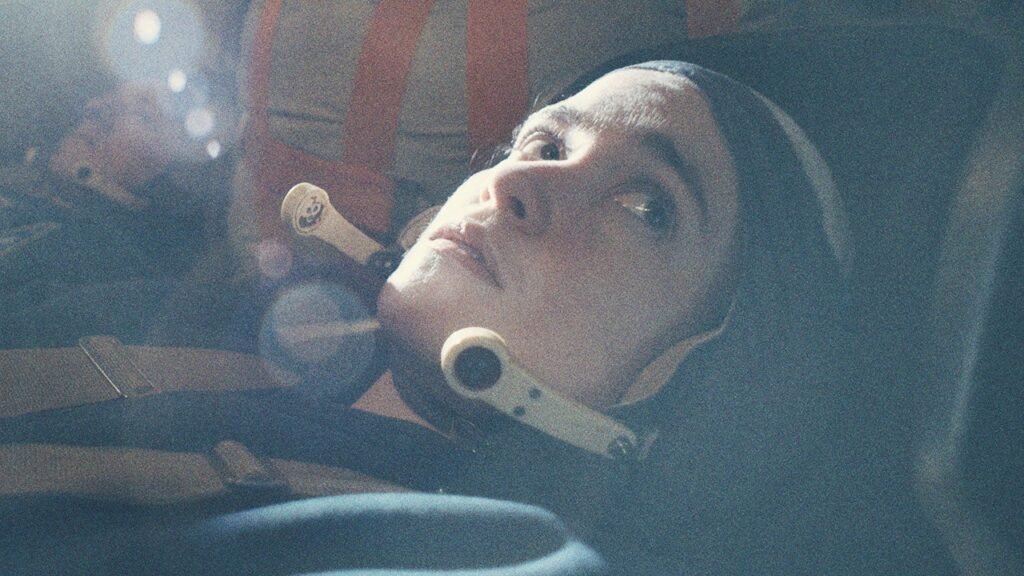

Star City Episodes 1 and 2 are available on Apple TV now. New episodes will be released weekly throughout the first season.
While For All Mankind creators Ronald D. Moore, Matt Wolpert, and Ben Nedivi have gotten the alt-history space-race format down to a science since that series debuted on Apple TV in 2019, they also felt there was an untapped mine of stories to be told on the other side of said race — the Soviet side. Hence, Star City was born, the new series from the trio that goes back to the late 1960s to show what was happening in the titular home of the Yuri Gagarin Cosmonaut Training Center while For All Mankind’s Ed Baldwin was tooling around in his Corvette over on the American side.
It’s safe to say the cosmonauts were not speeding around in Corvettes…
Flying Soviet Style
“The important thing was that this felt like its own show, not just a companion piece to For All Mankind,” Nedivi recently told me. “This concept allowed that to happen. It has mostly new characters, its own setting, tone, world, feeling. It looks and sounds different, and I think for us, that was important.”
While For All Mankind just finished its fifth season, jumping ahead to the 2020s in the finale (continuing the show’s seasonal 10-year time-jumps), it has developed its own look and feel with its sci-fi tech that’s grounded in reality, if just barely. Mars colonies and manned trips to Saturn are a thing on that show, but over in Star City our characters are riding their much more primitive — and realistic for the era — spacecraft by the seat of their pants.
Rhys Ifans (House of the Dragon) stars in Star City as a character everyone refers to as “the Chief Designer” — and indeed, he is the one calling the shots while shooting men (and women) at the moon. The actor says the Chief Designer’s driving force in life is “to get to the moon and to get to Venus and to get to space.” Not that the system always makes that easy.
“[He has to make] that happen within the constraints and obstacles presented to him by the Soviet state,” says Ifans. “To achieve that not necessarily against all odds, but while retaining some kind of moral and ethical fabric — it’s deciding what to jettison when in order to achieve what one needs to achieve.”
Wolpert adds that that particular level of intrigue — having these characters work in a world where “doing the wrong thing or saying the wrong thing could have dire consequences” — is one of the main reasons why they committed to making the show.
“The real Chief Designer [Sergei Korolev] was sent to the Gulag earlier in his life for basically no reason, and spent almost a decade there,” says Wolpert. “For someone like him who has had that experience, and then still came out of that prison camp and resumed working for that same government that punished him in that way, he has the knowledge of the consequences of bending the rules or breaking the rules. And so the fact that he still does that in pursuit of his dream of pushing humanity forward just speaks to the fascinating complexity of that man.”
Ifans points out that while the cosmonauts are going on very dangerous missions — you’ll have to watch the show to see some of the stuff they pull off — the Chief Designer has also internalized the risks of the job, even if he’s earthbound.
“In the same way that each and every one of the cosmonauts knows that when they get into a capsule of a space vessel, there’s a high chance that they’ll die, the Chief Designer knows that without even getting in one of those things, there’s a high possibility that he’ll die on the job,” he says. “So in a sense, it imbues him with a macabre courage. It’s like, ‘You know what? I’m probably going to die doing this anyway, so let me take the risks I take.'”
To Venus and Beyond!
While For All Mankind has mainly been preoccupied with the Moon, Mars, and most recently Saturn, the characters on Star City will — beyond their lunar activities — actually be turning their attention to Venus. Time will tell what that actually means for the show, but the Chief Designer definitley has a hankering to get to that nearby planet.

“In our early research for the show, one of the things that popped out at us and honestly shocked us was that there was a very robust ‘Venera’ — the Venus space program for the Soviets,” explains Nedivi. “They were obsessed with Venus.”
In fact, the Soviets were sending probes to the second planet from the sun as early as the 1950s. And Nedivi points out that the only images we have from the surface of Venus are from Soviet probes. It was this interest on the part of the Soviets that gave the Star City showrunners permission to focus on a planet they haven’t really touched on in For All Mankind.
“Our goal is to cover every single planet by the time we’re done with this,” says Nedivi. “But I think what’s amazing about Venus too, the more we learned about it, is how uninhabitable it is compared to Mars or the Moon. It’s not a place you can just stand on the surface and walk around — at all. So it almost also feels like the perfect planet for the Soviets to want to explore, because of the danger inherent in exploring it. And I think that allowed us to go about this season with a goal that felt really exciting.”
Danger Уилл Робинсон, Danger
In addition to studying up on the Soviets’ interest in Venus, the Star City creators also delved into the more shoot-from-the-hip approach that the Soviets are said to have taken with their space program at times, as compared to the NASA program. Wolpert thinks that there was just a different perspective in the Soviet Union on human life and sacrifice for the goals of the state.
“There was a true story about the premier of the Soviet Union — [he] basically asked for them to launch a mission on a certain day because it was like a national holiday or something,” says Wolpert. “And it made it incredibly unsafe to do, and the only way they could figure out to do it in time was to launch people without spacesuits. It was basically a death sentence for the cosmonauts that were chosen, except for the fact that [due to] the ingenuity of the engineers, they pulled the mission off. And so that kind of counterpoint, of the danger inherent and the risk taken but then the ability to bring it home, that was something we really wanted to capture in this show.”
Ifans laughs, recounting a story he came about while doing research for the show.
“It is quite extraordinary that they were able to achieve what they achieved against all odds,” he says. “Was it Gagarin, when he landed in a potato field somewhere in rural Russia and climbed out of the capsule to the surprise of a peasant woman and her daughter? And they had to point him to a telephone three miles away so he could call ground control and tell them, ‘Hey, guys, I’ve landed.’ I just love the kind of spirit in which all of it was done in the USSR. They were renegades in many ways.”
Women in Space!
For All Mankind had an entire storyline early in its run about a women’s astronaut program that began in 1970. This led to the introduction of some of the best characters on the show (go Molly Cobb!). The thing is, in the alt-history of the show, this program was created as a reaction to the first woman to land on the moon being… a Russian named Anastasia Belikova. And now Anastasia is one of the main characters on Star City (played by Alice Englert).
“What’s interesting is actually in Soviet society, on certain levels, they were all about [women exploring space], much more than the American space program,” says Nedivi. “I know in the early seasons of For All Mankind, [the real-life] Mercury 13 was a big inspiration, the program that was training women to go to space but then was quickly canceled. But in the Soviet space program, they put a woman in space, Valentina Tereshkova, way before the Americans did.”
All of which is to say, the table had already been set both in reality and in the fictional reality of both shows to continue the story of women being a major part of the Star City missions.
“It felt natural that there would be female cosmonauts on this show, the same way there was female engineers, female doctors on certain levels of a much more egalitarian society,” says Nedivi. “Although the Soviets did many times do this to also show the superiority of the Soviet system, that ‘Look, even our women can go to space!’ … But in particular with Anastasia, I think the symbol of a woman landing on the moon before Americans even landed a man on the moon in the alternate history felt like an especially powerful opportunity to show the Americans who’s boss.”
Talk to Scott Collura @scottcollura.bsky.social, or listen to his Star Trek podcast, Transporter Room 3. Or do both!