


What Makes a Monet a Monet?
Artificial intelligence forces us to rethink artistic authenticity.

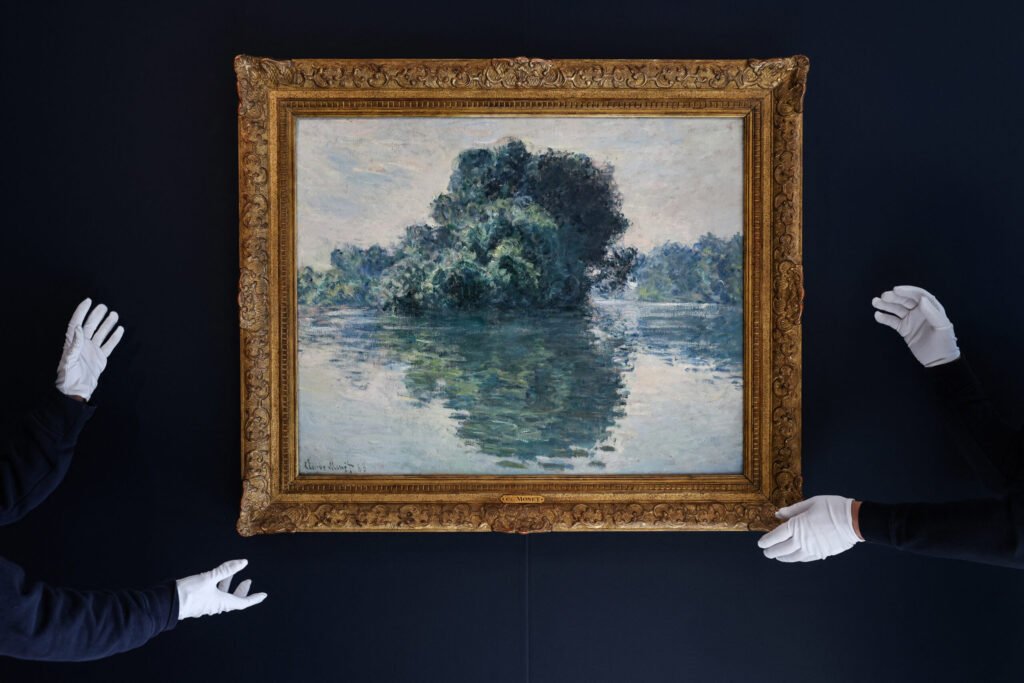
To mark the centenary of Claude Monet’s death, the auction house Sotheby’s sold Les Îles de Port-Villez and Vétheuil, effet du matin, two Monets that had gone unseen by the public for a century, hidden away in a private collection. The plein air works sold for a staggering $19.7 million in April, smashing pre-sale estimates. One hundred years after his death, Monet’s stature appears more secure than ever, even as the art world enters a new age of imitation and fakery.
Far from the auction houses of Paris and the climate-controlled vaults of private collectors, Monet was being litigated this month in a much stranger arena: the social media platform X. An anonymous account posted an image in the style of Monet and said it had been generated using artificial intelligence. Thousands of users confidently dissected the digital painting’s supposed flaws: the muddy composition, its incoherent brushwork, and the “soulless” texture so often associated with AI-generated art. The catch, revealed later, was that the image was not synthetic at all. It was a genuine Monet from the famous Nymphéas series.
The revelation sent the discourse spiraling. Some users felt duped. Others delighted in the prank itself. What can be agreed upon is that the episode turned into a sort of populist referendum on artistic expertise. In an online ecosystem increasingly suspicious of institutions, cultural gatekeepers, and artificial intelligence itself, the stunt exposed just how little trust people should have in their own ability to distinguish a masterpiece from an algorithmic imitation.
Long before artificial intelligence began generating images on command, Orson Welles understood that authenticity was often a matter of suggestion. In his brilliant and beguiling 1973 essay film F for Fake, Welles explored the concept of artistic legitimacy through the exploits of famed art forger Elmyr de Hory and the writer Clifford Irving, whose fabricated autobiography of reclusive billionaire Howard Hughes initially deceived the literary world. The great contribution of F for Fake was its thesis that authenticity almost never exists on its own. Paintings, especially, are filtered through provenance, expertise, institutions, and the stories built around them. Change the story surrounding an image, and the image itself begins to change.
In the era of generative AI, Irving’s distinction feels newly relevant. Much of the contemporary panic surrounding synthetic art concerns not imitation itself, but the fear that the imitation may become convincing enough to collapse the distinction entirely. Speaking of not only his own work but of fakery in general, Irving once stated: “The important distinction to make when you’re talking about the genuine quality of a painting is not so much whether it’s a real painting or a fake. It’s whether it’s a good fake or a bad fake.”
Welles understood performance not merely as entertainment, but as a mechanism of belief. After all, his career began with a similarly unforgettable act of forgery. At the age of 23, Welles rocketed to national prominence after his radio dramatization of War of the Worlds convinced listeners nationwide that an actual Martian invasion of New Jersey was underway. Even his landmark Citizen Kane drew its power from mythologizing and dissecting the life of actual newspaper magnate William Randolph Hearst. As with all successful forgeries, the boundary between truth and fiction was left for the audience to negotiate.
Pablo Picasso recognized that modern art had transformed authenticity into a kind of performance long before artificial intelligence arrived. By the 1930s, counterfeit Picassos circulated so widely that attribution itself became unstable. For example, 100 etchings that Picasso produced for art dealer Ambroise Vollard during the period only further complicated the notion of artistic singularity. Their reproducibility reduced the very concept of “masterpiece” to something that could be at once serialized and authenticated largely via signature and provenance. Picasso appeared delighted by the ambiguity surrounding authorship. “I can paint false Picassos as well as anybody,” he once quipped. The joke concealed a deeper truth: Once an artist becomes a brand, imitation ceases to be an aberration and becomes part of the work itself.
Which all leads us back to Monet and the widely-debated hoax on X claiming that a genuine Monet had been generated by artificial intelligence. It may help to begin with a simpler question: what actually makes a Monet a Monet? His method as an oil painter was based on the material attributes and behavior of paint itself. Monet was well known for his impasto technique, built on the thick application of oil paint. Working quickly outdoors, he layered color while tracking shifting light as it changed around him. His canvases often resolve into broken brushwork and atmospheric depth, their surfaces seeming to dissolve into illumination rather than representation. In such a context, seeing is believing, and the screen introduces a distance that complicates questions of authenticity and authorship.
On X, criticism of the Monet image ranged from anti-AI suspicion to anti-art dismissal. Some users suggested that if a Monet could be so easily replicated by machines, then what, precisely, made Monet’s work so remarkable in the first place? This way of thinking is frequently seen in online discussions that cast doubt on the validity of modern and contemporary painting, especially when it involves artists who are thought to be unduly cynical or disengaged from traditional mastery. Institutional validation rather than technical competence is core to such arguments, and artists such as Cy Twombly, Mark Rothko, and Basquiat often become shorthand for a broader skepticism about contemporary painting in general. On the opposite end of the spectrum, anti-AI commenters insisted that artificial intelligence is fundamentally incapable of producing a genuine masterpiece, since it lacks the subjective interiority that is associated with artistic greatness.
What both responses reveal, however, is less a disagreement about artificial intelligence than a shared uncertainty about how art is recognized at all. Whether through suspicion of contemporary painting or faith in a human “soul,” each position returns to the same assumption: that authenticity resides somewhere beyond interpretation. However, the history of forgery, reproduction, and artistic self-branding indicates otherwise. From Welles to Picasso to Monet himself, meaning has never truly been separate from how it’s seen. The question isn’t whether the image is real or fake, but what the viewer is required to believe in order to see it at all.
The post What Makes a Monet a Monet? appeared first on The American Conservative.