




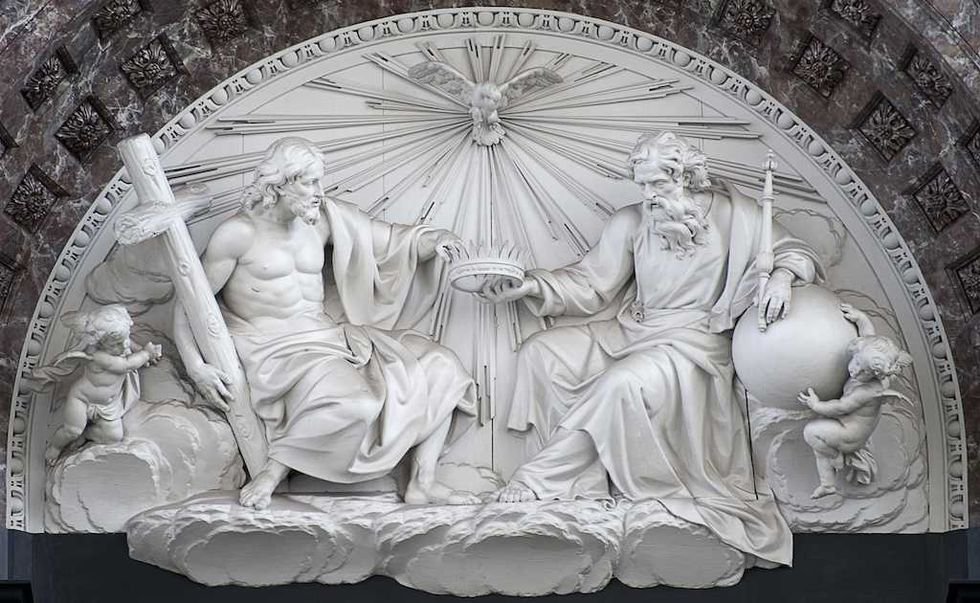
One of the most common objections to Christianity is simple: The word “Trinity” does not appear in the Bible. If that is true, why do Christians believe it?
Christians believe the Trinity because it is the inevitable conclusion of what Scripture teaches about God, Jesus Christ, and the Holy Spirit.
The doctrine of the Trinity is therefore not an arbitrary invention. Nor is it a concession to polytheism. It is precisely the opposite: a refutation of polytheism.
The story begins in Genesis.
The Jewish Scriptures, what Christians call the Old Testament, taught something unique among the religions of the ancient world. Pagan nations treated their gods as physical beings within the universe. Israel taught that God created the heavens and the earth. God was not part of the system. He brought the system into existence.
God is therefore not made of matter, not located at one point in space, and not one deity among many. He alone existed from eternity. Everything else had a beginning.
Israel was repeatedly tempted to compromise with the polytheistic religions around it. Time after time, the prophets called the nation back to the worship of the one true God. Through Isaiah, God declared, “I am the LORD, and there is no other; apart from me there is no God” (Isaiah 45:5).
The God of Israel was understood to be eternal, immaterial, omnipresent, omniscient, omnipotent, and perfectly good. These are not properties material deities could possess.
That raises an obvious question. If Christians inherited this uncompromising belief in one God, how did they arrive at the doctrine of the Trinity?
John opens his Gospel with these words: “In the beginning was the Word, and the Word was with God, and the Word was God” (John 1:1).
John then tells us that all things were made through the Word. The Word is distinguished from God, yet the Word is also called God. John 1:3 says all created things came into existence through Him. If all created things were made through the Word, then the Word Himself cannot belong to the class of created things.
Then John tells us, “The Word became flesh and made his dwelling among us” (John 1:14). The eternal Son of God became incarnate as Jesus Christ.
RELATED: Don’t let ‘Disclosure Day’ doom you to spiritual death by discourse

The New Testament repeatedly presents the same pattern. At Jesus’ baptism, the Son stands in the water, the Spirit descends as a dove, and the Father speaks from heaven. The three are clearly distinguished from one another, yet elsewhere in Scripture the Father, Son, and Holy Spirit are each identified as God.
Jesus commanded His disciples to baptize “in the name of the Father and of the Son and of the Holy Spirit” (Matthew 28:19). Baptism is done in the name of God. Paul gives a Trinitarian benediction in 2 Corinthians 13:14. Jesus, the Lamb of God, sits on the throne of God.
Jesus also claimed an existence that preceded Abraham: “Before Abraham was, I am” (John 8:58). His words echo the divine name revealed to Moses. The Jews understood the implication and tried to stone Him for blasphemy. Elsewhere, they accused Him of making Himself equal with God.
Scripture also attributes personal qualities to the Holy Spirit. The Spirit teaches, speaks, guides, gives life, and can be grieved. He is not merely an impersonal force.
The early Christians therefore found themselves committed to three truths taught by Scripture:
- There is only one God.
- The Father is God, the Son is God, and the Holy Spirit is God.
- The Father, Son, and Holy Spirit are distinct from one another.
Deny any one of those truths, and you contradict the Bible.
Over the first several centuries, as pagan polytheists converted to Christianity or challenged it, the church debated how best to explain the doctrine of God from Scripture.
The Gnostics denied that Jesus was truly incarnate. They taught that He was a spirit who only appeared human. In doing so, they denied the incarnation.
Another early controversy involved Sabellius, who taught what later became known as modalism. According to this view, the Father, Son, and Holy Spirit are merely different manifestations of the same divine person.
The church rejected this because Scripture repeatedly distinguishes the Father, Son, and Spirit from one another.
Then came Arius, who taught that the Father alone is eternal and that the Son is the first and greatest creature.
As Christians reflected on the biblical evidence, the church clarified its teaching: The Father is eternally unbegotten. The Son is eternally begotten of the Father. The Holy Spirit eternally proceeds from the Father and, in Western theology, from the Father and the Son.
The doctrine can be summarized simply: God is one “what” — one divine essence — and three “whos” — three distinct persons.
The church eventually summarized the biblical teaching as one God in three persons. Not one God and three gods. Not one person appearing in three forms. One God, three persons.
RELATED: Contentious theological debate erupts about Mormons over War Department faith list

The doctrine of the Trinity is therefore not an arbitrary invention. Nor is it a concession to polytheism. It is precisely the opposite: a refutation of polytheism. The doctrine preserves the full teaching of Scripture and answers the questions Scripture itself forces us to ask about God.
What is striking is how often modern religious movements that spin off from Christianity repeat ancient errors. Some deny the full deity of Christ, as Arius did. Others collapse the distinctions among the persons, as Sabellius did. Still others deny Christ’s full humanity or full deity. Some even teach polytheistic material gods.
What has united Christians across denominations and centuries is their shared commitment to the biblical doctrine of God. By contrast, new religious movements often claim allegiance to Scripture while introducing another authority that corrects, supplements, or supersedes it.
When Jesus called people to believe in Him, He did not require them to master centuries of theological debate. But neither did He leave them free to invent their own Jesus. They were to believe true things about Him and reject false things about Him.
A person may sincerely use the name “Jesus” while holding beliefs about Him that contradict the Jesus revealed in Scripture. The issue is not sincerity but identity. Not, “What do I feel?” but, “What does the Bible say?”
The question is whether the Jesus a person believes in is the Jesus revealed in the Bible or a Jesus drawn from some other source.
The church’s long debates about the Trinity were not abstract philosophical exercises. They were answers to the most important question any person can ask: Who is Jesus Christ in the Bible?