



The Pentagon’s ‘Missile Crisis’ Distracts From Deeper Problems
A history lesson from the First World War shows how munition shortages are less of a problem than military groupthink.
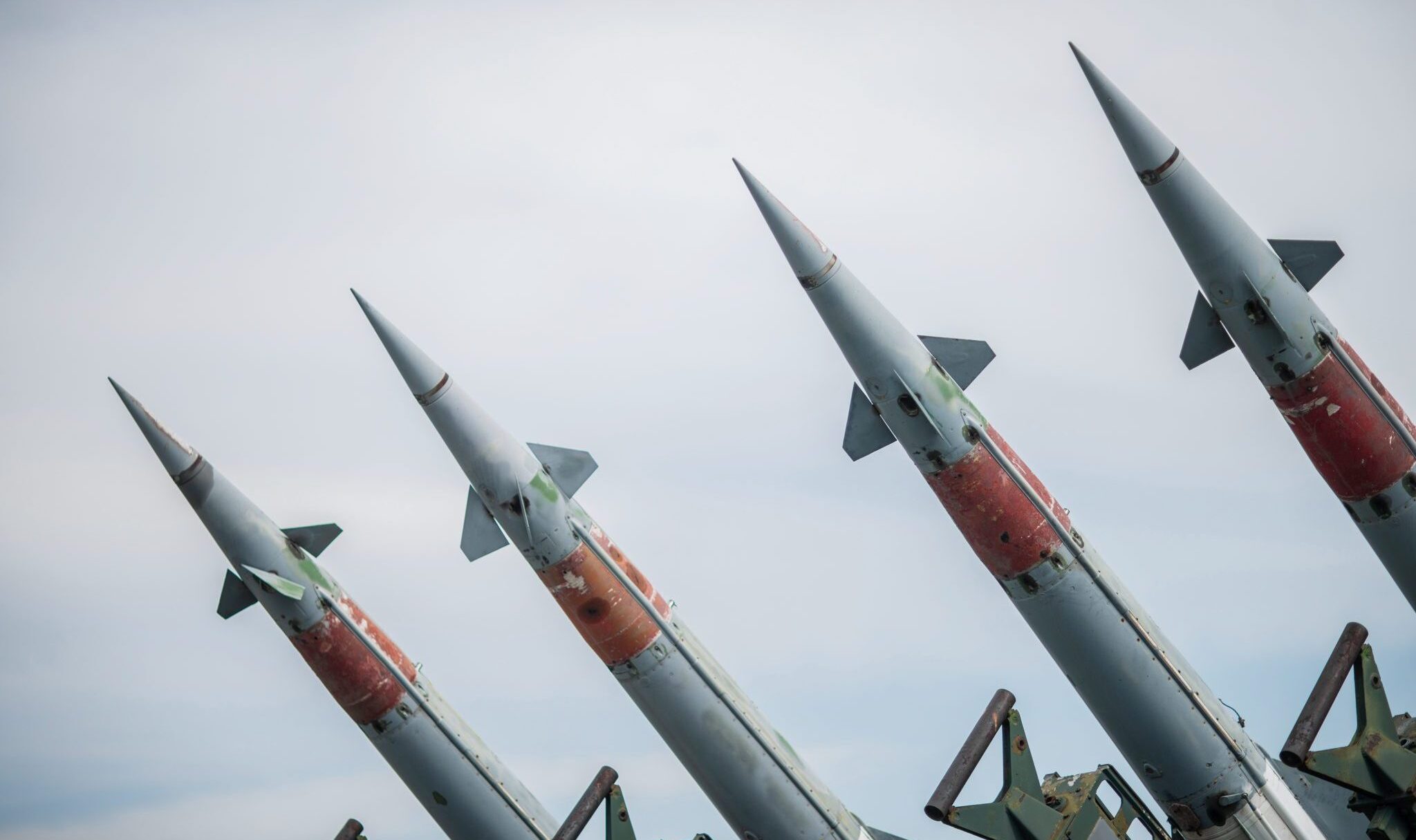
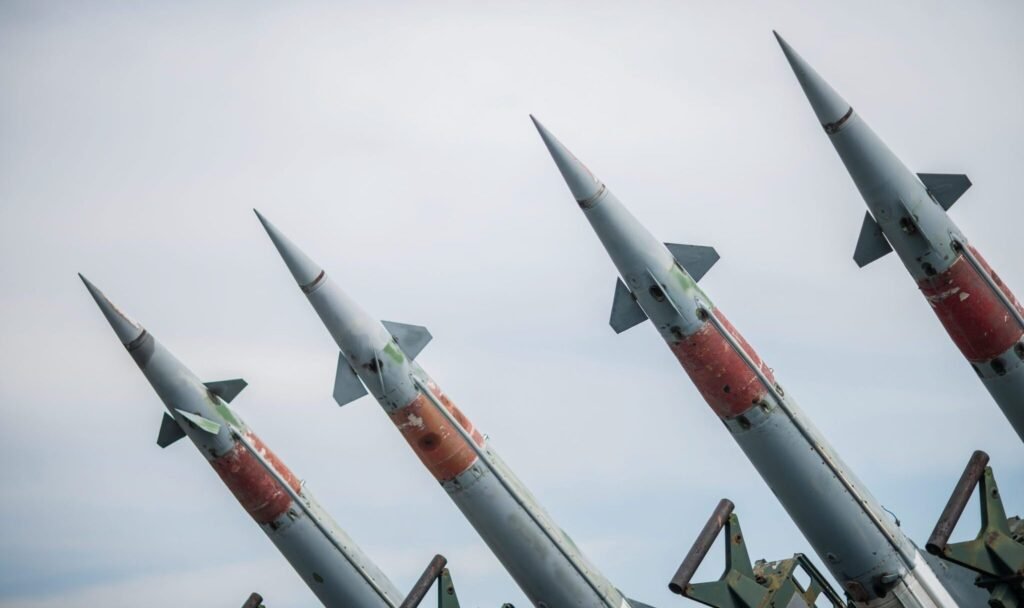
Recent headlines about U.S. weapons in the Persian Gulf are somewhere between ominous and confusing. Are we running low? Or are we being manipulated?
Reuters, August 4: “US has used ‘virtually all’ of its long-range precision missiles during Iran war.” CNN, same day: “Nearly 80% of interceptors for a key missile defense system depleted.” And on Fox News, Jennifer Griffin reported, “A growing reality after months of fighting in Iran: America’s stockpile of missile defense interceptors is shrinking so much that military planners are weighing whether they can continue the current cycle of limited retaliatory strikes.” To bolster the point, Griffin cited data gathered by the Center for Strategic and International Studies.
The Washington Post’s header injected personalities: “Trump, Hegseth clashed at Camp David over Iran missile depletion concerns.” The president vs. his own secretary of war—now there’s some gossip to go with PGMs. Needless to say, White House spokeswoman Karoline Leavitt denies everything: “This is 100% fake news.” When further challenged on the “missile gap” by the New York Times, Leavitt on-messaged: The U.S. possesses “more than enough firepower to carry out any operation the president orders at any time and place.”
Okay, but something is going on. After all, on August 6, President Trump blasted out a “truth”: “The U.S. has massive amounts of ‘munitions,’ especially of certain types. Additionally, large amounts are being manufactured and shipped to the U.S. as needed.” He added, “The ‘leakers’ of these treasonous statements are being hunted down. Long term jail sentences will be sought!”
The question of leaks brings out a sneakier question—cui bono?
To Iran War supporters, the answer is obvious—the war’s opponents benefit. Fox News’s Mark Levin opined, “The purpose of these leaks is to prevent further military operations.” National Review’s Rich Lowry agreed, “The leaks about U.S. munitions shortages are incredibly irresponsible and damaging…. These people should be hunted down and nailed to the wall.” And the American Enterprise Institute’s Marc Thiessen added, “There is an op to stop Trump from returning to major combat with dangerous leaks.”
Such words provoked Sean Davis of the Federalist: “You neocon clowns who have been behind every foreign policy disaster of the last 25+ years are the only cohort spending 100% of its time and effort into boxing Trump into a full-on ground war in Iran.”
Indeed, many espy a long-game political backdrop. Some among the neoconservative set put the blame on Vice President J.D. Vance, known to have been an internal opponent of the war, albeit an external team player. By zinging Vance, leak blame-gamers hope to deny him the 2028 Republican presidential nomination.
Yet on August 7, that pat anti-Vance narrative was disrupted. CNN published a piece headlined, “Trump’s top general is ‘looking for an off-ramp’ from Iran war as US military options remain limited.” One source said of Joint Chiefs of Staff Chairman Dan Caine’s motivations: “I think it is just his way of protecting the military.”
Whatever the exact truth here, it’s a stretch to pin the story on Vance. So now, of course, the neoconservatives are attacking Caine.
It will take congressional hearings and perhaps fact-finding commissions to cast legitimate light on the twinned questions of shortages and leaks. Only the passage of time will bring historical judgment.
Yet in the meantime, we can consider a well-illustrated moment from military history in which munitions shortfalls were the issue. We’ll have better perspective on our current situation if we know more about how others wrestled with the same dynamics—what they did right, what they did wrong, what was to be learned.
^^^
As we all know, the First World War erupted in August 1914. At the time, recalling the brief European conflicts of the late 19th century, most observers figured this new fighting would be over in weeks, or at most a few months.
Yet by the turn of the new year, 1915, the war had become a bloody slog. On March 25, the New York Times quoted the commander of the British Expeditionary Force on the needs for this worsening Great War: “Sir John French stated to a newspaper correspondent the other day that the problem of the war is ‘munitions, more munitions, always more munitions.’” The top general on the record: Whatever the security implications of his words, it wasn’t a surreptitious leak.
Indeed, in speaking to the press, French wasn’t just commenting, he was lobbying: “We have lost much valuable time, and have unwittingly made the war longer by our lack of provision. The sooner we turn out shells in greater abundance, the sooner the war will be over.”
Still, even absent what he deemed to be necessary quantities of artillery, French charged ahead. On May 9, 1915, the British attacked the Germans at Aubers, suffering 11,000 casualties for zero geographic gain. Five days later, the Times of London headlined, “Need for shells: British attacks checked: Limited supply the cause.”
So now the British government confronted the “Shell Crisis,” and the man supposedly in charge, Prime Minister Herbert Henry Asquith, was not up to the task. Steeped in the Oxbridge virtues of speaking well, reading the classics, and supporting incremental domestic reform, Asquith was fine as a peacetime leader—even if he, despite being a married chap, was preoccupied with a younger woman, not his wife.
Yet wartime leadership requires a singleness of purpose—making plans, coordinating resources, setting timetables, and perhaps most of all, rallying the public—that Asquith did not come close to possessing. In fact, his diffidence led Helen Maud Holt, known as Lady Tree, to ask the prime minister: “Tell me, Mr. Asquith, do you take an interest in the War?”
Here might wish to interpolate some contemporary news of another leader in wartime. On August 7, Axios ran an unsparing take on Donald Trump’s activities: “Rather than face the issues, Trump often pivots to showing visitors renderings of the new White House ballroom or a model of the planned Triumphal Arch. He showcases his new Air Force One, touts his plans for Dulles, and obsesses about the helipad being built on the South Lawn.” The story linked to the New York Times reporter Maggie Haberman’s assertion that “70% of the president’s mindshare goes to renovations and monuments.” Needless to say, Leavitt and the whole comms team at the White House dismiss this.
Returning now to 1915, within days of the Aubers debacle, Asquith’s government was shaken up, forced into coalition with political rivals. The Secretary of State for War Herbert Kitchener had mismanaged armaments, and yet he was too popular to be jettisoned outright. Instead he was steadily stripped of his authority and sidelined in the conduct of the war, while David Lloyd George took over materiel procurement as the first minister of munitions.
A nimble and energetic man dubbed the “Welsh Wizard,” Lloyd George brought with him a brash team of efficiency experts and industrialists; in the Welshman’s words, “men of push and go.” Additionally, Parliament passed sweeping legislation, empowering the state to commandeer factories, speed up assembly lines, halt strikes—even to prevent individual war workers from quitting.
“Modern warfare,” Lloyd George recalled in his memoir, “was to a far greater extent than ever before a conflict of chemists and manufacturers.” For sure, hardcore technological mobilization was needed—and Lloyd George delivered. Shell production rose from around 465,000 a month in mid-1915 to over a million a month in mid-1916.
Later in 1916, Lloyd George replaced Asquith at Number 10. Yet even with new-broom momentum behind him, the Wizard found himself frustrated by his generals. “Same old strategy, platitudes in action,” he wrote later. “Epauletted egoism is impenetrable to the assault of ideas.”
Confronting such obstinacy, could the prime minister make personnel changes? At the time, he didn’t think so, as his own coalition was unsteady, most of it still in the thrall of the generals. “Frankly on this subject the Government was so divided that it could not overrule the military experts.” Lloyd George added of his supposed subordinates, “They were fully aware of that division and took full advantage of circumstance to stick to their plan. We know what a ghastly fiasco it all turned out to be.”
So maybe the problems within the British war effort were deeper than a shortage of shells. Under both Asquith and Lloyd George, the generals had the same idea: frontal assaults. “We hammered the breastplate of Achilles,” Lloyd George later wrote, “and neglected his heel.” (The most daring exception to this dreary dead-ahead pattern was the Gallipoli operation, which sought to end-run Berlin by capturing Constantinople. A good idea, but it failed for lack of fast-moving leadership at the landing zone; for their part, the generals blamed… a lack of shells.)
Indeed, the war dragged on for two more years during Lloyd George’s premiership, and he faced loud accusations that he himself had painted an overly rosy picture of British military strength. It’s entirely possible that the war would not have been won at all were it not for the deus ex machina of American intervention. All this caused some to wonder if the shell shortage was, in fact, a convenient chimera.
Roy Jenkins, author of an admiring biography of Asquith, advances this cynical view: “When the generals set themselves an impossible objective, and failed to achieve it, they had to blame something. As they would not question the rules by which they fought, they blamed the lack of ammunition: ‘If only they had had more shells to fire all would have been well. Just a few more rounds, another few guns, and the miracle would have happened.’ But the miracles did not happen, and the generals blamed the politicians.”
Here again we can pause to ponder the contemporary situation. It seems clear that American war planners underestimated drones—the Iranians’ ability to hide them and use them, against ground troops, structures, and oil tankers in the Gulf, all three. (And the similar capability, too, of the Houthis.)
It would have been nice if the Pentagon had been paying more attention to, and drawing more conclusions from, the success of Ukraine’s startup drones in pin-pricking the Russians—nicks that, in aggregate, are drawing much blood.
Okay, mistakes were made, starting with the start of the Iran War. Yet now, more than five months into the fighting, we read this startling passage in the Atlantic: “The Trump administration has invested in the defense industrial base to accelerate production, as did the Biden administration, but for crucial systems such as the Patriot, supply is not projected to meet demand until about 2030. Meanwhile, Iran has ramped up production of its offensive drones and ballistic missiles, and enhanced their capabilities.”
Hmm. If this journalism is accurate—with the usual caveats about the risk of fake news—then the U.S. has a plan to get fully up to par in 2030, while the Iranians have a plan (perhaps with help from a foreign power) for acting right away. Does this timeline seem a bit off?
So maybe, in terms of what we can do in the Gulf, we need to be more realistic. Yet in its August 7 report on Caine’s concerns, CNN took note of one forever-flowing font of pro-war enthusiasm: “The only ones in favor of the operation were elements of CENTCOM.” That, of course, is the acronym of the U.S. military command in the Middle East, including the Gulf. As this author has written recently, CENTCOM’s automatic instinct “holds that there’s a military solution to every problem in the area.” To be sure, in any era, generals tend to see more war as the answer, especially in their own theater of command.
So while it’s disheartening, it’s not surprising to read that CENTCOM has been agitating for more bombardment. And so Caine, himself an Air Force guy—but now tasked with worldwide responsibilities, not parochial imperatives—is saying, in effect, to the CENTCOM-ers, Cool it. If we keep attacking and the Iranians keep attacking back, however asymmetrically, we’re not winning. We have to protect every GI, every high-rise, every oil-related asset, and we’ve learned we can’t do that. Our hammers can’t stop their mosquitoes.
And if we look back to the First World War, we see parallels. In his memoir, Lloyd George delved into milthink: “Unhappily, too, the War Office was hampered by a traditional reactionism. Its policy seemed ever to be that of preparing, not for the next war, but for the last one or the last but one.” By that he meant the generals were looking back to not only the Boer War, but even to the Crimean War.
Militaries are, after all, small-c conservative institutions. As Lloyd George noted, First World War commanders, old cavalrymen that they were, thought fondly of equestrian dashing—and little of machine guns and artillery. So today’s Pentagon chiefs, brought up in tanks and carriers, haven’t grasped drones, as well as whatever other wonder-weapons might be coming at them. And the phalanx of defense contractors, their patronage ladled into virtually every congressional district, is even more immobile. Yet even so, finally, having denied and evaded the challenge for as long as it could, the Pentagon is now scrambling.
By the way, if Lloyd George comes across as unusually perspectival for a politician, that’s because he was helped, a lot, in the drafting of his memoir by the up-and-coming military historian B. H. Liddell Hart. Himself a wounded veteran of the Great War—there at the Somme, the whole bit—Liddell Hart formed strong opinions as to what did, and did not, work in the military, and so he wrote knowing histories for decades. Lloyd George himself never so much as went to college, and yet in his wizardry, he saw the legacy-burnishing value of harnessing Liddell Hart’s smarts.
Indeed, because Lloyd George is such a consequential figure—up there near Churchill and the Pitts, Elder and Younger—one can study the works of the Wizard as a grimoire for warlords. The specified incantations: No Asquithian dilettantism, don’t trust the generals’ groupthink, knock heads in the military-industrial complex, and presto! a place in history’s pantheon of victors.
All that could be the U.S. today, if Trump is up for it. But 47 should know that the path Lloyd George trod was paved with hard stuff. Both of his sons served in the army in France, a daughter served as a volunteer orderly, and his wife knitted for the “Woollies for Soldiers” effort. Meanwhile, his homefront plan was higher taxes, draconian economic regimentation, a draft, stern warnings against shirking, restrictions on alcohol consumption, and regular invocations of collective spirituality. For instance, in 1916, Lloyd George called for a National Lent, in which “the nation as a whole shoulders part of the burden of victory.” Do these seem like Trumpian moves? Would such forbearances crimp the Mar-a-Lago crowd? Get in the way of golf?
It’s worth keeping in mind, as well, that in the geopolitical influence-grabbing after the First World War, Lloyd George sent British troops to occupy not only the German Rhineland, but also various fragments of the old Ottoman Empire. Oh, and let’s not forget the 60,000 British troops who intervened in the Russian Civil War—where almost 1,000 died. For those who believed in Imperial Britain policing the world, Lloyd George was the top Bobby.
By contrast, if Trump is hemorrhaging support when the KIA count in the Iranian conflict stands at 18, he wouldn’t fare well with extended ground-troop operations. How many dolorous journeys to Dover Air Force Base would he have to make?
Indeed, if Trump is having trouble building a White House ballroom, can he really expect to pull off a pivot from a “no endless wars” platform to a “win this war” agenda? Is he that much of a wizard?
Trump as a win-the-war mobilizer could expect the full support of CENTCOM, the hawks, a dwindling number of no-matter-what MAGAs, Bibi Netanyahu, and… that’s about it. Given this reality, maybe some pacific Asquithianism wouldn’t be so bad.
In fact, reports indicate that Trump is quietly scaling back his ambitions in the Iran War; regime change and an agreement to denuclearize are out of reach. In public he says he is “low-keying it.” Of course, he has been known to change his mood.
Yet in the meantime, other countries in the region are giving diplomacy a chance. TAC’s Jude Russo points to the new Mecca Agreement—Saudi Arabia to be defended by Pakistan and Turkey—as an indicator that the Gulf countries might be able to build their own stabilizing system (which might, in fact, be more stable than what the Americans have had to offer).
Trump tried on War President, and it didn’t fit him well. So now, he’d best be getting back to being the Peace and Prosperity President.
The post The Pentagon’s ‘Missile Crisis’ Distracts From Deeper Problems appeared first on The American Conservative.