




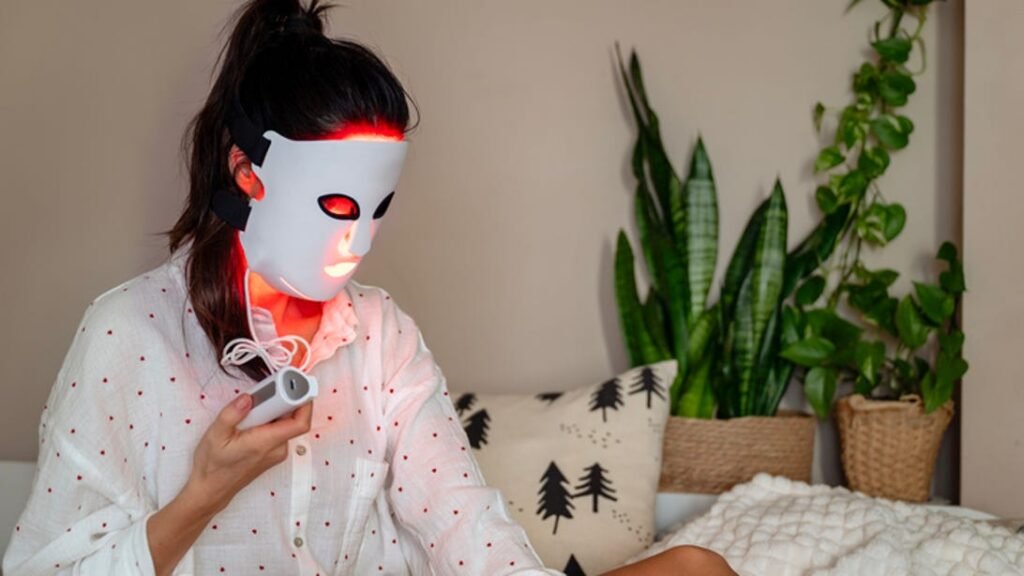
If your skin hasn’t been looking the best lately, you may want to consider an LED face mask or red light therapy mask. These masks have anti-aging benefits and may boost collagen for improved skin elasticity, reduce inflammation and target acne (if the mask offers blue light). These masks tend to be expensive, which is why we tested various ones on the market to determine which are worth the investment. We put popular models through their paces from brands including Shark, CurrentBody, Omnilux and iRestore.
Why we like it: The Shark CryoGlow LED Face Mask stands out by combining LED red light therapy with cryotherapy for a refreshing, spa-like experience at home. It uses red and blue LED lights to target collagen production and acne while delivering a cooling effect on your under eyes.
Jump to details
Pros
- Combined LED therapy with cryotherapy
- Cordless and lightweight at 1.49 pounds
- Quick treatment time of 4-15 minutes
- The cheapest mask on this list at $350
- Has the highest irradiance at 128mW/cm
Cons
- The cooling effect may not be for everyone
- The cryotherapy eye patches block the LED treatment on under eyes
Why we like it: The Chrona red light therapy mask uses a non contact design that positions the LEDs at about 1 cm from the skin, creating what Dreame calls a “3D light chamber effect” thats meant to improve light distribution (traditional masks let light escape through the edges). I like that the mask has a border around the eyes so light doesn’t enter them. This is especially important for those with light sensitivity. This mask is FDA-cleared and SGS-tested (meaning a product has been independently tested by SGS SA to meet specific national standards for quality, safety and compliance.
Jump to details
Pros
- Five wavelengths to target acne, dullness, redness, signs of aging and overall skin health
- Fully cordless
- Memory function recalls your last settings
- 10 minute sesstions
- SGS tested
Cons
- No extra features like cooing pads or built-in massage
- Only sold in the US
Why we like it: While this mask is deemed the best affordable LED mask, nothing about it feels cheap. The mask is made from soft medical-grade silicone that molds seamlessly onto your face. In the inner shell, you’ll see 324 LEDs, which cover your entire face and under the chin. (This is the only mask on the list that also covers the under chin.)
Jump to details
Pros
- Full face coverage, including under the chin
- Multiple light modes and intensity options to choose from
- Customizable timing: 10, 20 and 30 minutes
- Much more affordable than many premium brands
Cons
- Doesn’t have an ultra-premium feel to it.
- The lighter color makes it easier to stain
Why we like it: Omnilux is one of the most popular LED face masks on the market, and for good reason: Its tech is cleared with the FDA and it contains the right formula of light for anti-aging and brightening results (633nm red light and 830nm of near-infrared). Price-wise, it’s not the most expensive out there and is fairly middle-of-the-road. Of course, in LED face mask lands, that means it’s still a big chunk of change to drop.
Jump to details
Pros
- Provides 633nm red light and 830nm of near-infrared
- Company has a lot of publicly available research
- Comfortable and versatile with flexible mask
Cons
- Not as powerful or irradiant than other LED face masks on the market
- It comes with a chord and power button attached, so you need to carry it around during use
- No blue light
- Costs $395
Why we like it: The CurrentBody LED face mask is a great option for those seeking professional-grade skincare treatments from home. This mask offers a combination of red, infrared and near-infrared light therapies to address multiple skin concerns like fine lines, wrinkles, acne and uneven skin tone.
Jump to details
Pros
- Combines red, infrared and near-infrared light to target multiple skin concerns
- Comfortable to wear with adjustable straps
- Quick treatment time (10 minutes)
Cons
- Full-face coverage may feel bulky
- Priced at $470, the third highest on this list
- Lower irradiance of 30 mW/cm2
What is the best LED face mask overall?
The best LED face mask overall is the Shark CryoGlow LED Face Mask, which combines red light therapy with cryotherapy to provide a cooling effect. It’s also lightweight and sessions are quick, so it’s great for travel and busy schedules.
Best LED face masks of 2026
Pros
- Combined LED therapy with cryotherapy
- Cordless and lightweight at 1.49 pounds
- Quick treatment time of 4-15 minutes
- The cheapest mask on this list at $350
- Has the highest irradiance at 128mW/cm
Cons
- The cooling effect may not be for everyone
- The cryotherapy eye patches block the LED treatment on under eyes
Why we like it: The Shark CryoGlow LED Face Mask stands out by combining LED red light therapy with cryotherapy for a refreshing, spa-like experience at home. It uses red and blue LED lights to target collagen production and acne while delivering a cooling effect on your under eyes.
Who is it best for: Unlike traditional LED masks, this one is designed for quick sessions, making it easy to fit into busy skincare routines. You can choose from four treatment options: Better Aging (6 minutes — to target fine lines and wrinkles), Skin Clearing (8 minutes — for acne), Skin Sustain (4 minutes — for maintaining glowy skin) or Under Eye Revive (5-15 minutes — cooling routine without LEDs). Using the controller, you can choose from three cooling settings to fit what you’re most comfortable with. You can also track your progress to see how many sessions (and which ones) you’ve taken.
From the first use, I noticed how the cooling sensation instantly soothed my face (similar to an ice roller). I find the Under Eye Revive especially helpful in the morning to depuff my under eyes.
What I love most about the CryoGlow is how lightweight it is at 1.49 pounds, making it convenient to pack or have on while you multitask.
Who should not get it: At $350, it certainly is an investment, but I also think it’s the best bang for your buck as it targets multiple skin concerns. It is also the cheapest mask on this list.
… Show more
Pros
- Five wavelengths to target acne, dullness, redness, signs of aging and overall skin health
- Fully cordless
- Memory function recalls your last settings
- 10 minute sesstions
- SGS tested
Cons
- No extra features like cooing pads or built-in massage
- Only sold in the US
Why we like it: The Chrona red light therapy mask uses a non contact design that positions the LEDs at about 1 cm from the skin, creating what Dreame calls a “3D light chamber effect” thats meant to improve light distribution (traditional masks let light escape through the edges). I like that the mask has a border around the eyes so light doesn’t enter them. This is especially important for those with light sensitivity. This mask is FDA-cleared and SGS-tested (meaning a product has been independently tested by SGS SA to meet specific national standards for quality, safety and compliance.
Who it’s best for: Anyone who’s looking for a red light therapy mask that doesn’t have cords. If you’re someone who can’t sit still, this mask is for you: it’s entirely cordless (even the remote is cordless) and features a wide viewing window, which is great for reading, working and watching TV.
Who shouldn’t get it: Those looking for a mask with special features like under-eye cooling or built-in massage, since the Chrona doesn’t offer them. It’s also currently only sold in the US.
… Show more
Pros
- Full face coverage, including under the chin
- Multiple light modes and intensity options to choose from
- Customizable timing: 10, 20 and 30 minutes
- Much more affordable than many premium brands
Cons
- Doesn’t have an ultra-premium feel to it.
- The lighter color makes it easier to stain
Why we like it: While this mask is deemed the best affordable LED mask, nothing about it feels cheap. The mask is made from soft medical-grade silicone that molds seamlessly onto your face. In the inner shell, you’ll see 324 LEDs, which cover your entire face and under the chin. (This is the only mask on the list that also covers the under chin.)
I also appreciate the three different settings you can set it to: red and near-infrared (stimulates collagen production); blue and near-infrared (targets acne-causing bacteria); and red, blue, and near-infrared (combines anti-aging and healing benefits). I also love that you can set the intensity from one (being the lowest) to five (being the highest).
If your eyes are sensitive to red light therapy, the mask comes with removable eye cups to prevent light from entering your eyes.
Who it’s best for: This mask is best for those who are seeking the glow a red-light therapy mask gives and also for those who have mild to moderate acne since users can combine treatments for both. I’d also recommend this mask to anyone on a budget who is looking for an effective and FDA-cleared device.
Who shouldn’t get it: This mask delivers on everything you would want to get from an LED face mask for a much lower price that I recommend it for anyone. However, if you’re looking for a mask with an ultra-premium feel, like the TheraFace by Therabody, then this isn’t the mask for you.
… Show more
Pros
- Provides 633nm red light and 830nm of near-infrared
- Company has a lot of publicly available research
- Comfortable and versatile with flexible mask
Cons
- Not as powerful or irradiant than other LED face masks on the market
- It comes with a chord and power button attached, so you need to carry it around during use
- No blue light
- Costs $395
Why we like it: Omnilux is one of the most popular LED face masks on the market, and for good reason: Its tech is cleared with the FDA and it contains the right formula of light for anti-aging and brightening results (633nm red light and 830nm of near-infrared). Price-wise, it’s not the most expensive out there and is fairly middle-of-the-road. Of course, in LED face mask lands, that means it’s still a big chunk of change to drop.
Who is it best for: I’ve been wearing the Omnilux Contour on and off for the past few months and I’ve thoroughly enjoyed it. I don’t think I’ve used it consistently enough to see improvements in fine lines (for me, that’s mostly around my mouth), but I do like how it gives me a bit of a glow after. I plan to keep using it, as I was not expecting any LED face mask to work “miracles” or drastically change my face overnight.
Who should not get it: One thing about all Omnilux LED masks in general is that it has a cord and power button you’ll need to keep with you while using it. I don’t mind this at all, since I take my light therapy time as an opportunity to lay on the ground and practice mindfulness, but for multitaskers that want to do light therapy during chores, this may be annoying and they may opt for a different mask.
This mask also doesn’t offer blue light, so it wouldn’t be best for those with acne.
… Show more
Pros
- Combines red, infrared and near-infrared light to target multiple skin concerns
- Comfortable to wear with adjustable straps
- Quick treatment time (10 minutes)
Cons
- Full-face coverage may feel bulky
- Priced at $470, the third highest on this list
- Lower irradiance of 30 mW/cm2
Why we like it: The CurrentBody LED face mask is a great option for those seeking professional-grade skincare treatments from home. This mask offers a combination of red, infrared and near-infrared light therapies to address multiple skin concerns like fine lines, wrinkles, acne and uneven skin tone.
The red light stimulates collagen production, the infrared firms, tightens and brightens the skin and the near-infrared targets areas where aging signs are more pronounced, like wrinkles.
Who is it best for: It has an adjustable strap and a lightweight design, which will make it comfortable for most people to wear for the 10-minute sessions. I also appreciate that this mask covers the area under your chin, which I haven’t seen from most other brands.
Who should not get it: On the price side, this is the third most expensive mask on this list despite it having a lower irradiance of 30 mW/cm2, so if your budget is under $470, this wouldn’t be the right mask for you.
… Show more
Pros
- Specifically designed for men
- Omnilux is a solid LED face mask brand that makes other popular devices
- Mask is larger and provides for more room around the head and face
Cons
- Jury is out on whether the extra-deep, 1072nm near-infrared wavelength really is needed to benefit men’s skin
Why we like it: Omnilux, riffing off their wildly popular Omnilux Contour Face mask, has come out with a mask for men. No, light therapy isn’t gender-dependent. But Omnilux said it created this mask for men because men’s skin is a little thicker, so they included an extra-deep wavelength (1072nm near-infrared) to get under that thick skin.
Who is it best for: Whether or not this really matters remains to be seen, but I did find the mask for men much roomier, making it suitable for larger faces or features. It also has a different pattern than the Contour. In terms of treatment time, it’s the same drill: 10 minutes, and you hold the cord.
Who should not get it: If you don’t need a roomier mask and aren’t sold on the extra-deep, near-infrared wavelength for thicker skin, then another mask on this list would be better for you.
… Show more
Pros
- Comfortable
- Easy to use
- Lightweight at 181 grams
- Secure fit
- Three modes
- Breathable
- Has eye shield
- Higher irradiance at 59.11 mW/cm2 (all 3 wavelengths)
Cons
- Doesn’t come with USB power adapter
- May not be for those who prefer a flexible material
- Second highest price at $499
Why we like it: Complete with 360 LEDs, the Illumina Face Mask offers triple wavelength technology, featuring red, infrared and blue light therapy to target wrinkles, acne, sun damage and enlarged pores. It has also been FDA-cleared, IEC safety tested and ISO quality assured. It is recommended to be used 3-5 times per week for 10 minutes. Once you start a treatment, it will automatically turn off after 10 minutes.
We also have to mention that this product offers the longest trial period of 100 days.
Who is it best for: iRestore calls Illumina the “most multitasker-friendly mask,” and they are right. It has a built-in eye shield and slit for breathing, hovers over the face for comfort and to prevent sweating, is lightweight at only 181 grams and has dual straps for a secure fit. It has a MagSafe-inspired, snap-on power cable that connects to an easy-to-use remote that can be clipped onto a piece of clothing for moveability. Plus, the remote is interchangeable and can be used across different iRestore masks.
The Illumina Face Mask comes with a storage pouch and microfiber cloth for cleaning. It requires a USB power adapter (not included) for charging and takes 2 hours to charge.
Who should not get it: This is the second most expensive mask on this list, so if $499 isn’t in your budget, this wouldn’t be the right mask for you. While this mask has the longest return window of 100 days, it does have the shortest warranty of 1 year. However, you can extend it to three years for an extra $49.
… Show more
Best LED face mask FAQs
Red light therapy may not be safe or suitable for people with some health conditions, including lupus erythematosus, photosensitive eczema or albinism, according to Omnilux information. You also shouldn’t try light therapy at home (at least without asking your doctor first) if you have a photosensitive disorder which makes you especially sensitive to light, or if you have light-induced headaches.
Otherwise, as long as you choose a brand that’s been cleared by the FDA, and you follow each company’s directions for use, LED masks should be generally safe to use for most people. At the wavelengths mentioned, red and near-infrared light shouldn’t hurt the eyes. Some people may have eyes more sensitive to light and should invest in eye shields or keep their eyes shut.
Blue light is another story, however. Blue light may be largely safe to look at when emitted through a screen, for example, but there isn’t as much research on blue light from LED masks on the eyes. If you’re using a light therapy mask for acne (and choosing one with blue light), make sure you’re following the instructions and consider wearing eye shields or goggles, usually sold through the LED mask company.
If you’d like to target sagging skin or are interested in anti-aging effects, you should look for an LED mask with appropriate wavelengths of red and near-infrared light (about 633nm and 830nm, respectively).
The Mayo Clinic’s research and dermatologists suggest that LED face masks are generally safe to use. However, people who are sensitive to light should avoid them. Additionally, eye protection is recommended, especially with blue light.
While home LED masks are usually not powerful enough to cause high-intensity damage, it is still possible to cause skin irritation if used for excessively long durations of time. When using LED masks, you should always follow the manufacturer’s recommendations for duration of use.
You don’t need to put anything on your skin before red light therapy. However, you should cleanse your skin and make sure it is completely dry before treatment.
Yes, 10 minutes is enough. However, you should always follow the specific instructions and recommended treatment time for your device.
The potential benefits of LED lights — and specifically red light therapy — include skin health, wound healing, cellular health, improved circulation, detoxification, pain relief and recovery, a boost to your mood, supporting heart health, hair growth and promoting better sleep.
Specifically for LED face masks, the different types of LED lights include red (anti-aging and skin-brightening), blue (acne) and near-infrared light (which penetrates deeper into the skin to boost skin regeneration and healing).
If you’re sensitive to light or take medication that makes you sensitive to light, you should avoid using LED lights in face masks. You should also read your specific device’s contraindications to ensure you don’t have a medical condition that would make using an LED mask unsafe. Consult your doctor before using an LED face mask.
For red light therapy, the most effective LED light wavelength is between 630-660nm. For near-infrared light, 830nm is recommended. As for blue light, it seems that most devices operate at a 415nm wavelength.