




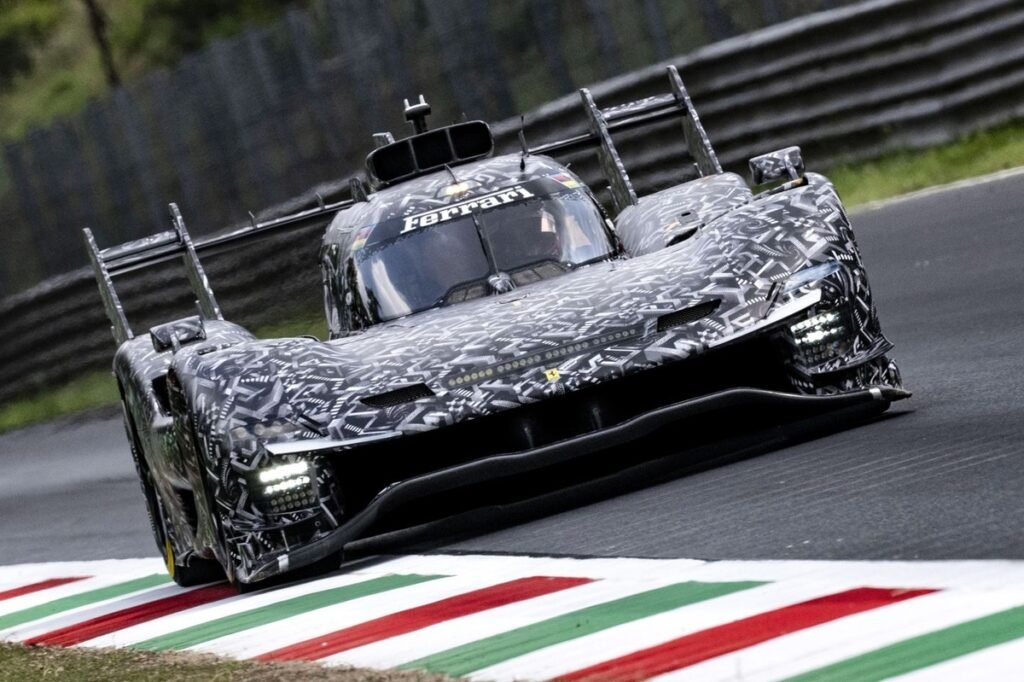
‘A taste of the future’. That was the caption Ferrari used for the first images of the updated 499P. But rather than offering just a glimpse, the photographs revealed a wealth of details that were immediately visible to the naked eye.
The revised LMH took to the track at the end of July for two days of testing at Monza, ahead of its debut in the World Endurance Championship in 2027.
The prototype ran in a black, white and grey camouflage livery, similar to the one used during the programme’s launch in 2022. The current-spec 499P also lapped the circuit, allowing Ferrari to compare the two cars directly.
Antonio Fuoco and Miguel Molina took turns at the wheel representing the #50 crew, whilst Antonio Giovinazzi and Alessandro Pier Guidi of the #51 car joined them on a programme aimed at generally improving the performance of the hybrid prototype, which is powered by a V6 turbo engine based on that of the 296.
On the eve of the Le Mans 24 Hours, Ferrari’s technical chief Ferdinando Cannizzo had made it clear that the updates would be designed with the car as a whole in mind, rather than focusing on just one area. Cannizzo had stated that Ferrari was planning to use ‘less than four and more than two’ evo jokers, while emphasising just how important it was to make the entire 499P competitive.
“You know full well how much I focus on the car’s integration; everything has to work well. And this seemed to us to be the right way to arrive at a structured package. Instead of using one joker at a time, we’ll be bringing a package of upgrades that represents a truly comprehensive integration,” Cannizzo had said.
“It won’t be a completely new car, but we’re working on it and we have four evo jokers to use.”

Ferrari 499P EVO at Monza
Photo by: Ferrari
Visible changes were put on hold until 2024
At Maranello, Ferrari had been working on the 499P to unlock its full potential. The engineers were aware that they had a car with enormous potential, but one that needed to be uncovered gradually and with meticulous attention to detail.
The first obvious issue was spotted right from the start, when tyre wear management problems arose; rather than resting on their laurels after winning Le Mans twice with the same car (2023–24), the first evo joker was deployed in mid-2024 – following the second victory at La Sarthe – to redesign the rear brake cooling duct, while also modifying the front aerodynamics by adding two side flaps (known as ‘flicks’) beneath the headlights.
The rest was achieved over the winter; it was there that the internal and ‘spiritual’ transformation truly took place. The 499P went on to dominate the first half of 2025 by securing four consecutive victories and managing to make progress even in races that had proved more difficult, such as Sao Paulo and Fuji, sweeping all WEC titles.
At the end of last season, Cannizzo admitted that Ferrari’s extensive development work had played a crucial role in unlocking the 499P’s full potential. By that stage, however, there were very few avenues of development left unexplored ahead of 2026. One inherent weakness still remained under the microscope, and that has now been addressed.
All-round development
In the current era of Hypercars (LMH and LMDh), it is natural that cars ‘frozen’ by homologation regulations may be designed to deliver their best performance under specific conditions. In other words: some teams wanted a car capable of winning primarily Le Mans, while attempting to patch things up for the rest of the season.
What has become clear is just how competitive Ferrari has been at Le Mans. That was true again this year, when – despite what the team suggested was a less favourable Balance of Performance – the 499P still made gains in both lap times and overall performance, giving Ferrari plenty of reasons to be encouraged regardless of the final result.
The essence, however, has not changed, and the approach adopted by Cannizzo and his technical team had a very specific aim: to try to make the 499P a versatile car capable of holding its own in every possible situation, even on sections with low-speed corners – which have always proved problematic for the team (as seen in Brazil and Japan) – while remaining competitive overall. Consequently, the package that made its debut at Monza ties in with what was mentioned earlier, namely improving the car as a whole.
This year, the only new development stemmed from the requirement to take the cars to the Windshear wind tunnel to obtain a new homologation from the federation, forcing Ferrari to revise some minor bodywork details. Combined with Michelin’s latest tyres, that process has helped shape the development path towards 2027.
What can we learn the first official (and unofficial) photos to emerge from Monza?

Comparison of Ferrari 499P (2026 vs 2027)
Photo by: Ferrari
Starting at the front, there are some notable differences compared to the current model competing in the world championship: the splitter retains the same shape but is raised higher and has sharper edges in the central section, with the addition of two side strips alongside those fitted beneath the headlights.
The headlights are now smaller in size because a central strip of LEDs has been added, just above the nose, replacing the two small lights that were introduced at the start of 2024. The white lights on the edge of the nose have been retained, with the addition of two further lighting systems on either side above them, visible at the outer edges.
Between the front bumper and the splitter, the system that channels airflow and cools the front braking system has been modified, as the two air intakes that used to be located inside the headlight housings are no longer present; instead, a pair have appeared alongside the central LED strip, with underbody deflectors that direct the air towards the side skirts, passing behind the inner side of the front wings.
This is another major new feature, with an opening now visible between the newly-designed front wheel arch and the side panel, thanks to a solution similar to those already seen on Porsche, Genesis and Toyota models.
Moving on to the central section, the vents above the side skirts have been shortened and moved towards the bonnet, where three have been added to the lower section, near the exhausts. In addition, there is a large opening leading towards the rear wheel arch, which is also newly designed.

Current Ferrari 499P testing at Monza
Photo by: Ferrari
And it is precisely on the rear end that the other major part of the work has been concentrated. While the bonnet fin retains similar lines (with a slightly widened air intake above the cockpit), the rear wing is of a completely new design, with side supports that have now doubled in number, accommodating a double horizontal wing profile (different from the central one) within them at the top.
Moving down to the lower section, the second wing above the diffuser – which also served as a rear light cluster (known in the trade as a ‘beam wing’) – has been replaced by a strip of horizontal red LEDs mounted in the centre of the rear wheel arch opening, where one can also see a sort of separation in the side profiles, taking the place of the three diagonal openings currently in place.
The rear bodywork has been raised to accommodate a new diffuser featuring two much larger arches, which are no longer connected as a single unit but have been split, leaving a central opening. The whole assembly is connected to the redesigned bodywork on the sides, behind the rear wheels, with a completely altered shape that leaves space for a wide slit at each end.
These are the main changes visible on the prototype that tested at Monza, although all of them remain subject to change before the car is homologated.
Ferrari was pleased with the outcome of the test, with Global Head of Endurance and Corse Clienti Antonello Coletta saying: “The Monza tests concluded positively and allowed us to complete the programme we had planned. The two days were extremely valuable for beginning to verify the operation of all the new elements we are testing and for starting to understand the most promising directions to pursue, with the aim of finalising the solutions for next season as soon as possible.”

Ferrari 499P
Photo by: Ferrari