






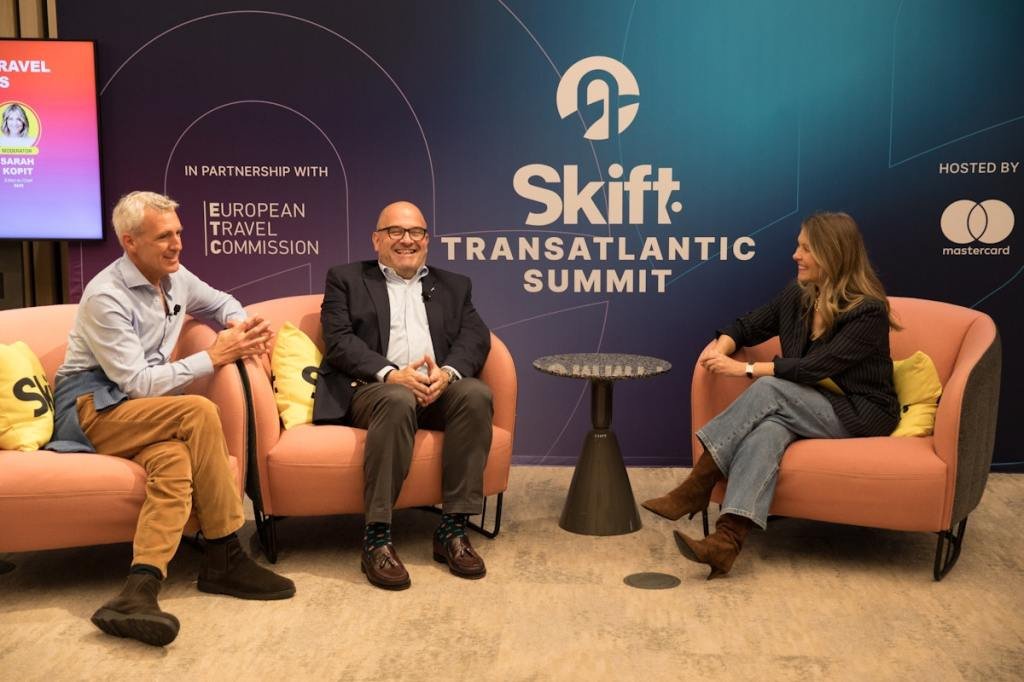
In Partnership with the European Travel Commission · Hosted by Tourism Ireland
October 15, 2026 · Portmarnock Resort & Jameson Golf Links, Dublin
Skift Transatlantic Summit 2026 · Pre-Read

The transatlantic corridor remains one of travel’s most important markets — and also one of the most exposed to global disruption.
Skift Transatlantic Summit:
Portmarnock Resort & Jameson Golf Links, Dublin, October 15, 2026
For senior leaders, director level and above. Applications are reviewed; places are limited and not guaranteed.
The Five Decisions
Cross-border demand has held up, but performance is uneven across markets and regions. Costs, confidence, connectivity, and perceptions of safety are shifting demand between destinations and seasons.
The decision is whether to stay the course in markets that are still performing or rebalance investment around a more volatile demand environment.
The Decisions Being Made Right Now
- What should drive the plan: stated intent, forward bookings, or actual spend?
- How should changing costs and demand patterns affect which source markets get budget?
- Which markets and routes create too much concentration risk?
What to Discuss in the Room
- Where Skift Research’s Lindsey Roeschke sees a gap between what travelers say, what they actually do, and where discovery is moving.
- How Tourism Ireland’s Alice Mansergh decides when a market shift is noise, and when it is big enough to change the plan.
- What Mastercard’s Ailish Campbell sees in cross-border spend and trust, and what Rome2Rio’s Wendy Olson Killion can see in search behavior before demand turns into a booking.
Politics is no longer background noise for travel. Conflict can change connectivity and costs overnight, while policy shifts can affect access, sentiment, and market economics. Companies still have to price, market, and commit capacity before the political picture becomes clear.
The practical decision is when political risk becomes significant enough to change the commercial plan.
The Decisions Being Made Right Now
- How are political shifts clearly redirecting traveler behavior, and how long will those changes last?
- How should operators plan around policy changes they can’t forecast?
- When should a political development prompt a change in market allocation or messaging?
- Where can the travel industry shape policy, and where does it need to adapt?
What to Discuss in the Room
- How the European Commission’s Maja Bakran sees tourism moving from a sector issue into a wider European competitiveness, mobility, and growth agenda.
- How Ireland’s Minister for Enterprise, Tourism and Employment Peter Burke weighs resilience and competitiveness for Ireland, and travel’s vital role in achieving ambitious targets for economic growth.
- What author and journalist Dylan Ratigan sees coming out of the U.S. economy and political system that European travel leaders may be underestimating.
Marketing alone won’t redistribute demand. Secondary destinations need connectivity, capacity, and enough demand to support service without recreating the pressures of major gateways.
The test is whether dispersal changes where and when people actually travel, or whether it remains a promise inside a marketing campaign.
The Decisions Being Made Right Now
- Is the shoulder season becoming a new high season, bucking the trend of summer saturation in Europe?
- How can gateway and secondary destinations coordinate without competing?
- How does a destination close the gap between what it offers and what travelers think it offers?
- What can destinations do to attract and invest in live tourism and mega events, driving broader awareness globally?
What to Discuss in the Room
- How Lindsay Milne Grant views live events as an opportunity for year-round demand for Boston, and what Arnar Már Ólafsson of Icelandic Tourism Board learned from eclipse tourism in 2026.
- How NBTC’s Yvonne Nassar and Montenegro Tourism’s Ana Tripković Marković judge whether visitor growth is actually producing better local economic outcomes.
- Why Trip.com’s Edison Chen feels the opportunity for destinations is not to assume that behavior in one market will automatically translate elsewhere, and why context matters in understanding the signals.
AI is becoming part of travel discovery faster than it is becoming a transaction channel. Seventy-one percent of travelers are comfortable using AI for inspiration, but only about half are comfortable letting it make a flight or hotel booking. [3]
That creates a new tension for destinations and suppliers: they need to be visible inside AI systems without giving up the trust and customer relationship that still drive direct bookings. Forty-nine percent of travelers cite greater trust in a supplier’s website as their top reason for booking direct. [3]
The Decisions Being Made Right Now
- When will AI shift from discovery and advice into transaction?
- Which traveler segments are already using AI extensively for trip planning?
- How much marketing investment should move toward AI-readable content and data?
- What do brand-managed channels have to keep within their control?
What to Discuss in the Room
- What Atout France’s Adam Oubuih and Sojern’s Sylvia Weiler think destinations should do now to become more visible inside AI-driven discovery.
- How Skift Research’s Lindsey Roeschke reads the say-do gap from travelers when it comes to AI specifically, and which parts of the travel stack AI is actually changing first.
Europe has talked about seamless multimodal travel for years, but travelers still do much of the stitching between air, rail, ferries, and local transport themselves.
Better ground connectivity can extend the reach of international flights into secondary destinations. The near-term question is what airlines, rail operators, destinations, and technology platforms can connect now rather than waiting for a fully integrated system.
The Decisions Being Made Right Now
- How can tier-two and tier-three cities create broader demand through streamlined mobility between air and ground, and how can they leverage that shift to influence the behavior of transatlantic travelers?
- Which integrations can companies build before common infrastructure arrives?
- Is the question only about having a single ticket or connecting one reliable journey?
What to Discuss in the Room
- Why Certares’ Greg O’Hara believes rail will reshape the European travel map, and where capital is moving before the network fully catches up.
- How Aer Lingus’ Reid Moody sees Dublin as both a destination hub and the connector to a wider journey into Europe.
- How Rail Europe’s Jean-Francois Bessiron plans to be the connective layer across European networks, and where the transatlantic traveler still hits a wall with rail.
What You Will Leave With
The numbers remain strong, but the forces underneath transatlantic travel are changing quickly. Demand, politics, AI, destination strategy, and connectivity are all changing where growth comes from and who captures it.
The goal of the Summit isn’t to build widespread consensus. It’s to gain a clearer view of what has changed, and what leaders should do differently in 2027.
Sources
- [1]European Travel Commission, European Tourism: Trends & Prospects, Q2 2026.
- [2]Skift Research, “The Mystery of the Disappearing Destination: How AI Is Transforming Travel Discovery,” October 2026.
- [3]Skift Research + McKinsey & Company, Winning Hearts in an Age of Infinite Travel Choices, September 2026.
- [4]European Travel Commission, European Tourism Trends & Prospects Q1 2026.
In Partnership With

Hosted By

Travel Industry Sponsors