

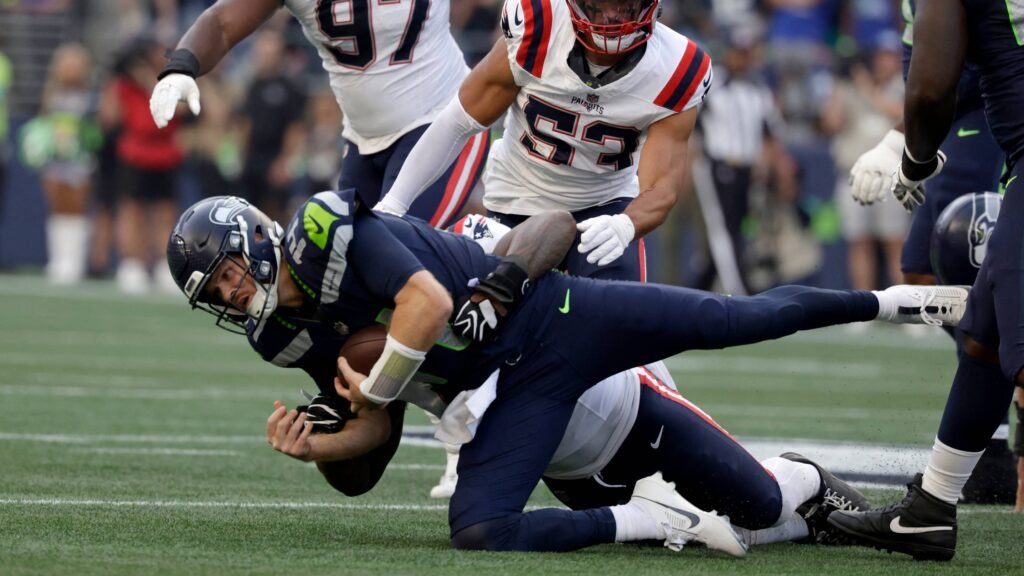
It is unclear what requirements one must attain in order to claim to be a doctor on social media, but depending on which one you follow, Seahawks quarterback Sam Darnold may have sustained a hip injury in the season opener, or worse, may soon be vaporized into a cool, liquid mist by artificial intelligence. Either way, it sounds serious.
Even more serious for Darnold may be that the matter of his established, unquestioned greatness (or at least the question of whether his rise was due to a realization of talent or his coincidental placement on a pair of teams with great play-callers and phenomenal defenses) is now—once again—a live topic, after he left the game and backup Drew Lock, buoyed by the same killer defense, grew comfortable enough in the offense to throw a game-tying touchdown pass (albeit with an incredible run after the catch) on a gutsy fourth down and slip through New England’s defense to set up another goal-to-go situation. This, despite Lock not having any meaningful first-team reps this summer. Lock was efficient in Wednesday night’s 13–10 win, especially in Seattle’s bigger personnel sets; roughly doubled the EPA per play of his counterpart, Drake Maye; and had the Seahawks at a better success rate on drives started with a pass than drives started with a rush.
For those who have ridden the Lock-coaster before—pop and Lock’d?—this was not an unusual occurrence in the short term. He is a guy who can make the fourth quarter of an utterly meaningless Giants game feel like a shootout with the Doolin-Dalton Gang. We know better than to expect it will last. We know deep down that Darnold is the best option for this team moving forward. The game before this one, he won the damn Super Bowl.
But we must simply acknowledge, on a night when Seattle’s defense had New England so completely sideways that it looked like its offensive line and backfield were running two completely different plays on Maye’s ill-fated, game-ending third interception, that it seems Darnold may never escape the skepticism that was attached to him earlier in his career under circumstances that were beyond unfair. This may simply be his fate, so long as he plays alongside this defense.
That statement centers around a truth that has survived a long offseason. Seattle’s defense is so dominant and so deep that, despite the absence of several key players, it was still a tackle-for-loss machine that mobbed New England from the opening drive and forced a player who finished second in MVP voting last season into a painfully conservative game management role. For a while, those of us not on the field couldn’t understand why the Patriots weren’t in attack mode from the opening snap and settled for 18 largely uneventful Rhamondre Stevenson rushing attempts at 2.8 yards per carry. The team was more afraid of what ended up happening: Maye, without A.J. Brown and with Romeo Doubs still clearly attempting to find his role within this offense (along with his confidence), drifting from the pocket and firing passes into the abyss.
In a way, Patriots offensive coordinator Josh McDaniels was more accepting of what he knew to be a fruitless effort—and attempting to shrink the scope of the game—than he was exploring what the Seahawks would look like without four of their most important players from February’s Super Bowl matchup. This is the hallmark of a defense that is not just great, but maddening to play against. Mike Macdonald may truly be the defensive answer to Sean McVay, producing success that is not quite talent-independent, but maintains a standard even when certain parts are missing.
While Seattle would never want its starting quarterback to miss significant time, an absence would help answer the question of Darnold’s central value more definitively. What is possible with properly managed play-calling and a shutdown defense and what can a team get away with under center? Darnold is about 16 more solid NFL games away from becoming one of the highest-paid quarterbacks in the NFL. His longtime journeyman compatriot Baker Mayfield finally heaved himself over the white picket fence and into the neatly manicured neighborhood of quarterback financial security. Darnold is approaching the cusp of the same walk year this coming offseason.
Seahawks general manager John Schneider has already navigated the pitfalls of keeping a Super Bowl contender together. It gets complicated. In the case of the Legion of Boom and its cultural clash with corporate signal-caller Russell Wilson, it ended up driving a wedge through the heart of a truly great football team. The Darnold social dynamic is far less complicated—nearly to a person, his teammates have publicly stated how much they loathe the share of the blame he gets when the team loses versus the credit he gets when they win—but the finances may not be. Feeding the furnace of Macdonald’s amoebic defense needs to be the priority in order to play to his strengths now and forever. Soon, the budget will necessitate more funding to replace a handful of veteran players and, likely, overpay other young players to keep them from free agency.
We can say these are lofty ideas and a classic Week 1 overreaction, but it’s impossible to argue that every snap Darnold misses, and every game that the Seahawks continue to win like this without him, doesn’t matter in some way as it pertains to the future of this team. Seattle missed its chance to be a dynasty once before. In its quest to create another, everything must always be under evaluation. Including, unfortunately, how much it matters that the starting quarterback isn’t on the field.
 Add us as a preferred source on Google