

Netflix’s 9/11 Documentary Is Too Big for its Runtime
Turning Point never settles on what it’s actually arguing.
Isaac Newton’s Third Law of Motion: Every action has an equal and opposite reaction. Much of the director Brian Knappenberger’s new Netflix film, Turning Point: Generation 9/11, attempts to explain the reaction to the terrorist attacks. Though Knappenberger does a fair job laying out a cursory view of the varied consequences that emanated from that fateful day, his documentary struggles to find its footing while hastily considering a myriad of concerns that fail to amount to a key thesis.
Knappenberger’s film is a follow-up to his 2021 five-part series, Turning Point: 9/11 and the War on Terror. This new companion piece, released days before the anniversary of 9/11, fails precisely because it attempts to cram 25 years of history into a 97-minute runtime. It is a historical review eager to sort through the chaotic vestiges of memory, the transformation of the country, and the haunting specter of one of the gravest days in the history of the United States. But by stuffing so much content into such a short window, Knappenberger fails to define one single thread in his attempt to ultimately argue that 9/11 crystallized long-simmering anxieties that were then used to pursue some of the worst foreign and domestic policies of the 21st century.
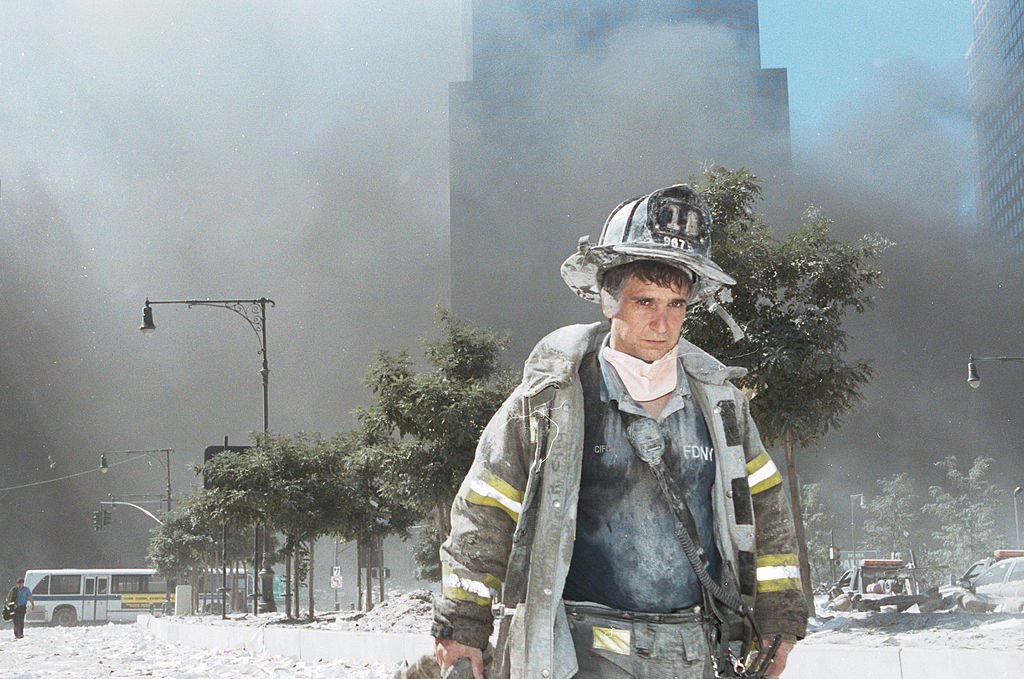
Knappenberger begins at the start: on September 11. Through amateur videos and archived newsreels, the documentary does well to situate time and place, confidently leveraging the emotional weight of the attacks to establish the motivations that influenced the political and cultural manifestations of America over the last quarter-century. For older Americans who lived through the attacks, much of this is well-trodden territory, but for the younger generation, at whom the film is directed, the first third of the documentary does its best to revive the horror and explain just how impactful the attacks were on the psyche of America and its people. Though it’s ham-handed in its delivery, here the film succeeds because it knows exactly what it’s attempting to accomplish: pure emotion.
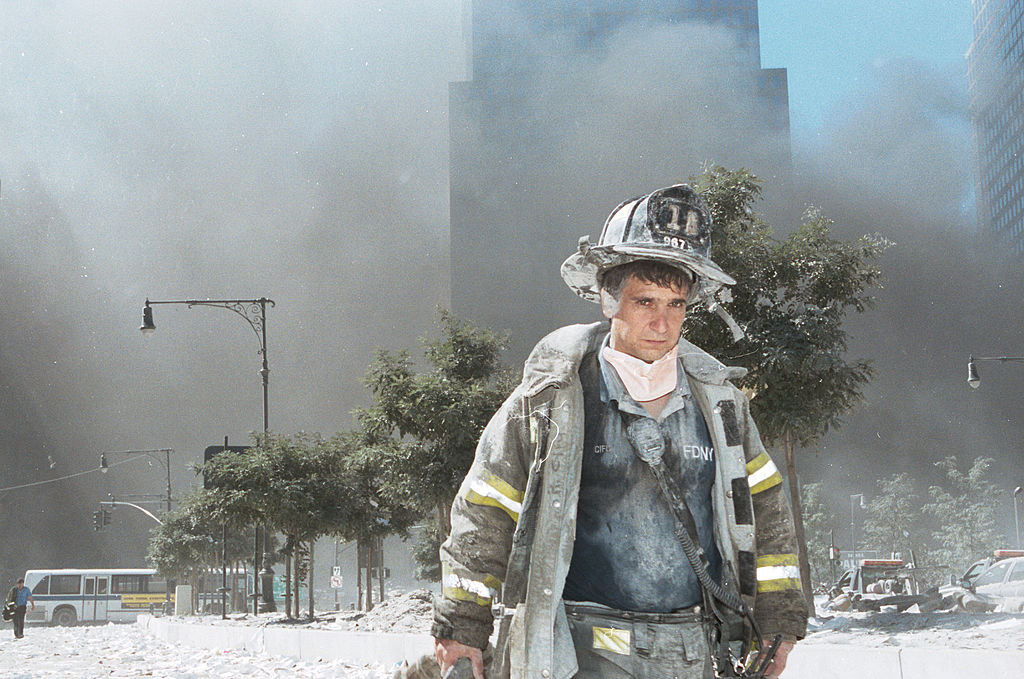
We hear from firemen who heroically worked to save those they could before the towers collapsed around them. Knappenberger also interviews people who lost loved ones on that harrowing day. Again, for those who were too young to remember or were born after 9/11, this section does heavy lifting. It clearly explains why, as the rubble was still being cleared at Ground Zero, America’s politicians were already seeking revenge and pushing forward narratives about terrorism and security threats that have been used to expand the security state in the U.S. to this day.
The next hour of the film is dedicated to the missteps that occurred across multiple presidencies as a result of the attacks. It attempts to follow the chaotic strategy employed first by President George W. Bush, whose promise to rid the world of terror created an endless march of death and chaos across the Middle East and beyond. Oona Hathaway, special counsel to the general counsel at the U.S. Department of Defense from 2014 to 2015, expresses her discontent with the years that followed 9/11, arguing that the attacks were used to expand executive power while neutering Congress.
“The Constitution was written to really constrain the president’s authority to use military force,” Hathaway tells Netflix. “The idea was we didn’t want to have a king, we didn’t want to have one person who could just launch the country into war. So, the Constitution very carefully separates out those powers. It’s Congress that gets to declare war. The 2001 Authorization for Use of Military Force was enacted without a lot of time for careful deliberation and careful reflection.”
Hathaway’s interview is immediately followed by a soundbite of CNN host Wolf Blitzer citing a post-9/11 poll in which, he tells viewers, 66 percent of Americans said they “would be willing to give up some” of their liberties. This all leads to a long section on the 2001 AUMF, which the documentary accurately calls the “foundation stone” that provided a legal framework to fight forever wars, to detain enemies, and to organize black sites abroad.
But instead of using the rest of the runtime to focus on the permanent destructive effects of the 2001 AUMF—how it led to nearly two sprawling decades of war while creating onramps for President Donald Trump and future presidents to invoke its language to launch wars without Congressional authorization—Knappenberger scatters the lens between Middle East terrorist groups and anti-Muslim fervor in the U.S.
Refocusing on New York City, the documentary interviews Mohammad Razvi, founder and CEO of the Council of Peoples Organization, whose father had emigrated to the U.S. and was one of the first business owners in a part of New York City colloquially referred to as Little Pakistan. Razvi speaks fondly of the years before 9/11. “I was living the American dream,” he tells Knappenberger. “Everybody, we all were immigrants, but we’re like Americans. I never felt my identity was negative.”
Razvi expresses the emotional and psychological toll he felt while witnessing the attacks occur on 9/11. “I was working in this fabric store and my Italian paisans said ‘How could your people do this?’” Razvi recounts. “And I’m like, ‘These are not my people.’ What do you think the local people are going to do? They’re going to go to war on us. All of a sudden, I’m a foreigner.”
By the time Knappenberger reaches Razvi’s story, Generation 9/11 has already sprinted through the attacks, the invasions, the AUMF, and the slow-burning rot of executive overreach. Adding more layers about the Muslim experience and tying the 9/11 attacks into the formation of Immigration and Customs Enforcement (ICE) in the end is too much. That’s the documentary’s fundamental problem. Every thread it follows, from the firemen who rushed toward the towers to Hathaway’s constitutional alarm to Razvi’s overnight transformation into a “foreigner” in his own Brooklyn neighborhood, deserves the kind of sustained attention Knappenberger gave the War on Terror across five hours in 2021. Here, each point receives only a few spare minutes before the film ploughs forward.
Newton’s third law promised an equal and opposite reaction to every action. What Turning Point: Generation 9/11 delivers instead is a smattering of small reactions, scattered in passing, never quite adding up to the reckoning the subject demands.
The post Netflix’s 9/11 Documentary Is Too Big for its Runtime appeared first on The American Conservative.