



Metric!
Metric!
Metric!
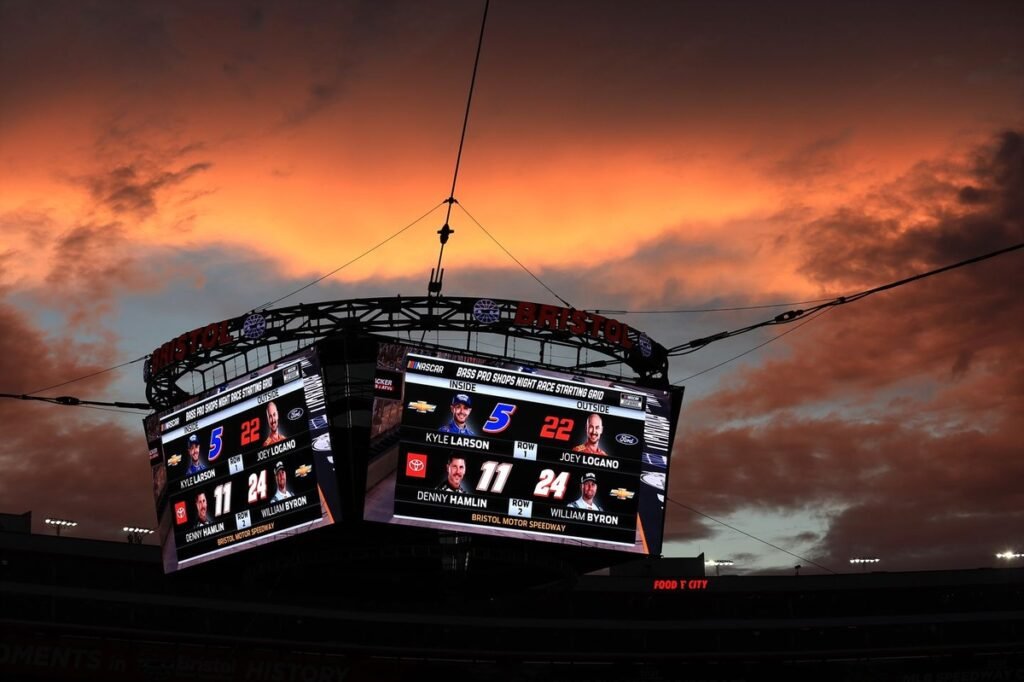
Lost in the hoopla of the Bristol Night Race and a very competitive Chase for the Championship, two of the first three playoff races have had rained out qualifying sessions and a starting lineup set by The Metric.
Given the value of stage points in deciding the eventual champion, this has become somewhat of a polarizing topic as summer turns to autumn.
As a refresher, the metric sets the qualifying order for each race throughout the season. The metric is comprised of 70 percent a car’s finishing position in the most recent race and 30 percent the car’s rank in the owner points standings.
This system was first instituted during the 2020 season, when COVID eliminated qualifying each week, effectively creating an alternative to giving championship leader Kevin Harvick the pole every week.
During the 10 playoff races, the qualifying order metric is adjusted to where the drivers racing for the championship are the final 16 to take their turns. Should qualifying gets rained out, which is what happened for the Southern 500 and the Bristol Night Race, the starting lineup is set entirely by the metric … but without grouping the playoff drivers together up front.
It was especially problematic at Darlington, because 70 percent of what determined the starting lineup was the previous race at Daytona, where superspeedway Big One crashes claimed several contenders.
This made it practically impossible for them to challenge for the Stage 1 win and a tremendous amount of first stage points. The most notable victim was Kyle Larson and the Hendrick Motorsports No. 5 team, who then benefitted from the metric at Bristol, where he was awarded the pole after winning the week before at Gateway.
Always intellectually honest and consistent, crew chief Cliff Daniels has told Motorsport.com on two different occasions this month that his team should start wherever they are in owner points if qualifying gets rained out.
That would have been seventh at Darlington and second at Bristol. Larson himself also feels that way.
“I mean, you can have the metric to set the qualifying order, but I think just lining up the field based off points would be good,” Larson said. “Especially in The Chase now or with this point format, every point being so important.
“I thought it just was kind of crappy to feel like we were starting off a disadvantage (at Darlington) and we raced our butts off and just missed stage one points.”
Larson currently holds a one-point championship lead over Denny Hamlin with seven races to go and those missed Darlington points could loom large.
“But I mean, you can look at it both ways,” Larson added. “We could have done better at Daytona to set ourselves up better for the starting position. But yeah, I think curious what other teams think, but I think setting the metric for qualifying order is okay, but I think if it rains out, I would say I’d be for going back to just starting off points.”
For his part, Hamlin wants no part of going back to a random pill draw for qualifying order, so he agrees with Larson there.
“The random stuff, no,” Hamlin said. “Absolutely not. I mean, could you imagine going to the finale and two guys battling for a championship, one draws pill one, like that’s horrible. Random? Absolutely not.
“You’ve got to earn your way. If you want to do 50-50, that’s fine, because we’re 20 some races in. If you’re buried in the point, it’s not because the metric did it. It’s because you didn’t perform well.”
What about when qualifying rains out?
“If it rains, it’s difficult because (Darlington) kicked off the Chase, and it also was after a (super)speedway, and we all know speedways can get very random, right,” Hamlin said. “Yeah, I don’t know. We don’t want to make it too complicated for the fans that at this racetrack, you set your metric one way, another way, you do it, I don’t know, if you just do 50 percent or more of where you are in the standings, then I think that that kind of will fix itself in the long run.”
When asked about it at Gateway, Ryan Blaney feigned indifference. He said it is what it is.
“Those things, they don’t happen incredibly often as far as coming off a (super)speedway, where you have kind of a mixed-up finishing order and then it’s a Chase race,” Blaney said. “So kind of raised everyone’s eyebrows.”
Except, then it happened again at Bristol, having a real impact on pit stall selection and first stage points earned.
“I personally feel like the metric is a good thing,” Blaney said. “Random draws have been brought up, but then we’re going to complain when I draw pill one and it’s like, ‘well, why the heck should I go out first when I’m in The Chase?
“So I don’t know. I personally think it’s good where it’s at. It was just one of those situations (that) weekend that was pretty unique and sometimes those unique things happen, you have to just deal with it.”
When asked about the topic, Ross Chastain said he is not in those meetings with NASCAR and does not want to be in those meetings. He said he will race whatever formats NASCAR challenges teams with and he will just do his job to make the most of it.
Wallace also appreciates the metric from a qualifying order standpoint.
“That part is fair,” Wallace said. “You have the top 16 guys that are fighting for a championship and the metric is a competition within the race, because we all want to go out last on Saturdays.
“If you have a bad race, you pay for it, and that’s sport. I think that’s fair, and I have no complaints.”
His only point of confusion is that he gets tripped up when it rains because he goes from having a guaranteed chance to go out late in qualifying to being beholden to wherever he finished the week before.
He thinks it’s fair but he also finds it confusing.
Similar answer from Michael McDowell, who says, on average, a qualifying rainout is only going to happen once or twice over the Chase for the Championship.
“How you feel about it depends on where you are right,” McDowell said. “I mean, I don’t know what the fairest thing is, right, because like even out late isn’t advantage (everywhere) you know, and those Chase guys that get to go out last, that’s an earned advantage over the whole season. I think I’m okay with how we’re doing that.
“As far as rainouts go, I don’t think you can change it. The metric is working everywhere else except in those scenarios. The rainout will happen once or twice over a Chase format, but over the whole season, it’s fair.”
The generally philosophical Brad Keselowski said asking for fairness out of the qualifying format is akin to asking for fairness out of life itself — which is sometimes untenable.
“I don’t know if there’s really a great way to work through those situations,” Keselowski said. “I’ve been around the sport long enough to see multiple different systems and I didn’t really like any of them. None of them are great
“You’re trying to find a solution to something that isn’t equitable to begin with. It rains out or whatever the situation is that makes you have to use the metric, there’s no real equitable or fair way to do it, so then NASCAR is just trying to be consistent.
“There’s winners and losers. That’s how life works. I don’t particularly feel great about any of the systems enough to sit here and say that, ‘Oh, we should do this one instead.’ And I have a lot of empathy for NASCAR who gets forced into making that decision because I can honestly sit and say that if I was in their position, I don’t know what better decision there is to make.”