





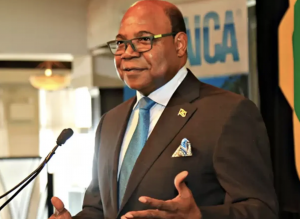
Jamaica’s Minister of Tourism, the Hon. Edmund Bartlett, has spent years arguing that resilience must sit at the heart of tourism strategy.
Now, as Minister Bartlett accepts an invitation to co-chair the World Economic Forum’s Beyond Tourism Day 2026 at its Geneva headquarters on September 25th, the appointment marks a remarkable rise, both for resilience as a global economic priority and for the man who has spent years driving it.
Held under the theme “Resilient Growth. Renewed Impact”, the closed-door meeting is expected to bring together approximately 80 leaders from government, business and civil society.
The agenda will address the structural fragmentation of travel and tourism, alongside workforce pressures, technological disruption, infrastructure constraints, climate exposure and increasing pressure on destinations.
Speaking to Breaking Travel News, Minister Bartlett said: “Resilience can no longer be treated as an abstract concept or a response mechanism activated after a crisis. It must become part of the operating architecture of global tourism.
“We have lived through a pandemic, intensifying climate events, geopolitical conflict, cyber threats and economic disruption, and each has demonstrated how deeply interconnected our industry has become.
“The task before us is to move from recovery to readiness. We must invest in people, intelligence, infrastructure and financing before the next shock arrives.
“The invitation from the World Economic Forum is significant because it takes this discussion beyond tourism and places it where it belongs, at the heart of the global economic agenda. For Jamaica, it also demonstrates that smaller tourism-dependent states can develop solutions with genuine global relevance.”
A succession of overlapping crises has made that argument increasingly difficult to ignore.
Resilience has moved beyond the language of emergency response and risk management. It is becoming a horizontal leadership and growth agenda, connecting economic security, geopolitics, technology, infrastructure, supply chains, climate, workforce development and organisational capability.
Tourism sits at the intersection of them all.
A conflict thousands of miles away can close airspace, disrupt routes and raise fuel and insurance costs overnight. Extreme heat, hurricanes, floods and wildfires can threaten destinations and critical infrastructure. A cyberattack can immobilise an airline, airport or hotel group.
Artificial intelligence is reshaping employment, distribution and how travellers make decisions, while misinformation can damage confidence in a destination within hours. Inflation, energy shocks and supply-chain disruption can quickly undermine tourism businesses and planned investments.
COVID-19 demonstrated how rapidly these risks can converge. Borders closed, aircraft were grounded, supply chains broke down and millions of tourism workers lost their livelihoods.
The crisis exposed the fragility of an industry that contributed US$11.6 trillion to the global economy and supported 366 million jobs in 2025, according to the World Travel & Tourism Council.
The ongoing Gulf crisis has provided the latest and most immediate demonstration. Airspace restrictions, route suspensions, rising fuel costs and disruption to vital energy and shipping corridors have affected aviation, tourism, trade, investment and confidence far beyond the region.
The World Travel & Tourism Council expects the Middle East’s travel and tourism economy to contract by 14.5 per cent during 2026 as a result of short-term geopolitical disruption. Its longer-term forecast nevertheless identifies the region as the world’s fastest-growing travel and tourism market between 2026 and 2036, illustrating the difference between temporary disruption and underlying resilience.
Justin Cooke, Editor-in-Chief of Breaking Travel News, said: “The ongoing Gulf crisis has been a further catalyst for the adoption of resilience thinking. It has shown how a geopolitical event can move horizontally through aviation, tourism, energy, logistics, supply chains, investment and consumer confidence with extraordinary speed.
“Resilience has consequently entered our everyday vernacular. Our analysis of Google Trends indicates that search interest in the term has increased by as much as fivefold since 2022.
“This is because resilience is no longer the preserve of risk managers or crisis-response teams. It is a defining 21st-century skill for individuals and leaders, as well as a capability that must sit at the centre of every organisation’s strategy.
“Minister Bartlett understood this earlier than most. He recognised that resilience is not simply about recovering from the last crisis. It is about developing the intelligence, agility, people and institutional capacity required to anticipate the next one, adapt under pressure and emerge stronger.”
That thinking led to the establishment of the Global Tourism Resilience and Crisis Management Centre in Jamaica in 2018, before the pandemic brought international travel to an unprecedented standstill.
The Centre created an institutional platform for crisis preparedness, research, training, policy development and data analysis, addressing issues ranging from climate exposure and public health to cybersecurity, digital transformation and entrepreneurship.
Jamaica then led the successful campaign for the United Nations to designate February 17th as Global Tourism Resilience Day.
The movement has continued to expand. The fourth Global Tourism Resilience Day Conference and Expo was held in Nairobi earlier this year, marking the first annual international observance staged outside Jamaica and the first held in Africa.
What began as an initiative from a vulnerable Caribbean island economy is now moving into the mainstream global economic conversation.
The World Economic Forum operates at the intersection of economics, government, investment, technology and geopolitics. It can convene the finance ministers, institutional investors, insurers, technology companies, infrastructure providers and global corporations needed to turn resilience from an industry conversation into a functioning international framework.
Its Beyond Tourism initiative reflects a growing recognition that travel and tourism is a “sector of sectors”, connecting visitors, residents, governments, businesses, infrastructure, technology, finance and local communities.
Ahead of Geneva, Minister Bartlett will participate in WTM Spotlight Riyadh, taking place from September 8th-10th at the Riyadh Front Exhibition & Conference Center.
There, the focus will be human capital, another fundamental component of resilience.
Minister Bartlett will join senior representatives from Saudi Arabia’s Ministry of Tourism, King Salman Gate Project, Red Sea Global, King Saud University and Qiddiya to explore the education, career pathways and leadership development needed to support the Kingdom’s ambition of attracting 150 million visitors and creating more than one million tourism jobs by 2030.
Saudi Arabia’s challenge illustrates the horizontal nature of the resilience agenda. New destinations, hotels and infrastructure cannot deliver their full economic potential without the people, skills, institutions and leadership needed to operate them.
Training alone is insufficient. Resilience requires occupational standards, recognised qualifications, employer demand, credible hiring routes and opportunities for people to progress into specialist and leadership positions.
The same principle applies throughout the tourism economy. Physical infrastructure cannot be resilient without cyber protection. Climate adaptation cannot succeed without investment. Technology cannot deliver sustainable growth without skills and public trust. Destinations cannot withstand crises if their workers, communities and small businesses are left exposed.
The rise of resilience is therefore bigger than any one event, destination or industry. It represents a fundamental shift in how leaders think about growth in an era of continuous and overlapping disruption.
Minister Bartlett is now calling for the next stage: a Global Tourism Resilience Fund capable of financing early-warning systems, cybersecurity, misinformation response, research, resilience monitoring and rapid technical assistance.
Global Tourism Resilience Day created recognition. The Centre created institutional capability. A properly financed global fund could begin to create the architecture required to turn ambition into action.
From Jamaica to Nairobi, Riyadh and Geneva, Minister Bartlett has helped take resilience from a specialist tourism conversation to the global economic stage.
The world is catching up with the agenda he has been advancing for years. Resilience is no longer about preparing for one isolated crisis. It is about developing the capacity to navigate continuous disruption and still grow.
That is the rise of resilience.