


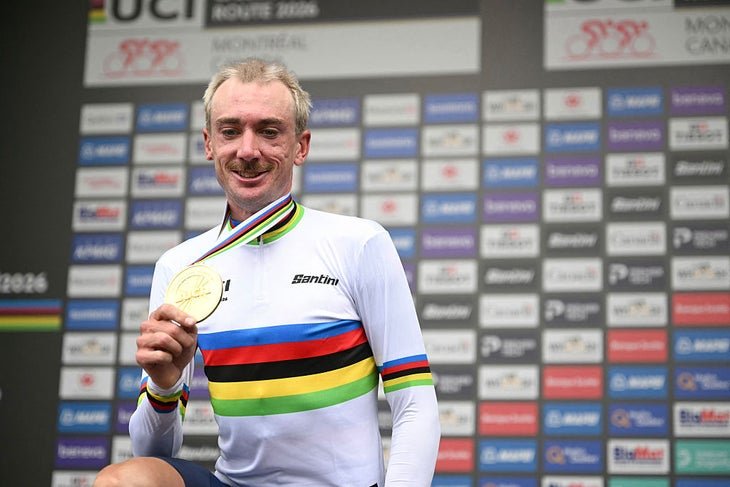
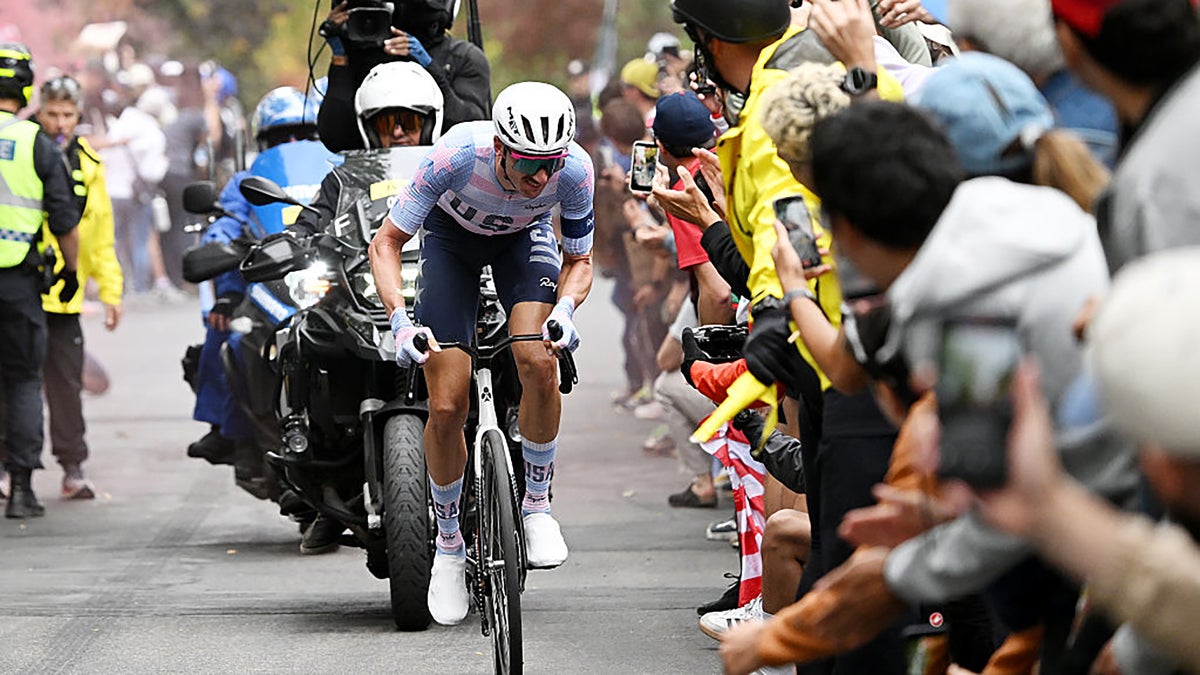
You may have seen a social media post or two celebrating an American cyclist named Brandon McNulty and his wild ride on September 27 to win the road cycling world championships in Montreal, Canada.
McNulty won the elite men’s road race in dramatic, edge-of-your-seat fashion. He broke away from the pack with 19 miles remaining in the 170-mile race, and then somehow held off multiple attempts from the other cyclists to chase him down.
The race’s final brutal miles delivered the agonizing will-he-or-won’t-he dynamic akin to a goal-line stand in the Super Bowl. On more than one occasion, the racers chasing McNulty came within a few seconds of him. At some points in the race it seemed more a question of when they’d catch him, and not if.
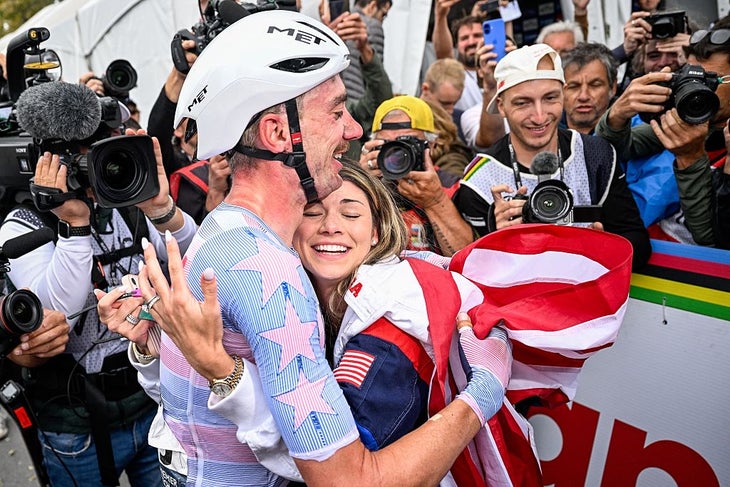
But in each instance, McNulty, who appeared utterly exhausted, sped further ahead. When he finally crossed the finish line, his ecstatic but bewildered expression captured the vibe of everyone who was watching.
“I never really thought this was something possible,” he told reporters after the event. “It’s absolutely crazy. It was my dream to be in the WorldTour even as a kid. But to do something like this is unbelievable.”
For the small but passionate community of American bike fanatics, McNulty’s victory is nothing short of a miracle—up there with the 1980 U.S. men’s Olympic hockey team beating the Russians.
That’s because the U.S. elite men have traditionally floundered at the world championships race, which is held every year in a new location near the end of the pro cycling season. The last U.S. elite guy to win it was Lance Armstrong in 1993, back when Nirvana’s In Utero dominated F.M. radio and cyclists raced the Tour de France without helmets.
But there are a few other elements of McNulty’s victory that are worth digging into—you know, beyond the historic connection to Armstrong.
Who Is Brandon McNulty?
Before joining Outside I was the editor-in-chief at VeloNews, a print magazine that covered pro cycling. I interviewed McNulty many times, and in 2017 I even wrote a lengthy profile on him for the publication.
Back then, Brandon McNulty was a teenager, one of a handful of wunderkind cyclists that U.S. coaches hoped would lead the country back to the pinnacle of the sport. His dad, RJ, showed me very cute photos of Brandon mountain biking as a child near their home in Phoenix, and recounted anecdotes of his son’s unusual love for cycling.
Lots of little kids love to ride a bike, but few of them enjoying pushing themselves to the brink of exhaustion seemingly just for personal satisfaction.
When Brandon was just eight years old, his dad took him on a three-mile biking loop that included a really hard climb—it was too steep for the kid to ride up without getting off to push. When RJ suggested the two go home, Brandon got upset and refused.
“He wouldn’t go home until he rode the climb,” R.J. told me. “I’m sure the other mountain bikers looked at me like I was some abusive dad forcing his kid to ride this hill. I was like, ‘It’s not me, it’s him!’”
By the time I met Brandon in 2017, he was one of the best junior racers in the world, and he was on a career trajectory toward the WorldTour ranks and the Tour de France. The biggest teams in Europe were interested in signing him, because in 2016 he’d won the junior world championships in the individual time trial—a true sign of otherworldly talent.
But that’s when McNulty broke from his peers. Most budding pros can’t say no not the big paycheck that comes from European teams. But the gap between junior racing and the European pro scene is enormous—think of it like going from high school basketball to the NBA. And every year, some talented juniors dive in too soon, flounder, and quit.
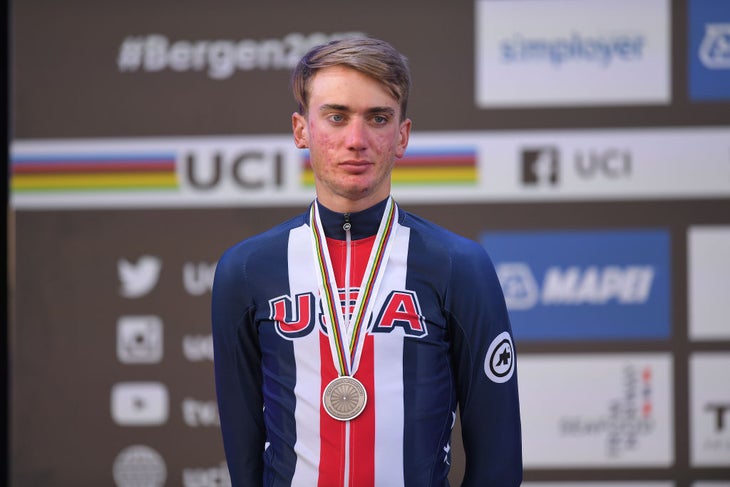
It’s even harder for top American kids, because they move overseas as teenagers and deal with culture shock, language barriers, and loneliness. In McNulty’s generation, several talented Americans had washed out of the European pro ranks before they ever got a chance to shine.
McNulty was cautious of this pitfall. So, rather than taking a big paycheck and moving to Europe, he signed a three-year deal with a smaller American professional team that raced predominantly in North America, but also did some European events. It’s as if Kobe Bryant decided to play three seasons in college before joining the Los Angeles Lakers.
“It was a really hard decision,” Brandon told me. “Racing full-time in Europe is something I one day want to do. I’d rather do it slowly than jump into it.”
The decision paid off. Over the next two seasons McNulty blossomed into a dynamic and very smart pro cyclist. In 2017, his results were blasé, the result of an injury. In 2018, he did better, even winning a European race. Then, in 2019, he excelled, winning a handful of events and racing up there with some of the strongest pro riders in the world.
By staying cautious, McNulty found his way to the top. For 2020, he was hired to join the best European team in the world, the UAE Team Emirates squad of Tadej Pogacar, now a five-time Tour de France winner.
A Team Effort to Win the World Title
American great Greg LeMond won the world road racing title in 1983 and 1989, and then Armstrong took it in 1993, long before his lifetime ban for doping. After that, Team USA’s elite men struggled at the race for decades.
There are several reasons why. The world road cycling championships falls at the end of the pro cycling season, when most racers are exhausted from the Tour de France and other events. In some years, the strongest American men actually skipped the event entirely due to fatigue.
And unlike the Tour de France and other pro races held throughout the year, the cyclists compete on national teams and not their traditional professional trade teams. On the global stage, Team USA is usually much weaker than powerhouse nations like Belgium, France, Italy, and The Netherlands.
With all that said, there were signs that 2026 could be the year where the USA ended its losing streak. McNulty, who is 28, is part of a generation of super strong Americans that’s hitting its stride. Idahoan Matteo Jorgenson, 27, and Coloradan Quinn Simmons, 25, are both regulars at the Tour de France. Riley Sheehan, 26, Kevin Vermaerke, 25, and Sean Quinn, 26, are also veterans of the WorldTour.
Still, in order to win, Team USA needed to ride as a cohesive squad, and that means having individual riders sacrifice their chance at winning to help a teammate take victory. I won’t get too deep into the nuances of bicycle racing tactics other than to confirm that Team USA raced with both brains and brawn.
With 45 miles to go, Simmons followed what appeared to be the winning attack from Dutch star Mathieu van der Poel, and stayed glued to his wheel in the perfect position to win. When the group chased Simmons and van der Poel down, McNulty made his winning move.
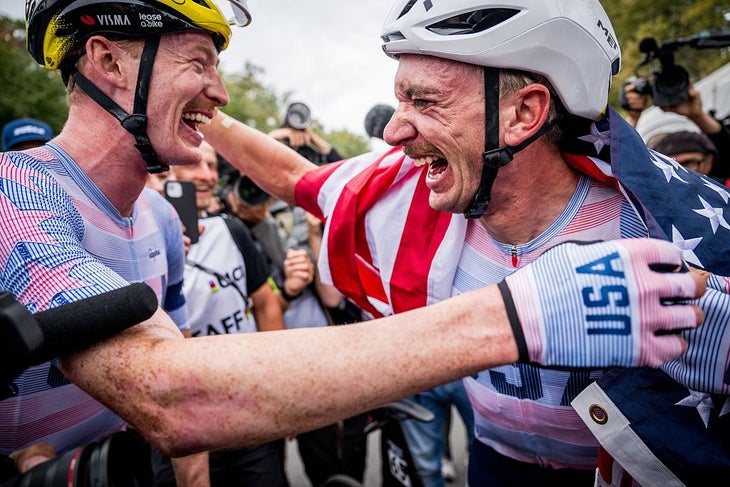
As McNulty rode on by himself, Simmons and Jorgenson chased down any cyclist who tried to bridge across the gap. I suggest watching the highlight video of the race to see how Jorgenson and Simmons sacrificed their chances to win in order to protect McNulty’s advantage. Their strategy was road bike racing 101, and it worked, and ended a 33-year-old losing streak.
What’s Next for McNulty?
Winning the road world championships comes with its own super cool prize: the rainbow jersey. For the next calendar year, McNulty will compete in this eye-catching white kit that will make him easily distinguishable in the colorful peloton (see below).
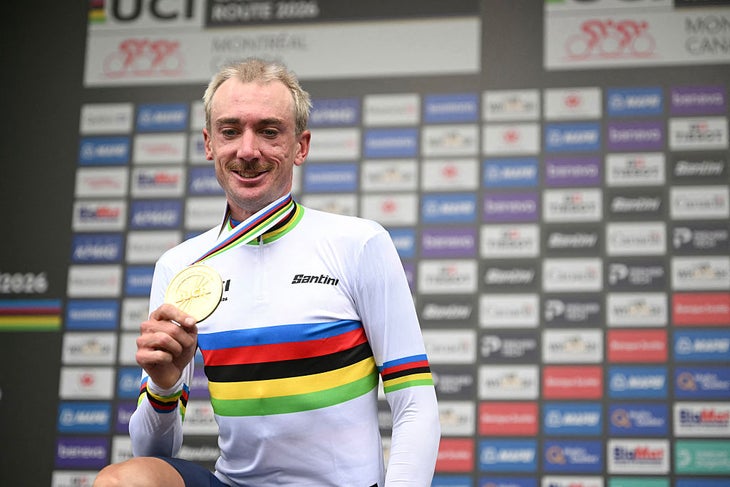
Beyond that, I’m doubtful that the big win will alter McNulty’s job that much in 2027. Like many cyclists, he is a worker bee, a domestique, in the peloton. His primary job is to help the sport’s biggest star, Tadej Pogacar, win the Tour de France.
During the Tour, McNulty rides at the front of the peloton up the longest climbs in the Alps and the Pyrenees, setting a pace that most cyclists simply cannot match. When he runs out of gas, Pogacar accelerates away to win.
My prediction is that McNulty’s job will remain the same for the foreseeable future. Perhaps he may be given the green light to lead Team UAE at smaller one-week races, or to compete for his own results at other races. But at the Tour, he will still serve as the primary pace-setter for Pogacar.
But McNulty’s result on September 27 will have greater ramifications far beyond his day job. He’s etched his name into pro cycling’s history books in a major way. The UCI road world championships date back to 1927, when they were held on the Nurnburgring auto racetrack in Germany.
European cyclists have dominated the event. In fact, just three non-Europeans had ever won it prior to 2026: LeMond, Armstrong, and Cadel Evans in 2009.
McNulty is just the fourth. And that alone is worth one helluva celebration.
The post Meet Brandon McNulty, the First U.S. Elite Man Since Lance Armstrong to Win the World Title appeared first on Outside Online.