






The Lithuanian Parliament has preliminarily approved a constitutional amendment that could allow it to host nuclear weapons on its territory, raising alarm bells in the Kremlin.
The first reading of a bill to allow nuclear weapons to be hosted in Lithuania passed with a vote of 106-18 on Tuesday. Six members abstained. A final vote to confirm the change will take place after a mandatory three-month waiting period — tentatively scheduled for Jan. 12, 2027. It will need at least 94 members to vote affirmatively, but it is expected to meet that threshold.
“We will ensure stronger support that could be available to us,” Parliament Speaker Juozas Olekas boasted Tuesday. “By addressing the legal exceptions that Lithuania had compared with other EU and NATO countries, they will be gone, and we will be equal.”
“We are responding to Russia’s aggression,” Defense Minister Robertas Kaunas said. “If Russia had not started the war in Ukraine, we probably would not be having the discussions we are having today.”
The United States would be the most obvious candidate for placing tactical nuclear weapons in Lithuania if the ban is abolished. President Donald Trump has been lukewarm on the NATO alliance since multiple members failed to support Operation Epic Fury against Iran, and this move is widely seen as a solicitation of continued protection from the White House.
Retired Gen. Philip Breedlove, former commander of U.S. European Command and NATO supreme allied commander in Europe, told the Washington Examiner that the motion does not surprise him.
“What you’re seeing is the fear of the U.S. removing its nuclear umbrella for NATO, as the U.S. entertains distancing itself from the alliance,” Breedlove said. “You’re going to see a lot of countries doing this — we’ve seen Poland, Finland, and others suggesting similar ideas. Partners are getting nervous about whether they’re going to have coverage and protection from nuclear threats.”
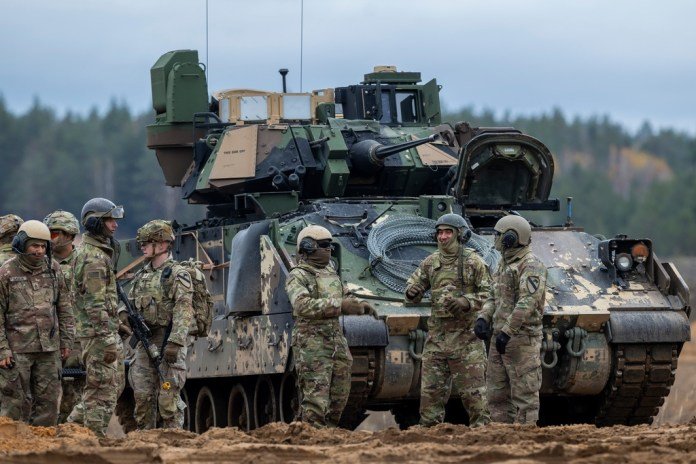
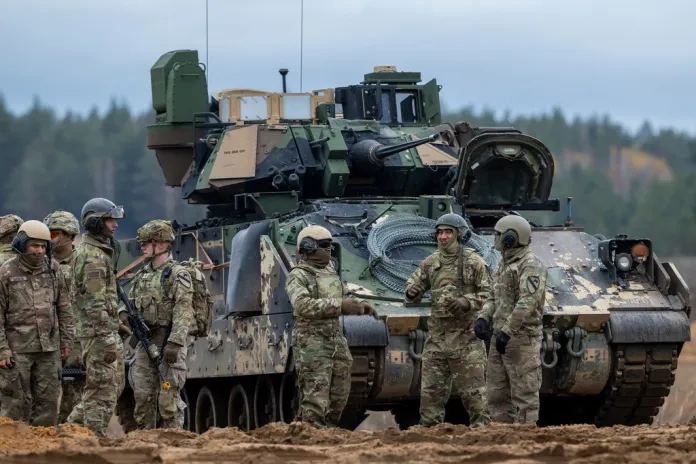
Lithuania’s government has already invited the U.S. to establish a permanent base within its borders as a replacement for the current practice of rotating forces.
Trump said he would “certainly look at” the proposal, prompting Prime Minister Mindaugas Sinkevicius to say he is “glad that this idea is being taken seriously” and promise Lithuania will “cover the associated costs.”
“Camp Herkus awaits you,” Sinkevicius said on Monday, referencing the temporary U.S. base in Lithuania.
These overtures have not pleased Russian officials, who see it as a naked attempt to encroach on the Kremlin’s sphere of influence.
Kremlin spokesman Dmitry Peskov was asked Tuesday about the motion to allow nuclear weapons into Lithuania, which he decried as unnecessarily provocative.
“If the military infrastructure of what is, in effect, NATO’s leading country is moving closer to our borders, then, of course, this cannot be perceived as anything other than a step towards escalating tensions,” Peskov said, referring to the U.S.’s presence in the Baltic country.
“The same applies to the deployment of nuclear weapons on the territory of a neighboring state,” Peskov said. “Neither of these developments will contribute to stability and predictability on the European continent. On the contrary, they will, much to our regret, mark yet another significant escalation of tensions.”
Breedlove questioned the Russians’ response, pointing to years of statements coming from the Kremlin suggesting that they will move nuclear weapons into Belarus and other neighboring client states.
“The Russians need to pay attention to their own house,” Breedlove told the Washington Examiner. “It’s almost laughable that the Russians would be infuriated about this. The Kremlin has no standing to make these complaints, given how they have thrown around the nuclear card and lowered the threshold for the threat of using nuclear weapons.”
Lithuania is widely perceived as the weakest link in the NATO alliance due to the Suwalki Gap, a small stretch of land between Lithuania and Poland that is bordered by Belarus and Russia. In Europe’s worst nightmare, Russian forces could blitz the 40-mile corridor and effectively cut off the Baltic nations from the rest of the NATO alliance.
Kaunas warned the Washington Examiner earlier this year in Vilinus that the Russian economy is now built on war and even the cessession of hostilities in Ukraine would not be able to stop its momentum.
“They will continue to build weapons, but after the war in Ukraine — where will those weapons go?” he said. “It’s very concerning because Russia can at least try to start a new war, and this new war can be with the Baltic states.”
Lithuania has experienced a slew of hybrid attacks and drone incursions from Russia in recent months, highlighting the small country’s vulnerability.