





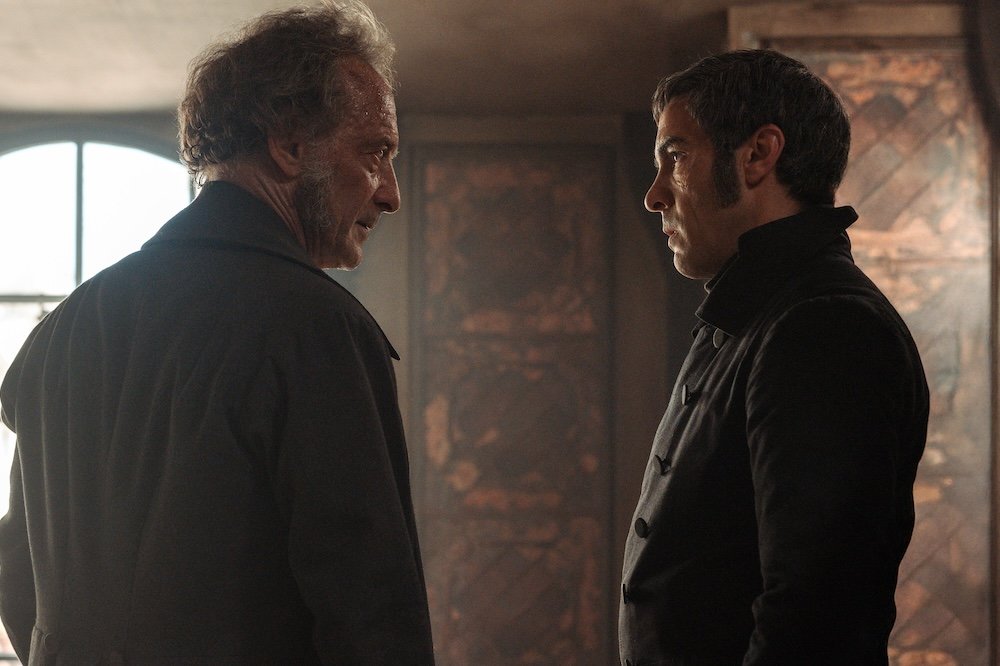
Here we are again on the streets of poverty-blighted 19th-century France, this time watching Vincent Lindon, Tahar Rahim, Camille Cottin and Noémie Merlant not-sing their way through an anodyne, politically incurious take on the classic novel.

Nobody sings in the latest adaptation of Victor Hugo’s 1462-page cinder-block classic, but the absence of rousing musical numbers does not mean that Fred Cavayé’s “Les Misérables” is going for gritty realism. The 179-minute film, enjoying a reported $37m budget and a host of Big French Stars trapped in starchily archetypal Big French Roles, spackles its resources across the screen in a manner that has come to stand in for “epic” (wide vistas of battlefields; gliding aerial angles on meticulous, digitally rendered 19th-century cityscapes; taverns and courtrooms teeming with costumed extras) but that actually just provides a lot of weightless distraction for how curiously unmoving it all is. Three gusty hours of lots to look at and nothing to see.
You do not have to be any stripe of “Les Misérables” fan — in fact, you don’t have to have read, seen, attended or listened to a single one of well over a century’s worth of books, movies, TV shows, theater adaptations, radio plays, musical productions and comics — to find Cavayé’s film familiar. The story of Jean Valjean’s decades-spanning beef with Inspector Javert is like chlorine in the water supply: you’ve ingested it whether or not you realize. What is of note, however, is how little this version distinguishes itself from its predecessors, as though Cavayé, who makes efficient work of streamlining the book’s sprawl into just three hours, was aiming to create a kind of median, ur-“Misérables” against which all future “Misérables”-es could be measured. But in going for definitive, it ends up derivative, with cramped ambitions making a big production feel paradoxically small. Small enough to be better suited to a smaller screen — why this is not a streaming-service miniseries is anyone’s guess, especially given Netflix is a production partner.
Popular on Variety
The casting is less perplexing. The role of Valjean, previously taken in Francophone versions by Jean Gabin, Jean-Paul Belmondo and Gerard Depardieu among other luminaries, is practically an earned honor at this point, a medal that can pinned to the chest of any French actor maturing into his “national treasure” phase. Vincent Lindon certainly fits that bill; it’s less clear if he fits with newbie actor Ryan Fartout who plays hot, young Valjean, whose rippling musculature is, as the film begins, being heartlessly exploited in construction labor. (Presumably because it will be 200 years until Calvin Klein launches their Eternity fragrance and needs him to model for it.)
Valjean’s famous bread-theft-to-feed-his-starving-family here becomes a footchase/fight setpiece before he is caught and consigned to an ever-lengthening prison sentence. Eventually released, the resentful ex-con experiences a Damascene conversion due to the Christian compassion of Monseigneur Myriel (Frédéric Pierrot). Years later, Valjean, now played by Lindon, has reinvented himself as M. Madeleine, the deeply decent proprietor of a glass factory and the popular mayor of Montreuil.
Javert (Tahar Rahim) has been on a different trajectory. He becomes crueler as he rises through the law enforcement ranks, spurred by self-hatred (he smashes a lot of mirrors) and frequent apparitions of his mother, who forced him into thievery as a boy and then abandoned him when he got caught pilfering a pocket watch — just one of several such timepieces that pop up throughout “Les Misérables” as a symbol of wealth, but also a reminder of all the time that is passing while you are watching “Les Misérables.” Which is not, to be fair, to suggest that the film is laggardly. Edited at a brisk clip by Mickael Dumontier, urged along by Christophe Julien’s adventure-and-action-pummelled score, it skims quickly along the surface of the narrative, unburdened by subtext or psychological complexity or socio-political texture. Instead, we get a lot of plot.
Javert is posted to Montreuil and becomes obsessed by the suspicion that there’s more to M. Madeleine than meets the eye. Elsewhere the venal Thénardiers (Benjamin Lavernhe and Camille Cottin) are introduced scavenging gold teeth from the bodies of fallen soldiers on the battlefield of Waterloo. In the greatest misfortune of a very unlucky life, Fantine (Noémie Merlant) stops at the tavern the Thénardiers run on her way to Montreuil with her angelic daughter Cosette. Mme Thénardier, knowing a mark when she sees one — she has scarcely a single line of dialogue that is not about how better to fleece some poor sap — persuades the young mother to leave the girl with them so she can bilk regular sums out of Fantine for her upkeep. But Fantine gets fired from M. Madeleine’s factory, and turns to selling her hair, then her teeth and finally her body, which M. Madeleine only discovers when Fantine is already on her deathbed. Filled with remorse, he vows to watch over Cosette, raising her as a surrogate father. Cosette (Megan Northam) then falls for Marius (Vassili Schneider) who despite his privileged background is a leftist resistance agitator who has also befriended the Thénardiers’ daughter Éponine (ensemble MVP Marie Colomb).
What, exactly, are we doing here, people? Why, in the year 2026, do we need another “Les Misérables,” in particular one so uninterested in reflecting its own time? Even the barricades of the Paris Commune in the finale are little more than bloodied background color. Though perhaps, given the recent controversy surrounding the production’s parent company, Canal+, reportedly blacklisting filmmakers who criticized the growing influence of their right-wing billionaire majority shareholder, a more trenchantly political take on labor resistance and the plight of the working poor would have been an irony too much for this stolidly irony-free project. Whatever the case, in a rather transparent attempt at justifying yet another retread, the final words of the narration run something like, “As long as misery exists, stories like this must always be told.” Which means if we’re ever going to staunch the flow of endless, interchangeable “Les Misérables” adaptations, all we have to do is eradicate human misery. So maybe let’s get to work on that.