




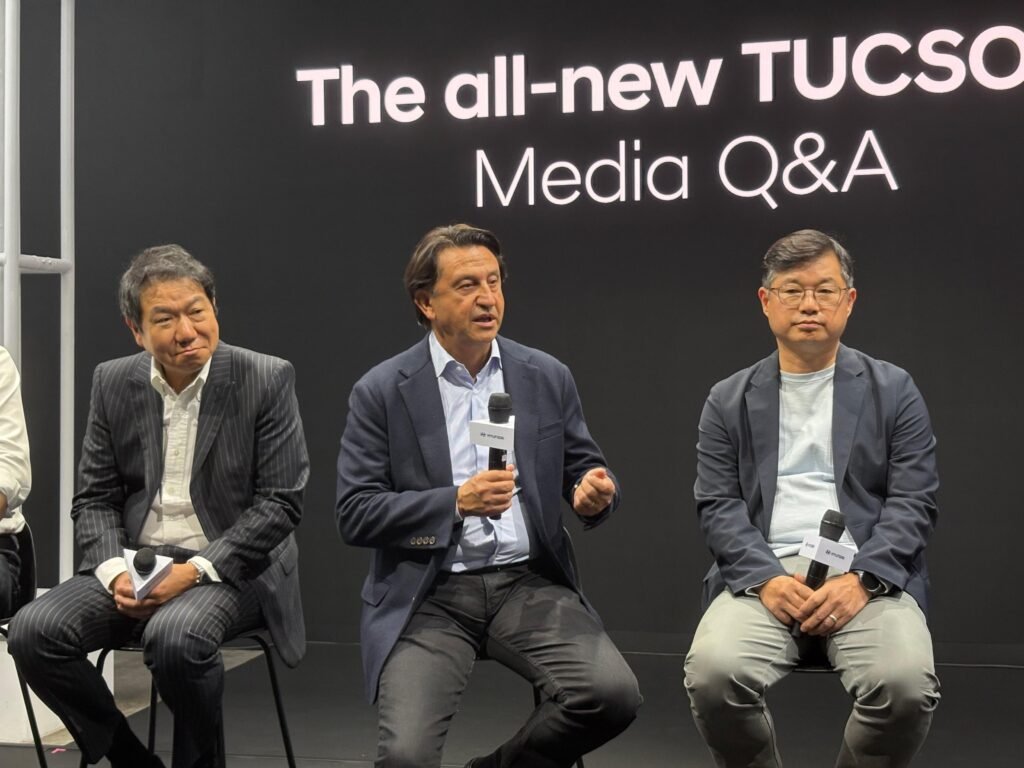
Hyundai CEO José Muñoz says the US could be overrun like Europe without protections in place.
Hyundai CEO José Muñoz says the US could be overrun like Europe without protections in place.

There’s been a lot of doom and gloom from the auto industry lately when the subject of China comes up. Automaker CEOs, in particular, warn that allowing low-cost, high-tech Chinese electric vehicles to be sold in the US would effectively spell the end of their businesses.
Hyundai CEO José Muñoz is not as pessimistic as some of his counterparts. He says he’s confident the right mix of protectionist policies and improvements on the product side can keep China at bay. Even though his company is feeling the squeeze from China, Muñoz isn’t ready to throw in the towel. But he also acknowledges that China could flood the US with affordable imports without established protections in place.
“As long as there is a level playing field for everybody,” Muñoz said at the reveal of the new 2027 Hyundai Tucson in New York City last week. “That’s all we ask, right? We compete everywhere in the world, and then we have seen that in the markets where that position is respected, so it’s really good for us.”
Chinese automakers have expanded rapidly in Europe, gobbling up market share and damaging domestic brands like Volkswagen, Volvo, and Mercedes by offering vehicles at much lower prices. US automakers warn the same could be true for them if China were allowed to import its vehicles here.
Steep tariffs and laws that prohibit the sale of cars with software from China have basically made it impossible to sell Chinese vehicles in the US. But in recent months, the dam appears to be weakening. President Donald Trump has said several times that he would be open to Chinese automakers building manufacturing plants in the US if they hire American workers. And experts across the board believe it’s only a matter of time before China finds a way to sell its cars in the US.
But if Chinese brands eventually set up manufacturing inside North America or enter via partner channels, it’s not clear whether Hyundai has a defensive strategy ready. I asked Muñoz whether his company had begun to plan for the eventuality of Chinese imports available in the US market. He said it had not.
“We don’t develop strategies specifically because of the Chinese or because of other types of consumers, or other types of competitors,” he said. “We are always trying to do better.”
If Hyundai has any strategy, Muñoz added, it’s vertical integration: bringing down costs by making its tech and components. “This allows us to be more competitive,” he said. “Better quality over cost.”
Muñoz cited Hyundai’s $5.8 billion investment in Louisiana to produce green steel as an example of the company’s efforts to vertically integrate in the US. Hyundai expects the investment to provide better, more competitive, and more environmentally friendly steel. He says the same philosophy applies to software and other technologies that Hyundai wants to develop internally.
“So there is always room to do better,” he continued. “So if the Chinese competitor were to enter in the market, we would see what would happen, but I don’t know, I don’t have a crystal ball. I just look around, for example, Europe, and see what has happened, and then you may expect similar type of behaviors.”
Chinese vehicles sold in Europe are on average about 30 percent cheaper than comparable European-made rival models, even when factoring in EU import tariffs. The US has already fallen behind the rest of the world when it comes to EV adoption, after Trump and Republicans in Congress eliminated federal subsidies. In Europe, EVs account for over 20 percent of sales; in China, it’s over 60 percent. In the US, it’s less than 6 percent.
Political polarization certainly plays a role in depressing sales, as does inadequate charging infrastructure. But the lack of affordable electric models is regularly cited as the biggest barrier to adoption in the US. On that front, Muñoz thinks the US can still catch up.
“I think the American market is the most competitive in the world,” he said, noting that Hyundai still records robust EV sales here. That may be true, but the company’s hybrids are what’s keeping its EV business afloat. Hyundai has added hybrids to a wide range of vehicles, including its top-selling Tucson.
Unlike other automakers, Hyundai hasn’t retreated from EVs. It continues to sell its Ioniq 5 and Ioniq 9 here in the US, as well as a growing number of hybrids. In fact, the Hyundai Group recently surpassed Honda to claim second place in US hybrid sales behind Toyota.
Muñoz acknowledged that the US was still catching up to China’s dominance in EV batteries. Hyundai operates a battery manufacturing joint venture with SK On in Georgia near its massive Metaplant, where it builds all of its EVs and hybrids.
“Obviously if you don’t have the critical mass, the volume, it’s very difficult to be competitive,” he said. “One of the biggest pieces of cost is the battery. That is the key element, right? But there is a lot of production of batteries in the United States with some of the best global manufacturers. So I’m not concerned.”