



For decades, researchers judged cycling helmets on how well they protected against direct impacts. The US Consumer Product Safety Commission (CPSC) still does, even though research shows the danger isn’t just how hard your head hits the ground, but how violently it twists. That rotational movement can make the brain twist and stretch inside the skull, increasing the risk of concussion and other brain injuries.
Not waiting for the CPSC to catch up, the cycling industry got to work. Multidirectional Impact Protection System, or MIPS, hit the market in 2007 and is now a common feature on premium helmets. At the same time, Virginia Tech turned helmet safety into something of a competition for manufacturers. In 2018, it launched helmet STAR ratings (Summation of Tests for the Analysis of Risk), testing beyond the legal minimum and measuring both linear and rotational impacts.
Only four of the first 30 helmets earned five stars, but by 2025, 167 of 272 achieved five stars, and Virginia Tech had to tighten its grading. That only drove competition and improved helmet technology. Suddenly, hitting the number one spot was good for business and brains.
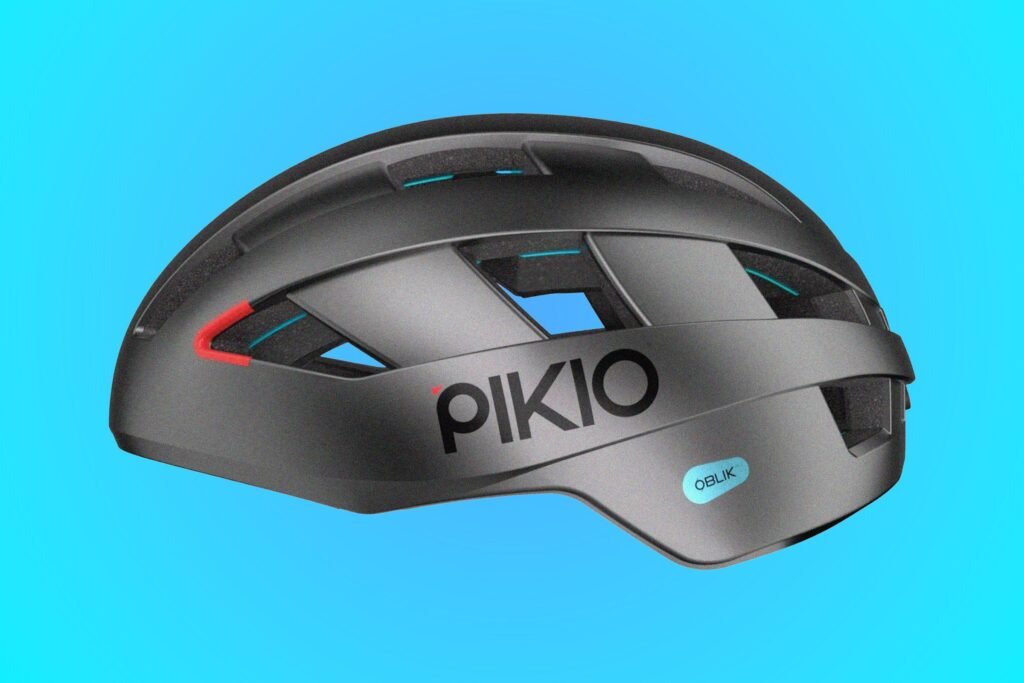
Sitting comfortably ahead of the competition, with a 4.61 score (10.1 or lower earns a five-star rating; lower is better), is the Pikio Si Oblik road cycling helmet, featuring a new safety system called Oblik. Inspired by the headbanging, concussion-proof woodpecker, this new design has wiped the floor with the competition. For context, Pikio’s 4.61 score is 2.21 points lower than the previous best Canyon Deflectr’s 6.82. That’s about 32 percent lower, a massive shift when many of the highest-rated helmets score only between 7 and 10 points.
How has this relatively obscure Vancouver startup gotten it right the first time? As founder Daniel Abram explains, it “comes from 18 years researching impact protection and helmet design.” After studying mechanical engineering, he moved into helmet research at Simon Fraser University, where he helped develop BrainShield, a system designed to reduce rotational forces during impacts. He later founded helmet technology company BiaGuard, before MIPS paid around $1 million for the patents and intellectual property in 2022.