



Ferrari says its lacklustre performance at the 2026 Le Mans 24 Hours was down to an “unbalanced” field, in a direct jibe at the Balance of Performance system governing the Hypercar class.
The Scuderia arrived at the weekend as the reigning three-time Le Mans winner, but it never appeared to be in contention for a top result after struggling for speed throughout practice and qualifying.
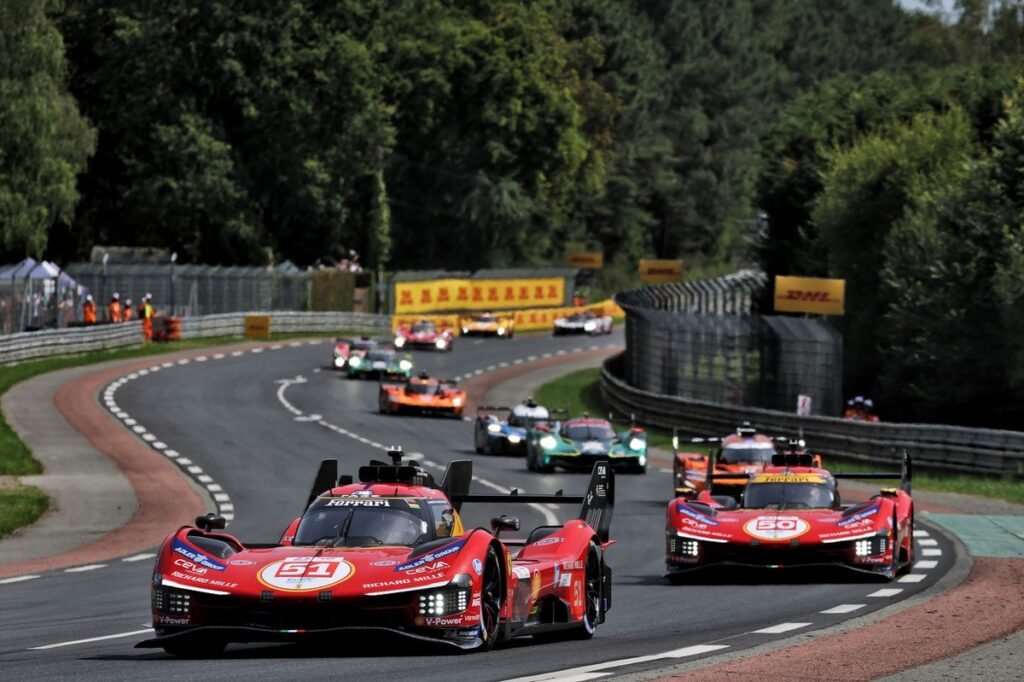
The best of the three Ferrari LMH prototypes, the #51 499P shared by Alessandro Pier Guidi, James Calado and Antonio Giovinazzi, finished the race in fifth place, more than two minutes down on the winning #8 Toyota GR010 Hybrid.
Mauro Barbieri, endurance chief designer at Ferrari, suggested that the Italian manufacturer was handicapped by an inferior BoP at Le Mans, without explicitly mentioning the system.
Drivers, teams and manufacturers are barred from directly discussing BoP under the sporting regulations, while the actual BoP data for each race is also kept secret from the public.
“I think it was clear already since the test day, maybe even before, that the field was unbalanced and that we were not among the top performing ones,” Barbieri said.
“We tried everything we could, during the week, different set-up philosophies to try and close the gap. We really couldn’t find anything that big to close such a gap.
“Also during the race, we tried to double-stint tyres, to triple stint tyres, to extend the stints and to go full push. [We tried] different tyre specs depending on the time of the day, different combination mixes. But again, the gap we had versus the top three manufacturers was too big.
“Also, the drivers pushed super hard for 24 hours, taking huge risks. We saw already since the first hours that we had contact with the other categories, with other cars. It is what it is, I think we can keep our heads up high, because in the end we did a good race.”

#50 Ferrari AF Corse Ferrari 499P: Antonio Fuoco, Nicklas Nielsen, Miguel Molina
Photo by: Alessio Morgese / NurPhoto via Getty Images
Except for a collision with the Proton LMP2 car in the fifth hour for which Pier Guidi was handed a drive-through penalty, the #51 Ferrari enjoyed a trouble-free race, with the deficit to the front entirely down to a lack of pace.
Barbieri stressed that Ferrari executed a perfect race at Le Mans, suggesting that fifth was the maximum it could achieve given the limitations.
“Since the test day, we saw that there were seven cars ahead,” he said. “Probably two more, considering the two Alpines [were faster]. And the fact that instead of finishing P10, we ended up P5 with the best car, is telling us that we really did the best that we could.”
Asked where he would place Ferrari in the pecking order, he replied: “Fourth or fifth [best car]. I think we were in the ballpark with the Alpine. The last six hours of the race showed that because we were running with a very similar pace to the #35 Alpine, which in the end was able to overtake the #83 [AF Corse customer Ferrari]. The cars that were in front of us at the end of the race were one step ahead and we couldn’t catch them.”
Despite having three cars in the top class, Ferrari was never able to mount a challenge for a podium position.
The #50 Ferrari 499P dropped out of contention early in the race with a malfunctioning fire extinguisher that led to a lengthy visit to the garage, before the 2024-winning car stopped on track on Sunday morning with a suspected electrical problem.
AF Corse’s satellite #83 entry that was eliminated in the first qualifying failed to make any inroads early in the race but gradually vaulted inside the top 10. A late splash and dash left Robert Kubica, Philip Hanson and Yifei Ye seventh overall.
Barbieri said Ferrari couldn’t have opted for an aggressive undercut strategy like the Toyotas, as it couldn’t have unleashed performance out of the car by running in clean air.
“A strategy like the one that Toyota did is very correct and very powerful if you have the pace. So if running in free air, you can go faster than the field,” Barbieri explained.
“In our case, we believe that the best way to try and close the gap with the competitors was to use their slipstream.”
Barbieri added that Ferrari wasn’t struggling with a lack of top speed and instead lost time due in low-speed corners.
Asked if Ferrari was banking on its straightline advantage to pass cars, he added: “Exactly, that’s what we were hoping for. But then, after a few laps, we just couldn’t stay with them. But still we tried to diversify the strategies a bit.”
He added: “We were in the ballpark [in terms of top speed] but it was just the lap time that was not quick enough. [We were losing time] mainly in the slow corners, and that’s it.”