



After more than half a century of federal protections, the Trump Administration on Tuesday announced a proposal to return management of grizzly bears in the Lower 48 to the states.
Secretary of the Interior Doug Burgum, flanked by governors Greg Gianforte of Montana, Mark Gordon of Wyoming, and Brad Little of Idaho, heralded the new rule at a press conference in the heart of grizzly country north of Yellowstone National Park.
“The grizzly bear recovery story is one of America’s greatest conservation successes,” Gianforte said from a makeshift stage just south of Big Sky, Montana. He cited a downside of the bears’ 50-year recovery and pointed to increasing bear-human conflicts in front yards, playgrounds and ranch pastures. “Montana is ready to have full authority to manage grizzly bears,” he said. (Disclosure: Before either became governor, Mark Gordon and Brad Little both served on the High Country News’ board of directors, from 2001-2004 and 1998-2002, respectively.)
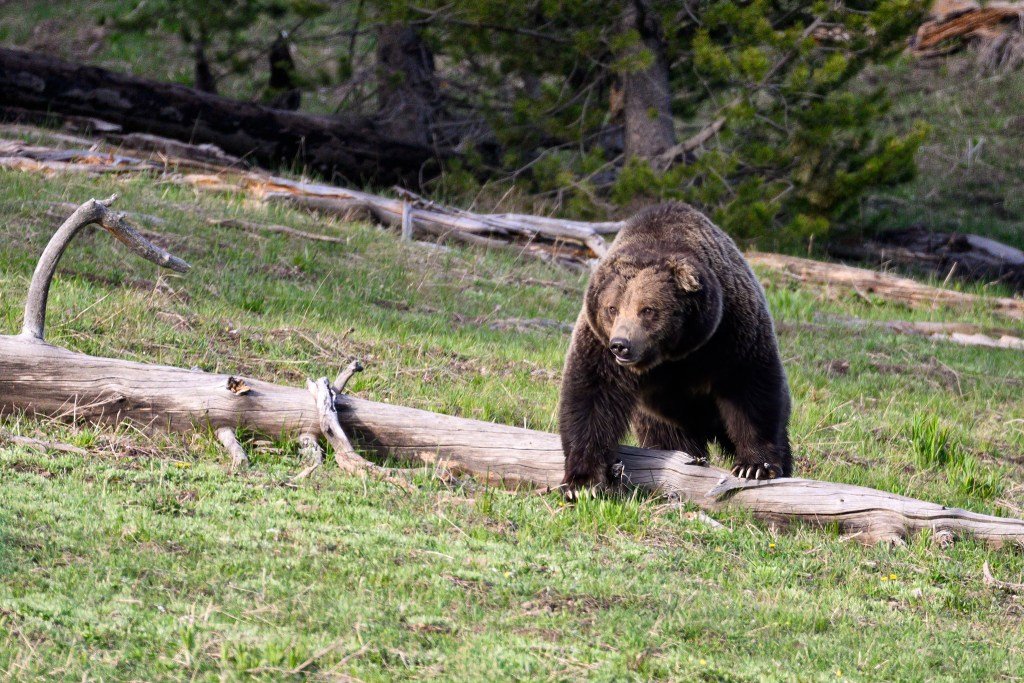
The U.S. Fish and Wildlife Service in 1975 listed grizzlies as “threatened” in the Lower 48 states under the Endangered Species Act. At the time, fewer than 600 members of the species existed south of the Canadian border. Today, two major populations thrive in and around Yellowstone and Glacier national parks, each with approximately 1,000 bears — along with a smattering of smaller ecosystems that could support grizzlies with far fewer resident bruins.

The federal government has twice attempted to remove Endangered Species Act protections for grizzlies, specifically in the Greater Yellowstone Ecosystem. The move to delist bears would mean returning management to the states of Idaho, Montana and Wyoming. Both efforts, in 2007 and 2017, respectively, were overturned in court. Yet states kept petitioning to remove federal protections. In January 2025, during the final hours of the Biden administration, FWS denied those petitions and released a new rule perpetuating the bears’ protected status.
The rule announced today took a different approach, amending the Biden administration’s 2025 edict: Instead of delisting grizzlies, the bears will stay on the endangered species list. But under a new revision of section 4(d) of the Endangered Species Act, the federal government will concede grizzly management to the states.
“I think of this as a dress rehearsal for delisting,” said Christy Clark, director of Montana Fish, Wildlife and Parks, after the meeting concluded.
“I think of this as a dress rehearsal for delisting.”
For decades, concerns over delisting have centered around a grizzly hunt that could come with state management. However, Montana has a five-year moratorium on pursuing the animals post-delisting and Gianforte said the new rule would not permit a hunt in Montana.
The text of the new 4(d) rule is yet to be published, but all three speakers and Secretary Burgum stressed that the new rule would grant states more flexibility to manage grizzlies on the ground as the states transition from an era of grizzly recovery to stewardship of the species.
Ultimately, critics say, the move could mean increased grizzly mortality.
“We’re disappointed the Trump administration is trying to make it easier to kill grizzly bears,” said Andrea Zaccardi, senior attorney at the Center for Biological Diversity, a nonprofit organization dedicated to species protection.
Jenny Harbine, managing attorney at the nonprofit environmental law firm Earthjustice, cited a slew of grizzly-bear threats coming down the pike from the federal government: weakened environmental reviews, a rescinded roadless rule, and fast-tracked logging and mining projects.
“This does not create a situation where the service should be relaxing protections for grizzly bears,” Harbine said. “They need them more than ever.”
Robert Chaney contributed to this reporting.
This story was produced as part of the Western Environmental Reporting Collaborative, a partnership between Mountain Journal/Montana Free Press, High Country News, Report for America and local news organizations across the West.