






Disclaimer: Early release articles are not considered as final versions. Any changes will be reflected in the online version in the month the article is officially released.
Evidence of Exposure to Highly Pathogenic Avian Influenza H5 Viruses in East Greenland Polar Bears
Author affiliation: University of Inland Norway, Koppang, Norway (K.J. Buhler, M. Tryland); Cornell University, Ithaca, New York, USA (K.J. Buhler); Public Health Agency of Canada, Winnipeg, Manitoba, Canada (C. Ranadheera, N. Bastien, M. Zirino); University of Saskatchewan, Saskatoon, Saskatchewan, Canada (E. Jenkins); Aarhus University, Arctic Research Cluster, Roskilde, Denmark (R. Dietz, J. Søndergaard, C. Sonne)
Suggested citation for this article
Abstract
We detected influenza A virus antibodies in plasma collected from East Greenland polar bears during subsistence hunts in 2024 (3/14 [21%]) and 2025 (6/14 [43%]). Four bears from 2025 had antibodies for the globally emerging highly pathogenic avian influenza virus H5 clade 2.3.4.4b, consistent with survival after exposure.
Highly pathogenic avian influenza (HPAI) is an emerging ecologic and public health threat in the Arctic (1). Seasonal bird migrations to Arctic nesting grounds create a hot spot for HPAI outbreaks, amplifying interspecies interactions and the risk for viral reassortment and dissemination across migratory flyways (1). Recent detection of HPAI in wild Arctic mammals, along with their nutritional and cultural relevance for Indigenous peoples, emphasizes a strong need for surveillance in Arctic ecosystems (2–4).
Polar bears (Ursus maritimus) are Arctic apex predators that face increased challenges associated with their ecologic position at the interface between marine and terrestrial ecosystems. Climate warming and the subsequent loss of sea ice leads to increased time spent on land and exposure to terrestrial pathogens through the exploitation of new food sources (5). Cases of deceased polar bears infected with HPAI have been reported in Alaska, USA (H5N1 in 2023), and Svalbard, Norway (H5N5 in 2026), emphasizing that these emerging viruses may pose a risk to Arctic species (2,6).
As part of an ongoing collaboration with Indigenous hunters, heart blood was collected during subsistence harvests from polar bears that appeared healthy near Scoresby Sound (Ittoqqortoormiit) in East Greenland (Appendix Figure) during the hunting season (January–May). We screened 109 plasma samples (collected during 2016–2025) for antibodies against all influenza A viruses by using a competitive ELISA (cELISA) that targets the influenza A virus (IAV) nucleoprotein (ID Screen Influenza A Antibody Competition Multi-Species; Innovative Diagnostics, https://www.innovative-diagnostics.com), according to the manufacturer’s instructions. We detected no IAV antibodies before 2024. Three bears (all male) harvested during 2024 had signal-to-noise values within the positive range (<45%) of the cELISA (21% [95% CI 8%–48%]; n = 3/14); the number increased to 6 bears (5 male, 1 female) in 2025 (43% [95% CI 21%–67%]; n = 6/14) (Appendix Table).
We conducted further screening on positive samples (n = 9) and a subset of negative samples (n = 3) by using a hemagglutination inhibition assay that used horse red blood cells (Rockland Immunochemicals, https://www.rockland.com), as described by Kayali et al. (7), with minor modifications. In brief, we heat-inactivated plasma at 56 °C for 30 minutes, then hem-adsorbed it and treated it with receptor-destroying enzyme. We used avian influenza viruses representative of H5 and H7 subtypes in the assay (Table). Plasma from 4 animals harvested in 2025 that were positive for IAV antibodies on the cELISA were positive (>1:40) for antibodies to H5N1 viruses falling within clade 2.3.4.4b on the hemagglutination inhibition assay, suggesting that the animals had been exposed to an HPAI virus in this clade (Table).
We first detected IAV antibodies in East Greenland polar bears in 2024 and antibodies to the highly pathogenic H5 clade 2.3.4.4b in 2025. H5N5 and H5N1 strains were previously confirmed in sea birds (including Uria aalge [H5N1 in 2022], Larus hyperboreus [H5N5 in 2023], Fulmarus glacialis [H5N5 in 2023 and 2024], and Larus marinus [H5N5 in 2024]) from the west coast of Greenland (8,9), consistent with our findings of evidence of IAV exposure in East Greenland polar bears in 2024. Positive bears probably were exposed during the summer–fall bird migration the year before the bears were harvested, given that migratory birds are absent during the polar bear hunting season. Hunters reported no clinical signs, suggesting that bears can recover from HPAI infection. That finding is consistent with the high prevalence reported in our study and survival of the bears for months after the departure of migratory birds. Although cross-reactivity with low pathogenic H5 subtypes is possible, plasma from all 4 seropositive bears inhibited hemagglutination of viruses within clade 2.3.4.4b (not observed when tested against clade 1) (Table). That finding strongly supports infection with a virus from clade 2.3.4.4b, which is exclusively an HPAI lineage.
Figure
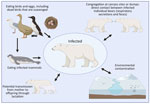
Figure. Potential mechanisms of transmission for highly pathogenic avian influenza viruses to polar bears, including direct contact through mucosal or nasal secretions, scavenging dead birds or bird eggs, eating infected mammals,…
HPAI spillover to mammalian hosts typically occurs through ingestion of infected birds or through contaminated environments (1,3,10). Transmission to wild mammals may involve multiple mechanisms, including direct contact through mucosal or nasal secretions, scavenging dead birds or bird eggs or infected mammals, and mother-to-offspring transmission through lactation (Figure) (10). Further studies are needed to identify which mechanisms are relevant for polar bears, although the most likely route is by eating dead or infected birds and mammals.
Greenland links the East Atlantic and the North American Atlantic flyways (Appendix Figure), and increased surveillance in this region may provide effective early warning signs of HPAI dissemination. Our findings indicate that East Greenland polar bears have been exposed to HPAI in recent years, consistent with the timeline of prior reports of HPAI in birds along the linked migratory superhighways (3,8,9). This carnivore may be an ideal sentinel for emerging HPAI in Arctic ecosystems, given that polar bears opportunistically scavenge coastal nests, birds, and marine mammals as they face nutritional stress associated with sea ice loss (2,5). Our study also highlights the strength of collaboration between scientists and local subsistence hunters, emphasizing the need for future research that incorporates diverse perspectives and cultural practices to effectively monitor the health of wildlife in these remote regions.
Dr. Buhler is a researcher at the University of Inland Norway and a postdoctoral fellow at the Cornell K. Lisa Yang Center for Wildlife Health at Cornell University. Her research interests include the epidemiology and ecology of zoonotic pathogens, using a One Health approach to investigate the transmission dynamics of pathogens in wildlife across the Arctic.
Acknowledgments
We thank the local subsistence hunters and communities in East Greenland, especially Jan Lorentzen, for ongoing collaboration and support with sample collection. We acknowledge Sandra Drewes Fabricius and Cecilie Nobel Zabel Dipo for their laboratory assistance. In addition, we thank Maria Jarque and Kim Hamonic for their assistance with sample transportation and permit acquisition.
No animal care and use committee approvals were needed because samples were collected from deceased animals from the annual legal subsistence hunting quota of 35 Greenland polar bears. Polar bear samples were collected and transported to Denmark under the International Union for Conservation of Nature’s Convention on International Trade in Endangered Species of Wild Fauna and Flora permits 16GL1166991, 17GL1167116, 18GL1717224, 19GL1717365, 20GL1717427, 21GL1717628, 22GL2089580 2022, 23GL2089714, 24GL2089884, 25GL2090110, IM 1202-580/16, IM 0818-549/17, IM 0928-712/18, IM0816-496/19, DK2020-0017113-01, DK-2021-0032841-01, DK-2022-0046312-01, DK-2023-0037644-01, DK-2024-0062523-01, DK-2025-0015153-01. Samples were transported to Norway and Canada under the International Union for Conservation of Nature’s Convention on International Trade in Endangered Species of Wild Fauna and Flora permits DK-2025-0024770-01 and 26NO-0002-EX and Canadian Food Inspection Agency import permit A-2026-00277-1.
We acknowledge Denmark’s Environmental Protection Agency for support through the Environmental Support for the Arctic program (Miljøstøtte til Arktis) and Cooperation for Environment in the Arctic (ZOO-PFAS grant no. 2022-86192 [awarded to C.S.], AMAP CORE BIOTA grant no. 2022-86218 [awarded to J.S.], and AMAP CORE BIOTA grant no. 2024-73867 [awarded to J.S.]). In addition, this work is funded by the European Union Horizon Europe (ArcSolution grant agreement no. 101135051), providing resources for the authors (C.S., R.D., and J.S.) to collect samples, and by the Morris Animal Foundation (grant no. D25ZO-430) and the Cornell K. Lisa Yang Center for Wildlife Health, providing early career support and funds for transportation and testing (awarded to K.J.B.).
References
-
Gass JD Jr, Kellogg HK, Hill NJ, Puryear WB, Nutter FB, Runstadler JA. Epidemiology and ecology of influenza A viruses among wildlife in the Arctic. Viruses. 2022;14:1531. DOIPubMedGoogle Scholar
-
Stimmelmayr R, Rotstein D, Torchetti MK, Gerlach R. Highly pathogenic avian influenza virus A (H5N1) clade 2.3. 4.4 b infection in free-ranging polar bear, Alaska, USA. Emerg Infect Dis. 2024;30:1660–3. DOIPubMedGoogle Scholar
-
Granstad S, Tønnessen R, Ytrehus B, Descamps S, Moe B, Strøm H, et al. Multiple introductions of highly pathogenic avian influenza viruses into the High Arctic: Svalbard and Jan Mayen, 2022-2025. J Gen Virol. 2026;107:002305. DOIPubMedGoogle Scholar
-
Graziosi G, Lupini C, Catelli E, Carnaccini S. Highly pathogenic avian influenza (HPAI) H5 clade 2.3. 4.4 b virus infection in birds and mammals. Animals (Basel). 2024;14:1372. DOIPubMedGoogle Scholar
-
Pilfold NW, Richardson ES, Ellis J, Jenkins E, Scandrett WB, Hernández-Ortiz A, et al. Long-term increases in pathogen seroprevalence in polar bears (Ursus maritimus) influenced by climate change. Glob Change Biol. 2021;27:4481–97. DOIPubMedGoogle Scholar
-
Norwegian Veterinary Institute. First detection of avian influenza in polar bears in Svalbard [in Norwegian]. 2026 May 19 [cited 2026 May 30]. https://www.vetinst.no/nyheter/forste-pavisning-av-fugleinfluensa-hos-isbjorn-pa-svalbard
-
Kayali G, Setterquist SF, Capuano AW, Myers KP, Gill JS, Gray GC. Testing human sera for antibodies against avian influenza viruses: horse RBC hemagglutination inhibition vs. microneutralization assays. J Clin Virol. 2008;43:73–8. DOIPubMedGoogle Scholar
-
Erdelyan CNG, Kandeil A, Signore AV, Jones MEB, Vogel P, Andreev K, et al. Multiple transatlantic incursions of highly pathogenic avian influenza clade 2.3.4.4b A(H5N5) virus into North America and spillover to mammals. Cell Rep. 2024;43:114479. DOIPubMedGoogle Scholar
-
World Organization for Animal Health. World Animal Health Information System. Events management [cited 2026 May 21]. https://wahis.woah.org/#/event-management
-
Shanta RN, Akther M, Prodhan MA, Akter SH, Annandale H, Sarker S, et al. Adaptation and outbreak of highly pathogenic avian influenza in dairy cattle: an emerging threat to humans, pets, and peridomestic animals. Pathogens. 2025;14:846. DOIPubMedGoogle Scholar
Figure
Table
Suggested citation for this article: Buhler KJ, Ranadheera C, Bastien N, Zirino M, Jenkins E, Tryland M, Dietz R, et al. Evidence of exposure to highly pathogenic avian influenza H5 viruses in East Greenland polar bears. Emerg Infect Dis. 2026 Nov [date cited]. https://doi.org/10.3201/eid3211.261050
Original Publication Date: October 13, 2026
Table of Contents – Volume 32, Number 11—November 2026